Power Monitoring
KPM31 single-phase DIN Rail Prepaid Energy Meter integrates data acquisition and control functions
Learn More
In today's world where the Internet of Things (IoT) is deeply penetrating the field of energy management, choosing the right communication protocol is crucial for building an efficient and stable monitoring system. Among the many protocols, MQTT and Modbus are the two most frequently mentioned and compared.
So, in the specific scenario of IoT energy monitoring, which protocol is more suitable? This article will provide a detailed answer.
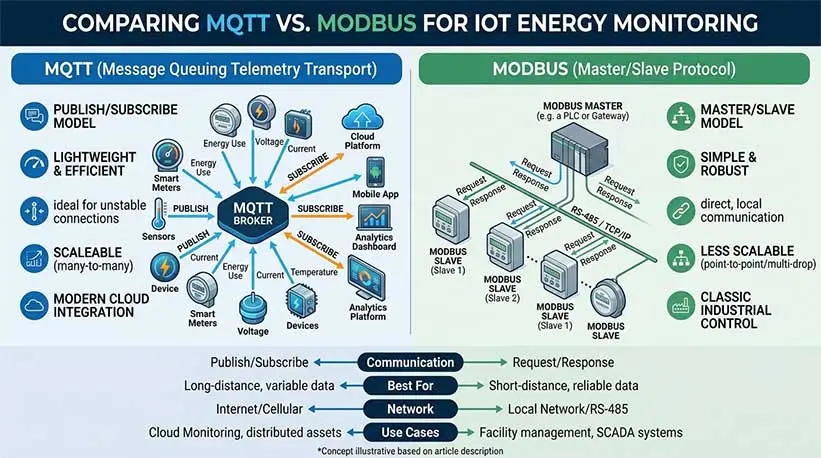
In industrial and power scenarios, "stability" is paramount. We must first clarify the fundamental differences in the underlying design philosophy of these two protocols:
1. Modbus: Ultimate "Determinism" and Hardware Fit
For electrical engineers, Modbus (whether based on RS-485 RTU or Ethernet-based TCP) is not a software concept; it is a register map.
Physical Layer Robustness: The RS-485 bus uses differential signals, providing extremely strong immunity to common-mode interference, making it ideal for environments with high electromagnetic interference (EMI), such as near transformers and in high-voltage distribution rooms.
Predictability of Timing: While polling mechanisms may seem outdated, their timing is completely controllable. The PLC or data acquisition gateway polls every 500ms, and whether data is returned is determined within one second (timeout mechanism). This "determinism" is crucial for power protection and transient analysis (such as three-phase imbalance and harmonic analysis).
2. MQTT: High-Concurrency "Decoupling" and Network Resilience
MQTT is a typical product of IT (Information Technology) thinking, solving the problem of "how to efficiently deliver information."
Asynchronous and Decoupling: Its publish/subscribe mechanism severs the direct coupling between the data source (smart energy meter) and the consumer (cloud platform). The meter only needs to send data to the broker, without needing to care who is reading it.
QoS's Double-Edged Sword: MQTT's QoS 1 (at least once) and QoS 2 (exclusive once) guarantee no data loss at the application layer, but this relies on TCP handshakes and retransmission mechanisms. In extremely poor network conditions, latency becomes unpredictable.
Combining real-world engineering cases such as photovoltaic inverters, microgrids, and integrated plant-storage systems, we compare four core dimensions of electrical engineering:
1. Data Acquisition Density and Bandwidth
Engineering Reality: Energy monitoring is not just about reading "kilowatt-hours (kWh)". High-requirement EMS needs to collect voltage, current, active/reactive power, power factor, frequency, and even the 2nd to 31st harmonic distortion rate. A single plant may have hundreds of circuits, resulting in a massive amount of data.
Professional Comparison: * Modbus polling of this data can get stuck at the RS-485 baud rate bottleneck (typically 9600 or 19200 bps). MQTT, in conjunction with the Sparkplug B specification (an industrial-grade MQTT data format), allows local edge devices to report data only when changes exceed the dead zone. This directly eliminates 80% of unnecessary communication traffic.
2. Weak Network Environments and Asset Security (Offline Storage)
Engineering Reality: Distributed photovoltaic or wind farms are typically located in remote areas, relying on 4G/5G cellular networks to the cloud, where signal strength is intermittent.
Professional Comparison: * Running Modbus TCP on a wide area network is disastrous. A single disconnection can cause the master program to block or discard energy consumption bills for the entire period of disconnection, leading to difficulties in financial reconciliation.
MQTT's Keep Alive mechanism can detect disconnections within seconds. Combined with the "Store and Forward" function of modern IoT gateways, the gateway stores data in local Flash memory during a disconnection and resends it in batches via MQTT after network restoration, ensuring the continuity of energy data (Data Integrity).
3. Local Control and Closed-Loop Response
Engineering Practice: Modern energy monitoring is not just about "monitoring," but also about "controlling." For example, automatically controlling the charging and discharging of energy storage batteries based on peak and off-peak electricity prices (EMS strategy), or cutting off secondary loads within seconds during overload.
Professional Comparison: Modbus is bidirectional, capable of both reading and writing (03 command for reading, 06/16 command for writing). Within a local area network (LAN), the gateway sends control commands to circuit breakers via Modbus with millisecond-level latency and extreme stability.
While MQTT can also send commands (by subscribing to control topics), its latency is significantly affected by network fluctuations due to the WAN and broker relay. In the field of electrical safety, we absolutely prohibit placing hard control logic such as "emergency tripping" involving personal or equipment safety on remote MQTT.
| Evaluation Dimension | Modbus (OT Standard) | MQTT (IT Standard) |
|---|---|---|
| Application Boundary | Device Level / LAN (OT Physical Layer Boundary) | Platform Level / WAN (IT Cloud Boundary) |
| Standard Physical Medium | RS-485 (Shielded Twisted Pair), Ethernet | RJ45, 4G/5G, Wi-Fi, Satellite Communication |
| Data Semantics | None. Represented only as Register Address (e.g., 0x0032) |
Extremely High. Supports Topic Tree (e.g., factory1/buildingA/meter3/voltage) |
| Local Real-time Control | Excellent (Millisecond-level, deterministic timing) | Poor (Affected by network jitter and Broker forwarding latency) |
| Information Security | Poor. Native plaintext, no authentication (Relies on physical/network isolation) | Excellent. Native support for TLS/SSL, X.509 certificates, Client ID authentication |
In IoT energy monitoring scenarios, there is no absolute superiority or inferiority, only the most suitable level. In fact, in modern, high-quality IoT energy monitoring systems, these technologies are not incompatible, but rather complementary "golden partners" with distinct functions.
Modbus is the obvious choice if your scenario meets the following conditions:
Direct communication with underlying meters, sensors, and inverters within a factory or substation LAN.
The physical medium uses RS485 bus or local Ethernet.
High local stability is required, and the device itself only provides a Modbus register interface.
MQTT is the ideal choice if your scenario falls into the following categories:
Distributed energy monitoring: such as distributed photovoltaic systems, energy consumption monitoring in nationwide chain stores, and charging stations scattered across various locations. Data needs to be aggregated to headquarters or the cloud via 4G/Wi-Fi or wireless networks.
Insufficient integration of energy consumption data with modern IoT platforms such as Alibaba Cloud and Huawei Cloud, or integration with big data and AI energy-saving algorithm systems. The system will require large-scale expansion in the future.
Currently, the most standard and efficient energy monitoring architecture in the industry is:
Underlying device (Modbus RTU) → IoT edge gateway (polling and parsing registers locally, and converting them to standard JSON format) → via MQTT protocol → Cloud/Monitoring Center (MQTT Broker → Energy Management System).
This "hybrid" model retains Modbus's strong compatibility with industrial hardware while leveraging MQTT's advantages in high concurrency, low bandwidth consumption, and event-driven operation over the internet, making it the optimal solution for current IoT energy monitoring.
Modbus vs MQTT: A Protocol Selection Guide For Energy Management Systems

Power Monitoring
KPM31 single-phase DIN Rail Prepaid Energy Meter integrates data acquisition and control functions
Learn More
Power Monitoring
The KPM33 Three-phase DIN-rail 4G Prepaid Energy Meter is designed for DIN-rail mounting.
Learn More
Power Monitoring
The KPM37 4G Three-phase OEM Energy Meter features a 35mm DIN rail mounting design and an LCD display.
Learn MoreCompere provides the integrated energy management solution including online monitoring, analyzing, reporting, controlling, maintenance, production management, prediction, and other functions. We offer u technical support and professional solution at 7*24h service.
Unit 1, Building 38, LIANDONG U Valley, No. 352 Lianhua Street, High-tech Zone, Zhengzhou, China
Our helpline is always open to receive any inquiry or feedback.Please feel free to drop us an email from the form below and we will get back to you as soon as we can.
Compere mainly provides kpm series smart energy meters. If you have any needs, please feel free to contact us.