Power Monitoring
KPM31 single-phase DIN Rail Prepaid Energy Meter integrates data acquisition and control functions
Learn More
Electricity costs constitute a significant portion of our daily expenses, especially in the operating costs of modern water treatment plants and wastewater treatment facilities, where electricity consumption is typically the second largest expense after labor costs. Among these, various water pumps (inlet pumps, booster pumps, return pumps, etc.) are absolute "electricity-guzzling monsters," accounting for 60% to 80% of the total electricity consumption of the entire plant.
With the introduction of dynamic electricity pricing (such as peak-valley time-of-use pricing and real-time pricing) in the electricity market, the traditional "fixed-frequency, constant-speed" pumping mode is causing companies to miss out on substantial energy-saving opportunities. Introducing industrial smart meters, combining energy data with the water pump control system, has become an inevitable trend for the water treatment industry to achieve refined cost reduction and efficiency improvement.
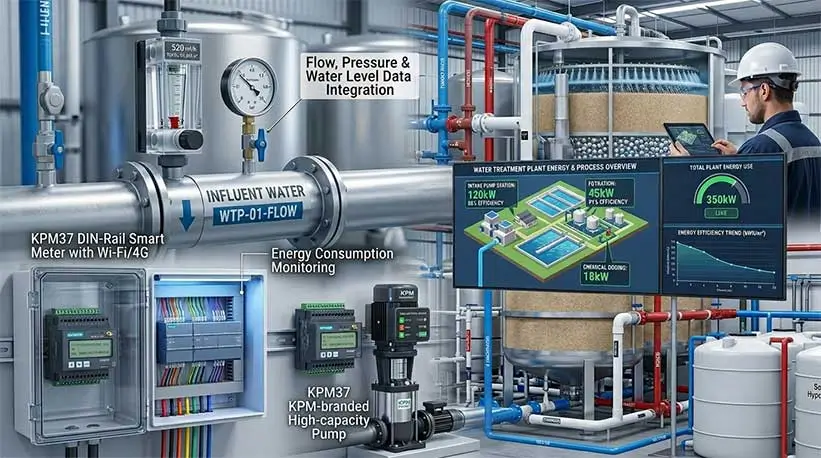
Traditional mechanical meters can only record total electricity consumption, while industrial-grade smart meters are "energy sensors" that integrate data acquisition, edge computing, and IoT communication. It primarily helps water treatment plants optimize pump energy consumption through the following three steps:
1. High-frequency data acquisition and visualization
Industrial smart meters can monitor pump voltage, current, active power, reactive power, and power factor in real time, at a frequency of seconds or minutes. This data is uploaded in real time to a central control system (such as an EMS), allowing managers to clearly see the actual energy consumption curve of each pump during start-up and shutdown.
2. Demand-side response and electricity price arbitrage
Electricity prices from power companies fluctuate dynamically throughout the day. After integrating real-time electricity price data from the local power grid, the industrial smart meter system can coordinate with the automated control system to perform "peak-shaving scheduling":
Water storage: During periods of low electricity prices (such as late at night), pumps are driven to full capacity to pump water to elevated storage tanks or clear water tanks.
Peak-shaving energy: During periods of high electricity prices (such as evening), pump power is reduced, prioritizing the use of gravity flow from storage tanks for water supply, thereby maximizing the "arbitrage" space for high electricity costs.
3. Real-time Diagnosis of Pump Efficiency
By cross-referencing the energy data from industrial smart meters with data from pipeline flow meters and pressure sensors, the system can calculate the specific energy consumption of the pumps in real time (i.e., the ratio of pump input power to real-time flow rate).
If the specific energy consumption index of a pump group suddenly increases while maintaining the same water production, the smart meter system will immediately issue a warning. This usually indicates impeller wear, pipe blockage, or cavitation, prompting maintenance personnel to perform timely maintenance to avoid "operating with defects" and resulting in soaring electricity bills.
1. Closed-Loop Control of Inverters and Industrial Smart Meters
The water supply and demand of water treatment plants often fluctuate with residents' water usage habits or rainfall. Linking industrial smart meters with inverters allows for precise control based on the biomimetic law of pumps (i.e., the shaft power of a pump is proportional to the cube of its rotational speed).
This means that through precise calculations by industrial smart meters, reducing the pump speed by slightly more than 10% can reduce energy consumption by up to nearly 30%. The system can fine-tune the inverter frequency based on real-time electricity prices and flow demand, ensuring the water pumps always operate at their optimal energy efficiency point.
2. Optimal Combination Scheduling of Multiple Pumps in Parallel Operation
Large booster pump stations typically employ multiple pumps. Traditional methods often use a "one-on-one" or fixed rotation system. The smart meter system can identify the energy efficiency differences among pumps due to varying wear levels. When combined flow is required, it automatically prioritizes starting the "most energy-efficient" pump combination, achieving the lowest overall energy consumption.
3. Power Quality Optimization (Power Factor Compensation)
Large water pump motors are inductive loads, easily leading to a drop in power factor. The smart meter monitors the power factor in real time. Once it detects a drop below the power company's required standard (e.g., 0.90 or 0.95), it automatically compensates using capacitor banks, not only avoiding low power factor penalties from the power company but also reducing line losses.
| Benefit Dimension | Specific Implementation | Expected Outcome |
|---|---|---|
| Direct Electricity Cost Reduction | Through time-of-use tariff arbitrage and avoiding peak demand charges. | Pumping electricity costs can be reduced by 10% to 25%. |
| Equipment Lifespan Extension | Reducing high-load operations during peak periods, and implementing precise maintenance based on energy efficiency status. | The service life of pumping assets can be extended by 15% to 20%. |
| Carbon Emission Compliance | Converting electricity consumption into carbon footprints in real time to satisfy corporate ESG audits and emission reduction goals. | Accurately measure and reduce the carbon intensity of water plant operations. |
In the wave of digital transformation in the water treatment industry, energy saving in water pumps is no longer simply about replacing motors with high-efficiency ones, but rather moving towards data-driven intelligent control.
By deploying industrial-grade smart meters, water treatment plants can transform previously "vague" electricity bills into "clear, real-time, and predictable" digital assets. This not only empowers water supply and wastewater treatment companies to take the initiative in the dynamic electricity market, but also forms the cornerstone for achieving green, low-carbon, and smart water management.

Power Monitoring
KPM31 single-phase DIN Rail Prepaid Energy Meter integrates data acquisition and control functions
Learn More
Power Monitoring
The KPM33 Three-phase DIN-rail 4G Prepaid Energy Meter is designed for DIN-rail mounting.
Learn More
Power Monitoring
The KPM37 4G Three-phase OEM Energy Meter features a 35mm DIN rail mounting design and an LCD display.
Learn MoreCompere provides the integrated energy management solution including online monitoring, analyzing, reporting, controlling, maintenance, production management, prediction, and other functions. We offer u technical support and professional solution at 7*24h service.
Unit 1, Building 38, LIANDONG U Valley, No. 352 Lianhua Street, High-tech Zone, Zhengzhou, China
Our helpline is always open to receive any inquiry or feedback.Please feel free to drop us an email from the form below and we will get back to you as soon as we can.
Compere mainly provides kpm series smart energy meters. If you have any needs, please feel free to contact us.