Power Monitoring
KPM31 single-phase DIN Rail Prepaid Energy Meter integrates data acquisition and control functions
Learn More
Residential buildings are significant consumers of electricity, with daily operations accounting for a substantial portion of utility expenditures. As energy costs continue to rise, property managers and building owners face increasing pressure to balance operational budgets while maintaining tenant satisfaction. Traditional energy monitoring methods, however, often fall short of modern requirements. Issues such as non-real-time data collection, labor-intensive manual meter reading, and a lack of granular consumption analysis hinder effective oversight. The IoT smart meter application in residential buildings addresses these challenges by providing a digital foundation for remote meter reading, real-time energy monitoring, and detailed consumption analytics, leading to smarter building energy management.
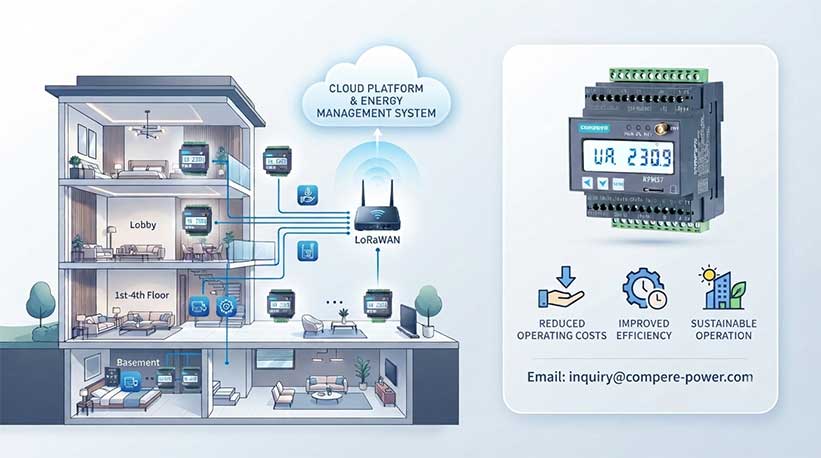
Effective energy management requires precise data. However, many residential facilities struggle with visibility due to outdated infrastructure and manual processes.
Residential buildings contain diverse zones, each with distinct energy profiles. Without digital monitoring, identifying waste is nearly impossible.
| Area | Main Energy Consumption Sources | Management Challenges |
|---|---|---|
| Apartments | Air conditioners, appliances, lighting | Difficult to monitor individual consumption |
| Common Areas | Lighting, elevators, public facilities | Energy waste is difficult to identify |
| HVAC Systems | Heating and cooling equipment | High consumption without detailed analysis |
| Water Pump Systems | Water supply equipment | Difficult to evaluate efficiency |
| Parking Areas | Lighting and EV charging facilities | Requires independent monitoring |
Without a residential energy monitoring system, property managers lack insights into peak usage periods or abnormal consumption patterns that indicate equipment failure or unauthorized usage.
Manual data collection is prone to error and consumes valuable staff time that could be better spent on property maintenance or tenant services.
| Item | Traditional Meter | IoT Smart Meter |
|---|---|---|
| Data Collection | Manual reading | Automatic data transmission |
| Monitoring | Periodic | Real-time |
| Labor Requirement | High | Reduced |
| Data Accuracy | Manual operation dependent | Improved |
| Remote Management | Limited | Available |
Managing electricity in multi-tenant environments like apartment complexes or student dormitories is notoriously difficult. Relying on manual readings often leads to administrative bottlenecks, increased management workload, and frequent billing disputes between tenants and management. A robust smart energy management system automates this process, ensuring accuracy and transparency.
An IoT smart meter is an intelligent electricity measurement device designed to collect precise energy data and transmit it seamlessly through communication networks. Unlike static legacy meters, these devices are active components of a building’s infrastructure.
The operational architecture typically follows this flow:
Selecting the right communication protocol is vital for successful integration within different building types.
| Communication Technology | Features | Suitable Applications |
|---|---|---|
| LoRaWAN | Long-range wireless communication and low power consumption | Large residential communities and apartment buildings |
| 4G | Wide coverage and independent connection | Remote or distributed buildings |
| WiFi | Easy deployment and common network availability | Small residential projects |
| RS485 Modbus | Stable wired communication | Centralized building monitoring |
| Application Scenario | Requirements | IoT Smart Meter Benefits |
|---|---|---|
| Apartment Buildings | Individual tenant monitoring | Remote reading and billing |
| Residential Communities | Large-scale meter management | Centralized monitoring |
| Student Dormitories | Room-level management | Electricity monitoring |
| Rental Housing | Multi-tenant billing | Easier operation |
| Smart Buildings | Energy data integration | Improved visibility |
The primary IoT smart meter application in residential buildings is to provide automated, granular energy data. These meters replace manual reading processes, allowing property managers to monitor energy consumption in real-time across various areas—from individual apartment units to common facilities. This data enables more accurate billing, faster identification of electricity waste, and improved overall energy efficiency, effectively transitioning properties from reactive maintenance to data-driven smart energy management.
IoT smart meters simplify apartment electricity management by providing accurate, automated usage data that eliminates the errors associated with manual meter reading. They facilitate precise, usage-based billing, which reduces administrative workload and minimizes tenant disputes over electricity charges. Furthermore, managers can identify high-consumption patterns, helping to implement energy-saving measures that lower utility bills and enhance the attractiveness of the rental property to tenants.
Common communication technologies used in these systems include LoRaWAN, which is ideal for large residential communities due to its long-range wireless capabilities; 4G, which offers independent, wide-area connectivity; WiFi, which provides easy deployment for smaller projects; and RS485 Modbus, which ensures stable, wired communication in centralized environments. The choice of technology depends on the size of the building, the installation environment, and specific data transmission requirements.
Yes. IoT smart meters significantly reduce energy management costs by lowering labor requirements associated with manual data collection and billing. By providing real-time data through a building energy management solution, property managers can pinpoint energy waste and optimize equipment operation, preventing unnecessary consumption. This transition to digitized, automated monitoring not only saves operational expenses but also prolongs the lifespan of building electrical infrastructure through improved maintenance insights.

Power Monitoring
KPM31 single-phase DIN Rail Prepaid Energy Meter integrates data acquisition and control functions
Learn More
Power Monitoring
The KPM33 Three-phase DIN-rail 4G Prepaid Energy Meter is designed for DIN-rail mounting.
Learn More
Power Monitoring
The KPM37 4G Three-phase OEM Energy Meter features a 35mm DIN rail mounting design and an LCD display.
Learn MoreCompere provides the integrated energy management solution including online monitoring, analyzing, reporting, controlling, maintenance, production management, prediction, and other functions. We offer u technical support and professional solution at 7*24h service.
Unit 1, Building 38, LIANDONG U Valley, No. 352 Lianhua Street, High-tech Zone, Zhengzhou, China
Our helpline is always open to receive any inquiry or feedback.Please feel free to drop us an email from the form below and we will get back to you as soon as we can.
Compere mainly provides kpm series smart energy meters. If you have any needs, please feel free to contact us.