Power Monitoring
KPM31 single-phase DIN Rail Prepaid Energy Meter integrates data acquisition and control functions
Learn More
In today's pursuit of carbon neutrality and reduced operating costs, upgrading commercial buildings to include energy monitoring is no longer a "bonus," but a "must." However, traditional wired energy monitoring systems often come with high retrofit costs—drilling holes in walls, interrupting services, and rewiring—pain points that deter many building owners and property managers.
Fortunately, with the development of the Internet of Things (IoT) and wireless technology, you can give older buildings intelligent capabilities without damaging existing wiring or disturbing tenants. Below is a practical guide to efficiently retrofitting commercial buildings for energy monitoring.
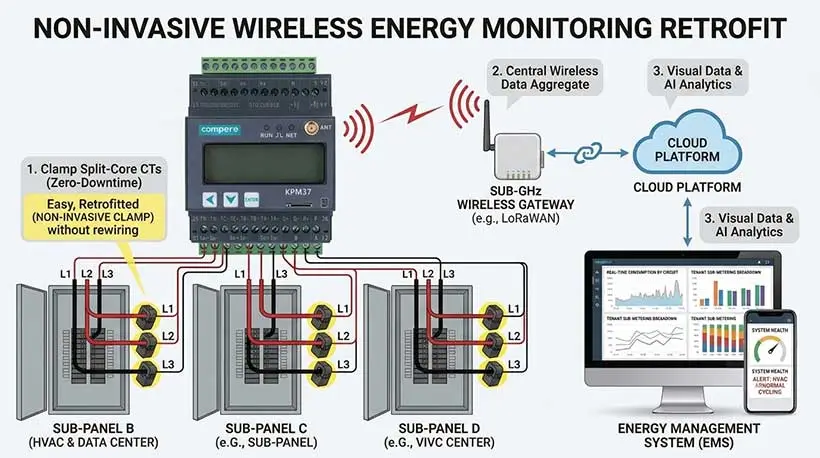
The key to avoiding "rewiring the entire building" lies in choosing non-invasive hardware and wireless communication protocols.
Split-Core Current Transformers (CTs): This is the most crucial no-wiring solution. Traditional current transformers require disconnecting cables before installation, while open-type CTs use a "flip-top" design, clipping directly onto existing power lines. This means installation can be performed without cutting cables and can even be safely deployed without power outages.
Wireless Communication Protocols: Abandoning the laying of hundreds of meters of network cabling, instead utilizing mature wireless networks to transmit data to a central gateway:
LoRaWAN: Extremely strong penetration, ideal for complex commercial buildings or underground distribution rooms.
Mesh Network: Devices can automatically network and forward signals to each other, perfectly solving coverage dead zones in large buildings.
Step 1: Endpoint Acquisition (Distribution Box Retrofit)
No need to touch the wiring in tenant rooms; the focus of the retrofit is entirely on the floor distribution panels or main distribution room.
Clip the open-type CT onto the circuits that need monitoring (such as central air conditioning, lighting, and power).
Connect the CT to a compact wireless smart energy meter. These energy meters are small and can typically be installed directly inside existing distribution boxes via magnetic attachment or DIN rail mounting.
Step Two: Wireless Gateway Deployment
Deploy wireless gateways in the center of the building or every few floors. The gateway collects data from all wireless energy meters and securely uploads the data to the cloud or local server via the building's existing Wi-Fi, Ethernet, or cellular network (4G/5G).
Step Three: Software and Data Integration (EMS)
After data upload, it is visualized through an Energy Management System (EMS) or a modern AI-embedded software platform. You can see in real time:
Energy consumption rankings for the entire building, each floor, and even specific devices.
Emergency power consumption alerts (such as air conditioners left on late at night).
Individual metering data for accurate electricity bill allocation to tenants.
| Dimension | Traditional Wired Retrofit | Wireless Non-Invasive Retrofit |
|---|---|---|
| Installation Cost | Extremely high (extensive labor, conduit routing, and heavy cabling expenses). | Minimal (Plug-and-play hardware reduces deployment labor by over 80%). |
| Operational Disruption | Requires prolonged, multi-zone power shutoffs, heavily disrupting tenant operations. | Zero Disruption (Safe, clamp-on installation allows deployment with minimal to no downtime). |
| Scalability & Flexibility | Rigid architecture; moving or adding data points later requires fresh rewiring. | Exceptional (Modular meters can be reconfigured or scaled up easily as tenants shift). |
| Aesthetic & Structural Impact | May require drilling walls, dropping ceilings, or exposing unsightly conduits. | Zero Footprint (Ultra-compact components hide entirely within existing electrical panels). |
Pilot First, Then Expand: It is recommended to start with high-energy-consuming systems (such as HVAC central air conditioning systems, data centers, or public lighting) to verify the return on investment (ROI) before expanding to the entire building.
Pay Attention to Signal Interference: Commercial buildings often have a large amount of reinforced concrete and metal pipes. When choosing wireless technology, prioritize sub-GHz (below 1GHz) low-frequency technologies such as LoRaWAN, whose penetration power is far superior to 2.4GHz Wi-Fi or traditional Bluetooth.
Data Security First: Ensure that the selected wireless devices and gateways support end-to-end encryption (such as AES-128) and are physically or logically isolated from the building's existing IT business network.
The maturity of IoT technology has completely broken down the barriers to green transformation in commercial buildings. Through the combination of "open-type sensors + wireless networks," you can give an old building energy sensing capabilities accurate to the minute in just a few days. This not only helps you quickly identify "electricity hogs" in buildings, but also lays a solid data foundation for asset appreciation and ESG compliance.

Power Monitoring
KPM31 single-phase DIN Rail Prepaid Energy Meter integrates data acquisition and control functions
Learn More
Power Monitoring
The KPM33 Three-phase DIN-rail 4G Prepaid Energy Meter is designed for DIN-rail mounting.
Learn More
Power Monitoring
The KPM37 4G Three-phase OEM Energy Meter features a 35mm DIN rail mounting design and an LCD display.
Learn MoreCompere provides the integrated energy management solution including online monitoring, analyzing, reporting, controlling, maintenance, production management, prediction, and other functions. We offer u technical support and professional solution at 7*24h service.
Unit 1, Building 38, LIANDONG U Valley, No. 352 Lianhua Street, High-tech Zone, Zhengzhou, China
Our helpline is always open to receive any inquiry or feedback.Please feel free to drop us an email from the form below and we will get back to you as soon as we can.
Compere mainly provides kpm series smart energy meters. If you have any needs, please feel free to contact us.