Power Monitoring
KPM31 single-phase DIN Rail Prepaid Energy Meter integrates data acquisition and control functions
Learn More
In the digital economy era, data centers are the heart of global mission-critical operations. 100% uptime is a core objective for data centers. However, many often overlook a hidden killer—power quality degradation.
Power quality issues not only lead to costly equipment downtime but also accelerate the aging of sensitive electronic components. By implementing comprehensive power quality monitoring, data centers can detect anomalies before catastrophic failures occur, ensuring stable system operation.
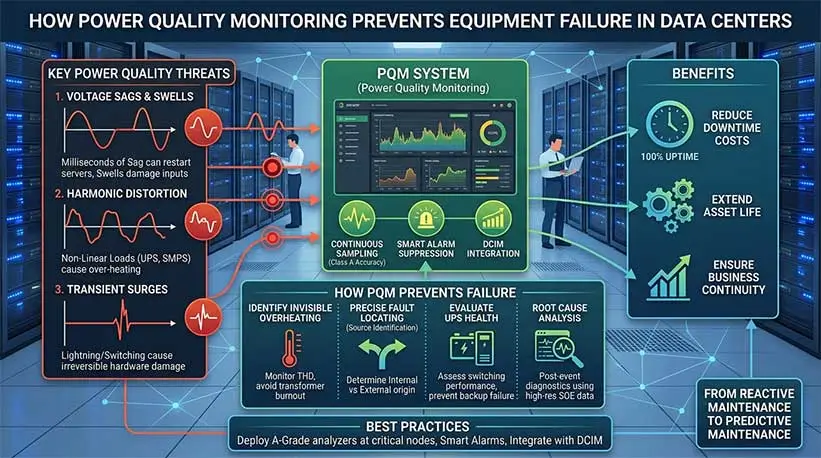
Data centers are filled with numerous non-linear loads (such as server power supplies, UPS, and variable frequency air conditioners). These devices are both victims and sources of power quality pollution. Common power quality problems include:
1. Harmonic Distortion
Causes: Switching-mode power supplies (SMPS) and variable speed drives in servers inject high-frequency harmonics into the power grid.
Consequences: Harmonics can cause abnormal overheating of transformers and cables, leading to premature insulation breakdown and even unexplained circuit breaker tripping.
2. Voltage Sags and Swells
Causes: External power grid failures, start-up or shutdown of nearby high-capacity loads, or startup of large chillers within the data center.
Consequences: Voltage sags are the most common threat. Even sags lasting a few milliseconds are enough to cause sensitive server power restarts; voltage swells can directly burn out the input circuitry of IT equipment.
3. Transient Surges
Causes: Lightning strikes, grid switching, or switching operations of internal inductive loads.
Consequences: Extremely high voltage spikes can instantly break down semiconductor components, causing irreversible hardware damage.
Power Quality Monitoring (PQM) systems are like a "24-hour Holter monitor" for the data center's power system. It achieves a shift from "reactive maintenance" to "predictive maintenance" by deploying high-precision analyzers at key nodes (such as incoming line cabinets, UPS output terminals, and PDUs at the top of the rack).
1. Identifying Hidden Overheating and Extending Equipment Lifespan
Temperature rises caused by harmonics are often slow and insidious. The PQM system can monitor the Total Harmonic Distortion (THD) in real time. When the THD exceeds the safe threshold, the system will issue an early warning, prompting maintenance personnel to de-capacitate transformers or activate active power filters (APFs), thereby preventing transformer burnout due to overheating.
2. Precisely Locating Fault Sources (Internal vs. External)
When voltage disturbances occur, data centers need to quickly clarify responsibility. The PQM system has disturbance direction identification capabilities, enabling it to determine whether voltage dips are caused by the external public power grid or by the startup of equipment within the data center. This helps the maintenance team quickly isolate the fault source and prevent the impact from escalating.
3. Assessing the Health of UPS and Core Assets
UPS (Uninterruptible Power Supply) is the last line of defense for data centers. By monitoring the voltage and current waveforms at the input and output terminals, PQM can assess the UPS's response speed and waveform smoothness during mains and battery switching. If increased transient oscillations are detected during switching, it indicates that the UPS's capacitors or battery packs may be in a sub-healthy state, requiring timely maintenance.
4. Evidence Analysis and Root Cause Analysis
In the event of an unexplained server outage, the high-sampling-rate event waveforms (SOE sequences) recorded by the PQM system are the best diagnostic evidence. By comparing the outage time with the timeline of power waveform distortion, engineers can accurately determine whether the outage was caused by a microsecond-level surge or by a three-phase imbalance triggering the server's protection mechanism.
To ensure that power quality monitoring truly plays a preventative role, data centers should pay attention to the following points during planning:
Continuous full-power sampling: Avoid using ordinary meters that are only refreshed periodically. A standard power quality analyzer supporting IEC 61000-4-30 Class A (A-level accuracy) must be selected to ensure that no microsecond-level transient events are missed. Intelligent Alarm Suppression: Prevents "auditory fatigue" for maintenance personnel caused by massive alarms. The system should have alarm convergence capabilities, merging multiple related alarms caused by the same power event into a single core event.
Integration with Data Center Infrastructure Management (DCIM) System: Integrates power health data with the Data Center Infrastructure Management (DCIM) system to achieve unified visualization of power, environment, and IT load, enabling predictive maintenance from a global asset perspective.
In today's data centers moving towards high density and high computing power, power quality is no longer just an "electricity" issue, but a strategic issue directly related to "business continuity."
Investing in a high-standard power quality monitoring system, while increasing construction costs in the short term, provides fault early warning capabilities, root cause analysis methods, and extends the lifespan of core assets, helping data centers avoid millions of downtime losses. Prevention is the key to the green and secure operation of modern data centers.

Power Monitoring
KPM31 single-phase DIN Rail Prepaid Energy Meter integrates data acquisition and control functions
Learn More
Power Monitoring
The KPM33 Three-phase DIN-rail 4G Prepaid Energy Meter is designed for DIN-rail mounting.
Learn More
Power Monitoring
The KPM37 4G Three-phase OEM Energy Meter features a 35mm DIN rail mounting design and an LCD display.
Learn MoreCompere provides the integrated energy management solution including online monitoring, analyzing, reporting, controlling, maintenance, production management, prediction, and other functions. We offer u technical support and professional solution at 7*24h service.
Unit 1, Building 38, LIANDONG U Valley, No. 352 Lianhua Street, High-tech Zone, Zhengzhou, China
Our helpline is always open to receive any inquiry or feedback.Please feel free to drop us an email from the form below and we will get back to you as soon as we can.
Compere mainly provides kpm series smart energy meters. If you have any needs, please feel free to contact us.