Power Monitoring
KPM31 single-phase DIN Rail Prepaid Energy Meter integrates data acquisition and control functions
Learn More
In modern commercial real estate operations, energy management is no longer simply a matter of "saving electricity," but has evolved into a two-way collaboration and interest game between property owners and tenants. With increasingly stringent global requirements for ESG (Environmental, Social, and Governance) compliance, coupled with companies' extreme sensitivity to operating cost control, a building's "energy bill" is becoming a key factor determining a property's core competitiveness and tenant satisfaction.
To achieve efficient energy management, it is first necessary to clarify the respective positions and pain points of both the property owner and tenants.
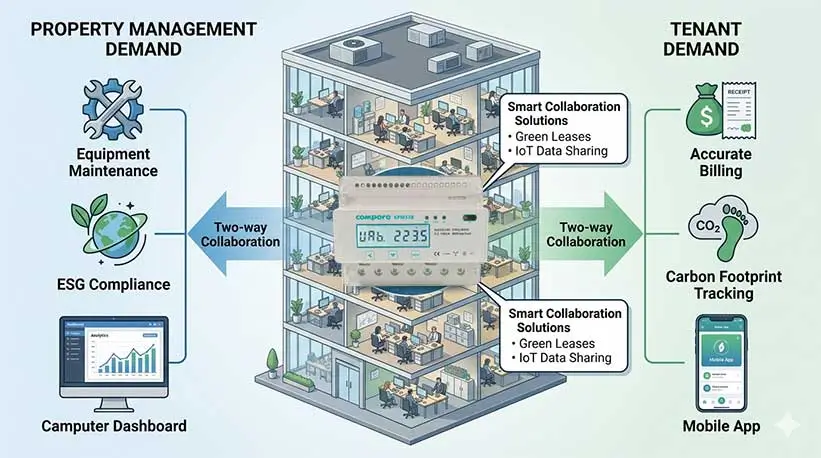
For both owners and property management companies (owners/managers) of commercial buildings, energy management is directly related to the building's life cycle value and the health of its daily operational assets.
Reducing Common Area and Operating Costs: Commercial buildings have significant energy consumption in their common areas (such as lobbies, corridors, exterior lighting, and central air conditioning units). Property owners urgently need to reduce operating expenses that cannot be fully passed on to tenants through energy-saving renovations (such as LED lighting upgrades and smart variable frequency air conditioning systems).
Asset Valuation and ESG Compliance: In the context of green finance, properties with green building certifications (such as LEED and three-star green building certifications) often receive higher valuations and lower financing costs. Meanwhile, regulations on carbon emissions from large commercial complexes are becoming increasingly stringent, and non-compliance may result in fines or downgrading risks.
Predictive Maintenance of Equipment: Through Internet of Things (IoT) energy monitoring systems, property owners can monitor the real-time operating status of core equipment such as transformers and chillers. Once abnormal energy consumption is detected (such as a sudden increase in current), maintenance can be performed before complete equipment failure, extending the asset's lifespan.
As companies increasingly demand better office experiences and brand image, tenants (especially multinational corporations and large technology companies) are placing more proactive and forward-looking demands on energy management.
Billing Transparency: Traditional commercial buildings often use a crude "shared area" billing method, which tenants who prioritize energy conservation feel unfairly treated. Tenants strongly desire sub-metering, expecting precise electricity usage reports down to their individual areas and even specific time periods, ensuring transparent pricing.
Supply Chain Carbon Footprint Tracking: Many modern companies commit to net-zero emissions and are required to regularly disclose their carbon emissions data for their workplaces. If the property management cannot provide detailed energy usage data, these tenants are highly likely to move to smarter, greener buildings when their leases expire.
Balancing Comfort and Flexibility: While pursuing energy efficiency, tenants do not want to sacrifice the comfort of their work environment (such as temperature, ventilation, and lighting). With the increasing prevalence of hybrid work arrangements and flexible get off work schedules, tenants need the property management to flexibly adjust energy supply based on actual attendance.
Although both parties are willing to save energy, in practice, traditional leasing models often lead to "split incentives."
A typical mismatch dilemma:
If the property management company funds the upgrade to a more energy-efficient central air conditioning system, the tenant directly benefits and saves on electricity bills. The property management company lacks the incentive for return on investment (ROI). Conversely, if tenants want to install smart sensor lighting indoors, due to property rights and lease term restrictions, they may feel they are "doing the work for the landlord."
This unequal distribution of "who invests, who benefits" has long been the biggest stumbling block in commercial building energy management.
To break the deadlock, commercial building energy management must transform from "one-way control" to "two-way service." The following three measures are currently the most effective breakthroughs in the industry:
Implement "Green Leases":
Re-determine the distribution of benefits through legal clauses. For example, property management companies can be allowed to allocate a portion of the cost of energy-saving renovations to tenants who benefit from the savings on electricity bills through a reasonable allocation. This makes both parties "energy-saving partners" at the contractual level.
Deploying a Fully Quantitative "Digital Foundation":
Property management companies should build a unified Building Energy Management System (BEMS). For property management, it's a "smart brain" capable of managing the building's water, electricity, heating, and cooling; for tenants, it's an open, visual mobile dashboard where they can view their energy consumption curves at any time and apply for overtime air conditioning or adjust lighting modes with a single click.
Promoting Behavior-Based "Green Incentives":
Property management companies can use energy consumption data to conduct activities such as "Energy Saving Pioneer Rankings" within the building, rewarding tenants with excellent energy control with both material and spiritual rewards, such as deductions from property management fees, free use of public meeting rooms, or joint green publicity campaigns, transforming rigid energy management into engaging community interaction.
Energy management in commercial buildings is essentially an experience upgrade linked by data. It connects the property's asset ledger on one hand and the tenant's experience and image on the other. When properties no longer treat energy as a consumer good, but as a service asset that can be optimized; when tenants no longer treat energy consumption as a passive cost, but as a social responsibility they actively fulfill—the convergence of these two demands is precisely where the future of green and smart buildings lies.

Power Monitoring
KPM31 single-phase DIN Rail Prepaid Energy Meter integrates data acquisition and control functions
Learn More
Power Monitoring
The KPM33 Three-phase DIN-rail 4G Prepaid Energy Meter is designed for DIN-rail mounting.
Learn More
Power Monitoring
The KPM37 4G Three-phase OEM Energy Meter features a 35mm DIN rail mounting design and an LCD display.
Learn MoreCompere provides the integrated energy management solution including online monitoring, analyzing, reporting, controlling, maintenance, production management, prediction, and other functions. We offer u technical support and professional solution at 7*24h service.
Unit 1, Building 38, LIANDONG U Valley, No. 352 Lianhua Street, High-tech Zone, Zhengzhou, China
Our helpline is always open to receive any inquiry or feedback.Please feel free to drop us an email from the form below and we will get back to you as soon as we can.
Compere mainly provides kpm series smart energy meters. If you have any needs, please feel free to contact us.