Power Monitoring
KPM31 single-phase DIN Rail Prepaid Energy Meter integrates data acquisition and control functions
Learn More
By introducing smart energy meters and a corresponding energy management system, hospitals can shift from "extensive electricity consumption" to "refined energy saving." As complex, energy-intensive facilities operating 24/7, hospitals benefit from smart meters primarily through the following core aspects to effectively reduce energy costs:
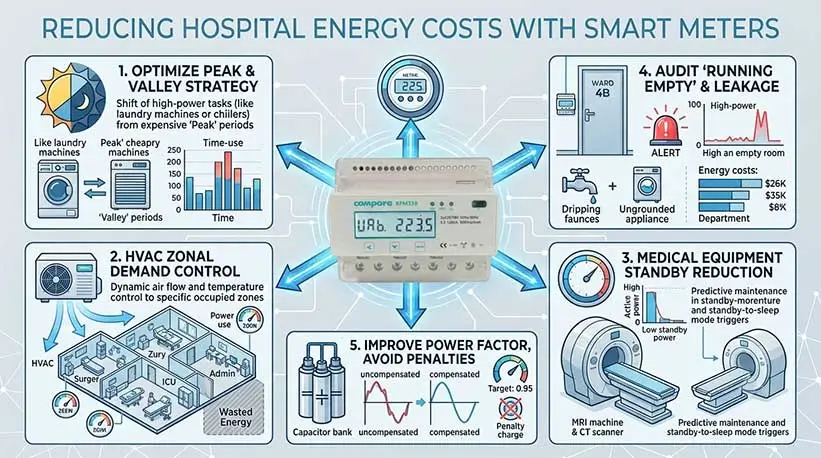
Most regions use time-of-use pricing for commercial and industrial electricity (higher electricity prices during peak hours and lower prices during off-peak hours).
Load Shifting: Smart meters can monitor and record electricity consumption every half hour or hour in real time. Hospitals can use this data to shift non-urgent, energy-intensive operations (such as large laundry operations, centralized ice making, centralized air conditioning pre-cooling in some administrative areas, and energy storage battery charging) to off-peak hours at night or early morning.
Demand Response: During peak grid load periods, the system can automatically or manually prompt hospitals to turn off unnecessary lighting or fine-tune air conditioning temperatures in non-surgical areas, thus avoiding the highest electricity rates.
HVAC systems typically account for 40%-50% of a hospital's total energy consumption. Smart meters can be linked to the hospital's building automation system (BAS).
Zone-by-Zone Energy Consumption Profiling: Smart meters can monitor the power consumption of air conditioning in different areas such as operating rooms, ICUs, wards, and administrative buildings.
On-Demand Energy Supply: By combining outpatient traffic and time-of-day data, smart meters can help managers identify "ineffective energy consumption." For example, if the meter shows that the air conditioning and fresh air systems are still running at full capacity when the administrative office area is empty at night or on weekends, the system can promptly issue an alarm and make adjustments to avoid waste.
Hospitals possess a large number of high-power devices (such as MRI, CT scanners, X-ray machines, etc.). Standby Power Consumption Optimization: Many large devices remain in a high-power standby state even when not scanning. Smart meters can accurately capture the standby power consumption curves of these devices at night or during off-peak hours. Through data analysis, hospitals can develop more reasonable low-power sleep strategies while ensuring equipment lifespan and preheating requirements.
Preventive Maintenance: When a device's meter reading suddenly fluctuates abnormally (e.g., excessive current or decreased power factor), it usually indicates a malfunction or aging of internal components (such as cooling fans or compressors). Maintenance before complete equipment failure prevents wasted electricity due to inefficiency and extends the lifespan of expensive equipment.
Real-time Anomaly Alarms: Smart meters have real-time monitoring capabilities. If a building experiences a sudden surge in electricity consumption at 3 AM, the system will immediately issue an alarm. This helps management quickly pinpoint whether it's an electrical fault, equipment left on unnecessarily, or a serious leakage.
Precise Calculation and Internal Auditing: Traditional electricity meters only display the total number of transactions for the entire hospital, while smart meters can measure at the departmental and even equipment level. By directly calculating energy costs for specific departments, energy conservation awareness among medical staff can be enhanced, reducing the phenomenon of leaving lights and computers on when not in use.
Many hospitals use a large number of non-linear electronic devices (such as frequency converters, UPS power supplies, and large imaging equipment), which leads to a decrease in the power factor of the power grid.
Avoid Fines: Power companies typically impose fines on institutions with a power factor below a certain standard (e.g., 0.9). Smart meters can monitor reactive power and power factor in real time.
Guidance on Reactive Power Compensation: Hospitals can use data provided by smart meters to precisely configure and adjust reactive power compensation devices (such as capacitor banks) to maintain the power factor at an ideal level, thereby directly avoiding this unnecessary expense and improving the overall capacity and stability of the hospital's power supply system.
In summary, smart meters are not just "money counters," but also energy consumption stethoscopes. By providing visualized, high-precision real-time data, they enable hospital logistics teams to move beyond the past "blind men and the elephant" approach to energy conservation, truly "speaking with data," identifying every energy consumption loophole, and thus significantly reducing operating costs without compromising medical quality and patient comfort.

Power Monitoring
KPM31 single-phase DIN Rail Prepaid Energy Meter integrates data acquisition and control functions
Learn More
Power Monitoring
The KPM33 Three-phase DIN-rail 4G Prepaid Energy Meter is designed for DIN-rail mounting.
Learn More
Power Monitoring
The KPM37 4G Three-phase OEM Energy Meter features a 35mm DIN rail mounting design and an LCD display.
Learn MoreCompere provides the integrated energy management solution including online monitoring, analyzing, reporting, controlling, maintenance, production management, prediction, and other functions. We offer u technical support and professional solution at 7*24h service.
Unit 1, Building 38, LIANDONG U Valley, No. 352 Lianhua Street, High-tech Zone, Zhengzhou, China
Our helpline is always open to receive any inquiry or feedback.Please feel free to drop us an email from the form below and we will get back to you as soon as we can.
Compere mainly provides kpm series smart energy meters. If you have any needs, please feel free to contact us.