Power Monitoring
KPM31 single-phase DIN Rail Prepaid Energy Meter integrates data acquisition and control functions
Learn More
In today's digital revolution, data centers, as the core foundation of computing power, are facing unprecedented challenges in energy consumption. With the explosive growth of artificial intelligence and cloud computing, data center electricity consumption has skyrocketed. How to achieve energy conservation and consumption reduction under high load has become a crucial question for every data center operator.
Among many metrics, PUE (Power Usage Effectiveness) is the gold standard for evaluating data center energy efficiency. The closer a PUE is to 1, the higher the proportion of electricity used purely for IT equipment, and the less "impurity energy" used for auxiliary facilities such as cooling and power distribution. To truly drive down PUE, introducing real-time sub-metering is currently the most effective breakthrough.
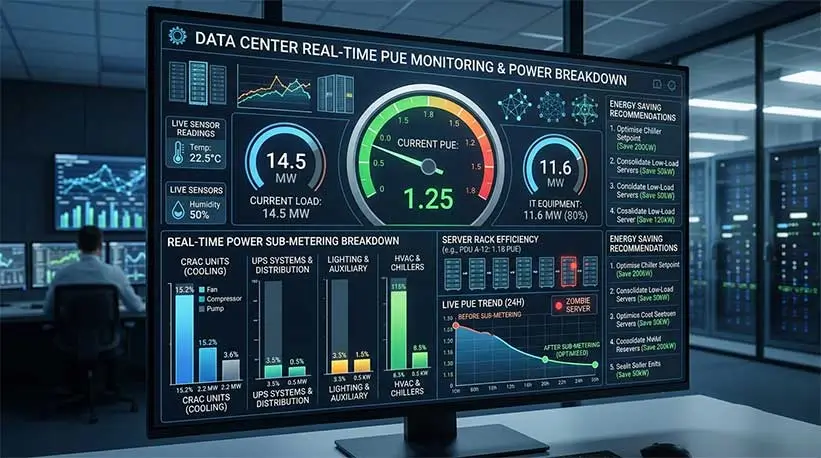
In the past, many data centers managed their electricity at the "general ledger" stage—checking the main meter monthly to know how much electricity they had spent and calculating a rough average PUE. This model has significant drawbacks:
Lack of granularity: It's impossible to accurately know how much electricity each chiller, server rack, lighting, or transformer consumes.
Lack of timeliness: By the time the bill is received, the high energy consumption may have already occurred a month prior, making preventative and real-time control impossible.
Lack of optimization basis: Wanting to implement energy-saving renovations, but not knowing which part offers the highest return on investment, one is left to grope in the dark based on experience.
Real-time sub-metering, simply put, involves dissecting the entire power supply network of the data center layer by layer. By installing smart meters and sensors at key nodes (such as transformers, UPS uninterruptible power supplies, rack-mounted power supplies, chillers, water pumps, etc.), power data is collected and uploaded to the monitoring system at a frequency of seconds or minutes.
This refined monitoring brings three core transformations:
1. Creating a Clear "Energy Consumption Profile"
The system automatically breaks down total energy consumption into IT equipment energy consumption, cooling energy consumption, power distribution system losses, and auxiliary energy consumption (such as lighting and office use). Through intuitive charts, operators can clearly see the real-time current, voltage, and power factor of each branch.
2. Capturing Instantaneous "Energy Consumption Anomalies"
Thanks to real-time monitoring, any abnormal surges in energy consumption cannot go unnoticed. For example, if a cooling pump experiences a decrease in efficiency due to mechanical wear, resulting in an unexplained increase in current, the system will immediately issue a warning. This "prevention is better than cure" capability can prevent large-scale energy waste before it occurs.
3. Supporting Dynamic PUE Display
Traditional PUE is a static monthly or annual average, while real-time itemized metering makes dynamic PUE (Live PUE) possible. Operators can see the PUE curve over a 24-hour period, showing how it fluctuates with outdoor temperature and IT workload, allowing for precise identification of optimization opportunities.
With real-time data as the "scalpel," data centers can perform refined energy-saving procedures to effectively reduce PUE:
1. Precisely Control Air Conditioning Cooling (Reduce Cooling Energy Consumption)
Cooling is typically the largest energy consumer in a data center besides IT equipment. By combining itemized chiller power consumption with temperature and airflow organization data within the server room, "on-demand cooling" can be achieved.
Eliminating Localized Hotspots: Identifying high power consumption and temperatures in certain server racks allows for targeted adjustment of air dampers in those areas, rather than blindly lowering the overall air conditioning temperature of the server room.
Optimizing Indirect Evaporative Cooling/Natural Cooling: Real-time monitoring of outdoor temperature and humidity with cooling system power consumption allows for immediate switching to the extremely low-energy natural cooling mode when conditions are met, shortening the operating time of high-energy-consuming compressors.
2. Improve Power Supply and Distribution Efficiency (Reduce System Losses)
Electricity experiences losses (manifesting as heat) during transmission through transformers, UPS systems, and cables.
Optimize UPS Load Rate: Real-time monitoring reveals some UPS systems operating at low load rates for extended periods (resulting in lower efficiency). Dynamic adjustments can be made to put some UPS systems into energy-saving sleep mode, improving the load rate and operating efficiency of the main UPS systems.
Balance Three-Phase Load: Sub-metering can promptly expose three-phase power imbalances, preventing additional line losses and equipment overheating caused by current imbalances.
3. Manage "Zombie Servers"
Extending sub-metering to the rack level or even the PDU (Package Distribution Unit) port level can accurately identify "zombie servers" that consume power without performing any work. These servers remain idle for extended periods; while individual power consumption may be limited, the cumulative effect can significantly reduce overall energy efficiency. Timely shutdown or migration of these services directly reduces both IT-side and subsequent cooling-side energy consumption.
Under the stringent requirements of carbon neutrality and green development for data centers, extensive energy management methods are outdated. Real-time sub-metering is like installing a 24/7 energy efficiency monitoring system for data centers.
It's not just a bunch of cold data; it's a key tool for making the energy consumption black box transparent. Through it, operations teams can discover where every kilowatt-hour of electricity goes, transforming energy-saving measures from "guessing" to "evidence-based," driving a steady decline in PUE with data, and ultimately achieving green, efficient, and sustainable intelligent operation of data centers.
View More Products
Power Monitoring
KPM31 single-phase DIN Rail Prepaid Energy Meter integrates data acquisition and control functions
Learn More
Power Monitoring
The KPM33 Three-phase DIN-rail 4G Prepaid Energy Meter is designed for DIN-rail mounting.
Learn More
Power Monitoring
The KPM37 4G Three-phase OEM Energy Meter features a 35mm DIN rail mounting design and an LCD display.
Learn MoreCompere provides the integrated energy management solution including online monitoring, analyzing, reporting, controlling, maintenance, production management, prediction, and other functions. We offer u technical support and professional solution at 7*24h service.
Unit 1, Building 38, LIANDONG U Valley, No. 352 Lianhua Street, High-tech Zone, Zhengzhou, China
Our helpline is always open to receive any inquiry or feedback.Please feel free to drop us an email from the form below and we will get back to you as soon as we can.
Compere mainly provides kpm series smart energy meters. If you have any needs, please feel free to contact us.