Power Monitoring
KPM31 single-phase DIN Rail Prepaid Energy Meter integrates data acquisition and control functions
Learn More
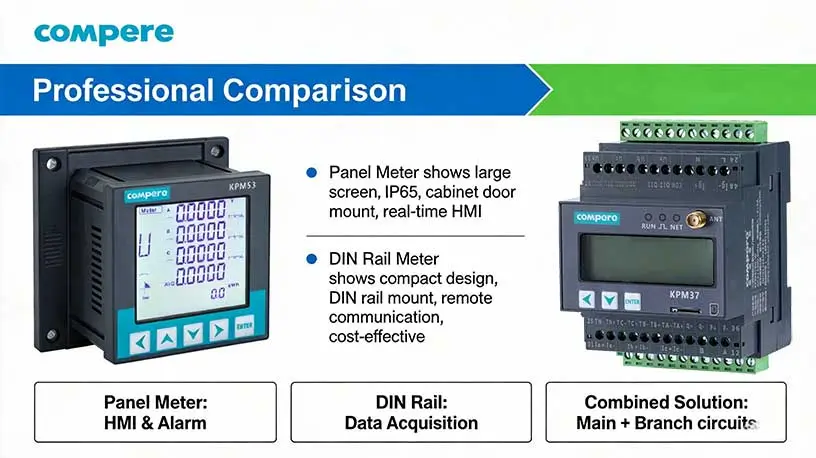
In industrial automation and power distribution systems, panel meters and DIN rail energy meters are the two most common types of electrical measuring instruments. Many engineers and purchasing personnel often struggle with which type to choose when faced with these two types of instruments.
The key to choosing lies in: your installation scenario, space constraints, and human-machine interaction requirements.
The following is a clear selection guide, outlining the core differences, selection dimensions, and practical application scenarios.
1. Consider Your "Human-Machine Interaction" Needs (The Most Decisive Factor)
Choose a Panel Meter: If your equipment requires on-site operators to frequently check current, voltage, and power, or to manually modify parameters and clear alarms directly on the meter, a panel meter mounted on the cabinet door allows for easy data viewing as you pass by.
Selecting Rail-Mounted Meters: If the instrument's data is primarily read by PLC, SCADA systems, or backend energy management software, and daily monitoring isn't required, rail-mounted meters are more suitable.
2. Consider Installation Space and Layout
Rail-mounted meters are suitable for situations with very limited space in the field control box, or for monitoring miniature circuit breakers in groups. Rail-mounted meters use standard 35mm rails and can be arranged like air switches, significantly saving space.
Selecting Panel Meters: When there's no space for rails inside the cabinet, but there's still considerable blank space on the cabinet door, or when it's necessary to prominently display the status of a critical circuit.
3. Consider Protection Rating (IP Rating)
Front-panel meters are suitable for industrial environments that require dust and water resistance. Mounted on the cabinet door, their front surface typically achieves an IP65 or higher protection rating, effectively blocking dust and splashes of water.
Rail-mounted meters, on the other hand, have a lower protection rating (usually IP20) and rely on an external distribution box/control cabinet for protection. 4. Consider the "Number of Circuits and Integration"
4. Consider the "Number of Circuits and Integration"
Choose a DIN rail meter: If a distribution cabinet has dozens of circuits to monitor (e.g., a multi-circuit energy meter), a DIN rail meter has a natural modular advantage, facilitating horizontal expansion and centralized wiring.
Choose a panel meter: For detailed monitoring of single circuits and core equipment (e.g., a dedicated meter for a high-power motor or frequency converter).
Scenarios suitable for panel meters:
Equipment Control Consoles/Operation Panels: Such as generator control cabinets and large machine tool control consoles, where operators need to monitor operating parameters in real time.
Key Power Distribution Cabinet Doors: High and low voltage incoming line cabinets, capacitor compensation cabinets, used to display total current, total voltage, and power factor.
On-Site Alarm Indication: Scenarios requiring on-site audible and visual alarm prompts using the meter's built-in relay output (DO).
Suitable Scenarios for Using Din Rail Energy Meters:
Intelligent Lighting/Power Distribution Boxes: Lighting boxes and power distribution boxes on each floor in building automation systems, with data directly uploaded to the backend.
Data Center Server Rooms (PDUs/Panel Cabinets): Requires power metering for hundreds or thousands of server circuits; rail-mounted multi-circuit meters are the absolute mainstay.
Factory Energy Management Systems (EMS): Power meters installed purely for energy saving, cost reduction, and cost calculation; all data is uploaded via RS485 (Modbus) or Ethernet.
In short: "Choose panel meters for data viewing, choose rail-mounted meters for data transmission; choose panel meters for external dust protection, choose rail-mounted meters for internal centralized control."
In actual projects, the two are often used in combination: a powerful panel meter is installed on the main incoming line cabinet door as the "face" and "central control," while rail-mounted meters are densely packed inside the cabinet for "refined cost accounting" on branch circuits. The most cost-effective solution is to balance these two factors based on your actual budget, space, and system architecture.

Power Monitoring
KPM31 single-phase DIN Rail Prepaid Energy Meter integrates data acquisition and control functions
Learn More
Power Monitoring
The KPM33 Three-phase DIN-rail 4G Prepaid Energy Meter is designed for DIN-rail mounting.
Learn More
Power Monitoring
The KPM37 4G Three-phase OEM Energy Meter features a 35mm DIN rail mounting design and an LCD display.
Learn MoreCompere provides the integrated energy management solution including online monitoring, analyzing, reporting, controlling, maintenance, production management, prediction, and other functions. We offer u technical support and professional solution at 7*24h service.
Unit 1, Building 38, LIANDONG U Valley, No. 352 Lianhua Street, High-tech Zone, Zhengzhou, China
Our helpline is always open to receive any inquiry or feedback.Please feel free to drop us an email from the form below and we will get back to you as soon as we can.
Compere mainly provides kpm series smart energy meters. If you have any needs, please feel free to contact us.