Power Monitoring
KPM31 single-phase DIN Rail Prepaid Energy Meter integrates data acquisition and control functions
Learn More
In today’s volatile global energy market, industrial facilities, commercial building owners, and energy managers face a common challenge: rising operational costs driven by high electricity tariffs. To remain competitive and hit strict corporate carbon reduction goals, corporate leaders can no longer rely on guesswork.
Power metering for energy conservation is the most reliable operational foundation for modern energy management. You cannot optimize what you do not track. Moving beyond standard utility bills to granular, real-time power consumption monitoring gives enterprises the visibility needed to uncover hidden operational waste, protect heavy machinery, and permanently lower electricity costs.
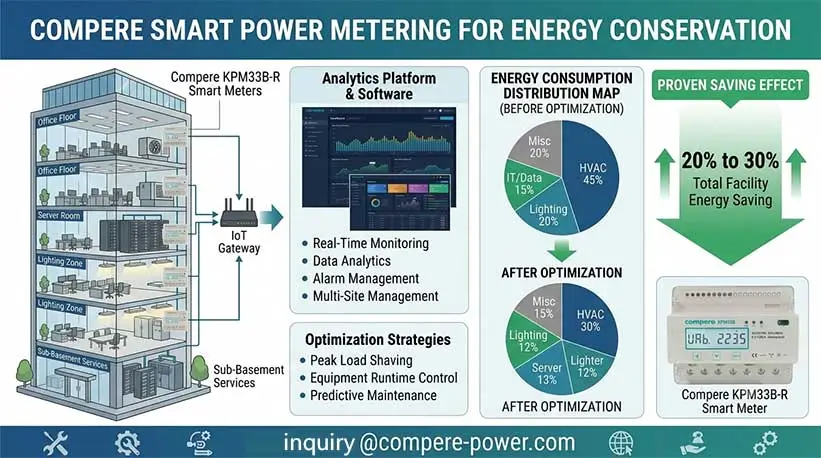
Power metering for energy conservation is the practice of deploying high-accuracy digital instrumentation across a facility to measure, log, and analyze electrical performance. Unlike standard utility meters that only report total monthly consumption, an industrial energy monitoring solution breaks down electricity usage by building, production line, or individual high-load assets like air compressors and chillers.
Achieving energy conservation through power metering relies on an ongoing data feedback loop. High-precision hardware captures electrical variables at the source and streams them to analytics software. This clear operational visibility allows energy managers to pinpoint exact sources of inefficiency and implement targeted, data-backed operational adjustments.
Many factories and commercial complexes pay inflated utility bills simply because their internal power infrastructure lacks transparency. Relying solely on macroscopic utility billing creates major blind spots:
Without sub-metering, operators cannot see where power goes. They cannot easily identify which machines run inefficiently or why consumption spikes during specific shifts. This lack of real-time consumption data makes it nearly impossible to set precise efficiency baselines, leaving plant managers guessing about the actual ROI of their sustainability efforts.
Fluctuating power prices directly impact bottom-line profitability. Inefficient machinery operation—such as large motors running with poor power factors—silently drains power and increases utility costs. Furthermore, without real-time tracking, facilities often cross peak thresholds, triggering expensive demand charges that could have been avoided by scheduling high-load processes outside peak utility hours.
Many facilities still rely on manual meter readings, a process prone to data entry errors, time lags, and info gaps. This delayed, historical data prevents agile decision-making, complicating long-term strategic planning for facility management companies and Energy Service Companies (ESCOs).
Implementing a modern power consumption monitoring system removes these systemic operational blind spots. Granular data tracking supports continuous energy efficiency improvement through several key mechanisms:
Modern digital energy meters continuously measure a full suite of vital electrical parameters, including:
A centralized energy management platform turns raw metrics into intuitive visualizations. Operators can compare usage patterns across different production lines, shifts, or seasonal cycles. This deep analytical insight helps teams optimize equipment schedules, uncover operational anomalies, and justify infrastructure upgrades with hard data.
Utilities charge heavy commercial users based on their highest power surge window. Smart meters track demand metrics in real time. If consumption approaches a critical peak threshold, the platform can trigger early alerts, allowing operators to shed non-essential loads, shift processes, and secure reliable electricity cost reduction solutions.
Anomalous energy draws are often the earliest signs of mechanical wear or electrical faults. Real-time sub-metering systems provide immediate alerts for out-of-spec power draws, allowing maintenance teams to service equipment before catastrophic breakdowns occur, maximizing uptime and thermal efficiency.
True energy optimization requires a balanced architecture that combines hardware engineering, secure field communication, and analytical software. An enterprise-grade IoT energy management system seamlessly links physical electrical panels to corporate management systems.
The hardware deployment process follows a highly accurate measurement flow. High-accuracy smart electricity meters are installed at main distribution panels and critical sub-panels to capture precise electrical footprints. Following measurement, integrated edge gateways collect data packets locally and transmit them reliably over long distances using robust industrial wireless or wired configurations. Finally, a central cloud monitoring platform ingests the data streams, transforming raw phase data into actionable dashboards, asset health reports, and consumption alerts.
When evaluating a smart power meter for energy management, procurement teams and system integrators should focus on several core criteria:
To support engineering teams and procurement integration, the technical standards below outline the design and operating profiles of our high-precision smart energy meters:
| System Parameter | Industrial Engineering Specification |
|---|---|
| Voltage Measurement Range | Nominal: 3×220/380V, 3×230/400V (Extended range up to 480V AC) |
| Current Connection Type | Transformer Rated: 1(6)A / 5A via External CTs; Direct Connect up to 100A |
| Measurement Accuracy Class | Active Energy: Class 0.5S (IEC 62053-22); Reactive Energy: Class 2.0 |
| Grid Frequency Selection | 50Hz / 60Hz (± 5% operational tolerance) |
| Communication Protocol Profile | Modbus-RTU, MQTT |
| Hardware Data Logger Memory | Built-in non-volatile memory; logs up to 12 months of historical profiles |
| Installation & Enclosure Fit | Standard 35mm DIN Rail configuration / Front Panel flush mount option |
| Ingress Protection Level | Main housing rated at IP51 (Front panel upgradeable to IP65 with sealing gasket) |
| Environmental Temperature | -25°C to +70°C operating limits (Relative humidity ≤ 95% non-condensing) |
Different industries face distinct power challenges. Sub-metering networks offer targeted, practical strategies across several major sectors:
In manufacturing plants, high-horsepower motors, heavy pump arrays, and process heating systems drive up operational costs. Sub-metering separates power costs by product batch or shift, giving plant managers the data needed to reduce idle power draw and schedule high-energy processes during lower-rate night hours.
In high-rise office buildings, shopping malls, and large hotels, HVAC systems and lighting account for the majority of power consumption. Digital energy meters help building managers run climate control systems based on real-time occupancy, isolate tenant energy costs, and earn green building certifications like LEED.
Data centers run continuous server operations that require intensive, 24/7 cooling. Sub-metering down to power distribution units (PDUs) allows operators to monitor Power Usage Effectiveness (PUE) in real time, identify cooling inefficiencies, and maximize computing power per watt.
As companies adopt on-site solar arrays or battery storage systems, smart meters track bi-directional energy flow. They measure exactly how much green energy is generated, used on-site, or fed back into the local grid, optimizing overall return on investment.
Deploying an integrated smart power metering system brings immediate and long-term business advantages:
Selecting an enterprise-grade power monitoring setup involves evaluating a few key operational requirements:
Determine whether you need revenue-grade billing precision or general reference monitoring. For main building feeds and tenant sub-billing, choose Class 0.5S or Class 0.2S certified hardware to ensure completely reliable data.
Verify that the meters connect smoothly with your current systems. Choose meters that support open industrial standards like Modbus to ensure hassle-free integration into your current automation systems.
Work with an established manufacturer that has deep industry experience. Look for companies that provide robust warranties, responsive technical support, and flexible OEM/ODM customization options—such as tailored firmware or custom current transformer bundles.
A: Power metering works by providing complete visibility into electrical consumption patterns. It isolates hidden energy waste, measures equipment efficiencies, and tracks load anomalies. This granular data allows managers to optimize operational schedules, fix faulty machinery, and eliminate idle power draw, driving down total waste.
A: Industrial energy management typically requires multi-functional, DIN-rail or panel-mounted digital smart meters that support sub-metering. These meters should feature high-accuracy data acquisition (Class 0.5S or better) and natively support open communication protocols like Modbus or LoRaWAN to easily transmit data to monitoring software.
A: Yes. While meters themselves do not alter power draw, the real-time data they capture enables automated demand-response strategies. This allows facilities to shed non-essential loads during peak pricing windows, improve poor power factors to avoid utility fines, and eliminate equipment idling, which lowers overall utility bills.
A: Our smart power meters feature versatile, multi-protocol communication architectures. Depending on your configuration, they support wired industrial standards like RS485 (Modbus RTU), as well as wireless IoT networks including 4G LTE, Wi-Fi, and LoRaWAN for simplified field integration.
Ready to eliminate energy waste and optimize your facility's power consumption? Contact our technical engineering team at [email protected] to discuss your operational challenges. We invite you to reach out for a free professional consultation, request complete product specifications, or work directly with our engineers to build a customized, one-on-one on-site energy monitoring solution tailored precisely to your B2B infrastructure and cost-reduction goals.

Power Monitoring
KPM31 single-phase DIN Rail Prepaid Energy Meter integrates data acquisition and control functions
Learn More
Power Monitoring
The KPM33 Three-phase DIN-rail 4G Prepaid Energy Meter is designed for DIN-rail mounting.
Learn More
Power Monitoring
The KPM37 4G Three-phase OEM Energy Meter features a 35mm DIN rail mounting design and an LCD display.
Learn MoreCompere provides the integrated energy management solution including online monitoring, analyzing, reporting, controlling, maintenance, production management, prediction, and other functions. We offer u technical support and professional solution at 7*24h service.
Unit 1, Building 38, LIANDONG U Valley, No. 352 Lianhua Street, High-tech Zone, Zhengzhou, China
Our helpline is always open to receive any inquiry or feedback.Please feel free to drop us an email from the form below and we will get back to you as soon as we can.
Compere mainly provides kpm series smart energy meters. If you have any needs, please feel free to contact us.