Power Monitoring
KPM31 single-phase DIN Rail Prepaid Energy Meter integrates data acquisition and control functions
Learn More
In energy-intensive industries, minor measurement inaccuracies rapidly compound into massive operational deficits. A calibration drift of just 0.5% on a high-voltage main feeder can leak tens of thousands of dollars annually in undetected billing discrepancies. Beyond direct financial loss, inaccurate power telemetry puts regulatory alignment at risk and compromises the data driving your facility's energy management software.
Implementing a structured framework for preventive maintenance for industrial energy meters is no longer optional—it is a critical operational mandate. For international procurement managers, utility engineers, and plant operators, managing these assets effectively means addressing three primary challenges: Compliance, Cost, and Efficiency.
By aligning equipment procurement with a proactive maintenance strategy, industrial facilities can secure long-term grid reliability while minimizing Total Cost of Ownership (TCO).
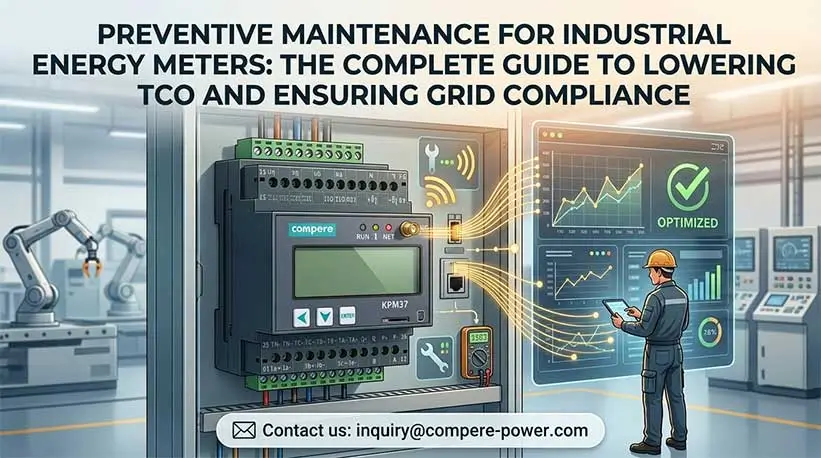
Industrial substations and factory floors present harsh operational environments. Voltage transients, harmonic distortion from variable frequency drives (VFDs), ambient temperature cycling, and airborne dust place continuous stress on electronic components. Over time, these factors lead to component aging and measurement drift.
Transitioning from a reactive "run-to-failure" approach to a structured industrial meter maintenance program directly addresses critical operational risks:
To optimize maintenance schedules, industrial facilities require robust, low-maintenance hardware engineered for continuous field deployment. The matrix below outlines standard technical specifications alongside recommended preventive maintenance intervals:
| Technical Parameter | Specification Standard | Preventive Maintenance Action | Recommended Frequency |
|---|---|---|---|
| Accuracy Classification | Active: Class 0.2S (IEC 62053-22) Reactive: Class 2S (IEC 62053-23) |
Field accuracy verification via reference standard | Every 12 to 24 Months |
| Regulatory Compliances | CE, UL 61010-1, RoHS | Visual inspection of physical anti-tamper seals | Every 6 Months |
| Telemetry & Communications | Modbus RTU/TCP, DLMS/COSEM, MQTT, NB-IoT | Remote communication link and port health audits | Monthly (Via EMS Software) |
| Data Logging Capabilities | Load profiles, sequence-of-events (SoE), THD | Memory sector integrity checks and log clearing | Annually |
| Environmental Protection | IP51 (Indoor) / IP65 (Outdoor enclosure) | Cleaning of terminal blocks and gasket inspection | Annually |
The specific operational environment dictates the focus of your preventive maintenance for industrial energy meters protocol. Different applications present distinct failure modes that engineers must mitigate.
In facilities operating large inductive loads—such as steel mills, automotive assembly plants, and chemical processing facilities—meters are exposed to high thermal variations and intense electromagnetic interference (EMI).
Maintenance Focus: Prioritize checking terminal torque specifications (to counter vibration-induced loosening) and verifying harmonic measurement accuracy up to the 63rd harmonic.
Data centers demand uninterrupted power supply and precise Power Usage Effectiveness (PUE) metrics. A failure in data transmission can blind energy management software.
Maintenance Focus: Focus on automated loop testing of communication protocols (Modbus TCP/DLMS) and testing backup battery supplies for internal real-time clocks (RTC).
Meters deployed at co-generation plants (solar/wind) must handle bidirectional energy flows and high-voltage grid interfaces.
Maintenance Focus: Annual phase-angle verification and ratio testing of instrument transformers (CT/PT secondary circuits) to ensure absolute system-wide synchronization.
When executing physical maintenance on industrial instrumentation, field technicians must follow a structured, safety-compliant sequence to ensure data integrity and personnel safety.
Access the central Energy Management System (EMS). Extract the meter’s historical event log to check for phase loss flags, extreme temperature alerts, or erratic voltage data prior to arriving on site.
Adhere to local Lockout/Tagout (LOTO) protocols. Visually inspect the meter enclosure for signs of overheating, tracking, moisture ingress, or terminal degradation. Confirm anti-tampering seals are intact.
Utilize shorting blocks to safely isolate Current Transformer (CT) secondary circuits. Ensure Potential Transformer (PT) connections are stable. Measure secondary voltages and currents to verify they match expected burden ratings.
Connect a high-precision, portable reference standard meter (Class 0.05 or higher) to the secondary circuits. Run a standard energy injection test across multiple load points (e.g., 100% rated current at 1.0 PF, and 10% current at 0.5 Lagging PF) to calculate percentage error.
Verify the RS485 or Ethernet wiring connections. Apply available, manufacturer-approved firmware security patches. Confirm data packets sent via Modbus or DLMS match local register readings exactly before returning the asset to active service.
International procurement managers and EPC contractors must evaluate suppliers based on long-term maintainability rather than just upfront hardware costs. A low-cost meter without robust technical backing frequently creates higher operational costs over its lifecycle.
Ensure your supplier provides verifiable documentation. Hardware should carry type-examination certificates from recognized global testing laboratories (e.g., KEMA, SGS, or UL). Having traceable calibration reports matching ISO/IEC 17025 accredited labs streamlines local regulatory approvals and utility interconnections.
Select meters designed with advanced self-diagnostic firmware. The hardware should actively monitor its own health metrics—such as internal die temperatures, voltage unbalance trends, and memory retention status. This capability allows operations to shift from rigid calendar schedules to cost-effective, condition-based predictive maintenance.
Industrial grids operate continuously. Procurement contracts should verify that the manufacturer provides detailed field-testing guides, clear API documentation for software integration, and accessible technical support lines.
A: Yes. By installing the meter alongside dedicated test terminal blocks (switchboard blocks), technicians can safely short-circuit the CT secondary paths and apply test signals from a portable calibrator. This allows comprehensive accuracy testing without opening the main breaker or dropping power to production lines.
A: High levels of harmonic currents cause additional thermal stress in internal components and can degrade analog-to-front-end (AFE) chips. Meters certified under IEC 62053-22 are tested against harmonic influences, but annual harmonic verification is still recommended in facilities running heavy non-linear loads.
A: While unmaintained electronics exposed to industrial dust and temperature swings may fail within 5 to 7 years, an industrial-grade meter subjected to annual preventive maintenance routinely delivers an operational lifecycle exceeding 15 years.
Our applications engineering team is available to help if you are currently designing a maintenance framework or upgrading your facility's metering infrastructure. We provide direct assistance with standard compliance mapping, communication architecture configuration, and customized field testing protocols.
For specialized technical guidance, or to request a comprehensive project blueprint tailored to your facility's exact parameters, contact our support team directly at [email protected]. We will connect you with a senior instrumentation engineer to review your drawings and provide a complimentary, application-specific solution.

Power Monitoring
KPM31 single-phase DIN Rail Prepaid Energy Meter integrates data acquisition and control functions
Learn More
Power Monitoring
The KPM33 Three-phase DIN-rail 4G Prepaid Energy Meter is designed for DIN-rail mounting.
Learn More
Power Monitoring
The KPM37 4G Three-phase OEM Energy Meter features a 35mm DIN rail mounting design and an LCD display.
Learn MoreCompere provides the integrated energy management solution including online monitoring, analyzing, reporting, controlling, maintenance, production management, prediction, and other functions. We offer u technical support and professional solution at 7*24h service.
Unit 1, Building 38, LIANDONG U Valley, No. 352 Lianhua Street, High-tech Zone, Zhengzhou, China
Our helpline is always open to receive any inquiry or feedback.Please feel free to drop us an email from the form below and we will get back to you as soon as we can.
Compere mainly provides kpm series smart energy meters. If you have any needs, please feel free to contact us.