Power Monitoring
KPM31 single-phase DIN Rail Prepaid Energy Meter integrates data acquisition and control functions
Learn More
In today's digital and intelligent power grid and industrial energy environment, smart power meters (such as multi-functional power meters and DIN rail energy meters) are no longer simply hardware devices, but key data touchpoints for enterprise energy management and IoT integration.
Choosing a power meter supplier for long-term cooperation cannot solely rely on early "price wars"; it requires a comprehensive evaluation of their underlying capabilities. This article will analyze how to select truly valuable long-term strategic partners, focusing on three core dimensions: technical strength, quality system, and after-sales service.
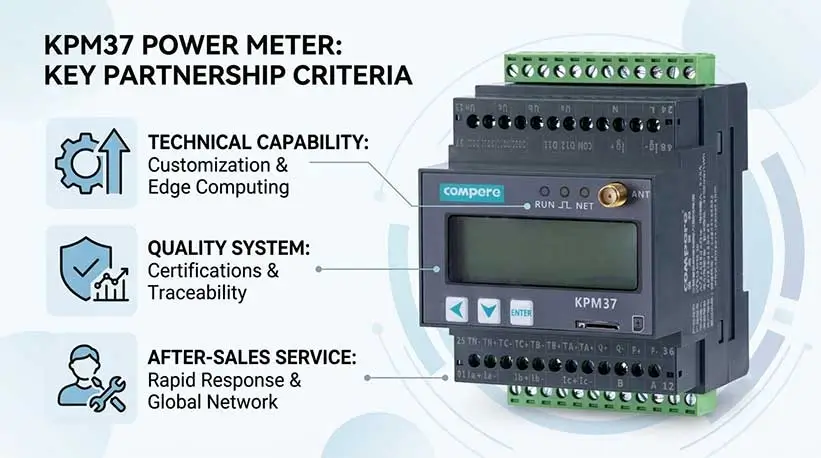
Evaluating a supplier's technical strength involves more than just checking the compliance of their existing product parameters; it also requires assessing their customized development capabilities and forward-looking technological R&D reserves.
1. Hardware Architecture and Measurement Accuracy
Core Component Autonomy: Focus on the brand and quality of core components such as metering chips, microprocessors (MCUs), and sampling resistors used. This directly determines the instrument's long-term stability, anti-interference capability, and temperature drift performance.
Hardcore Capabilities of Accuracy Level: Can it stably achieve active energy measurement accuracy of 0.5S or even 0.2S? Under complex operating conditions with severe harmonic interference, is the instrument's measurement data still reliable?
2. Software Algorithm and Protocol Compatibility
Protocol Breadth and Depth: High-quality suppliers should be proficient in supporting traditional power protocols such as Modbus-RTU, DL/T 645, and IEC 60870-5-104, and possess integration capabilities for Internet of Things (IoT) protocols such as MQTT.
Edge Computing and Harmonic Analysis: Modern power instruments often need to handle some edge-side data processing. Whether a supplier possesses advanced algorithm capabilities such as high-order harmonic analysis (e.g., 2nd to 63rd harmonics), transient event recording, and waveform capture is key to differentiating technological capabilities.
3. Continuous R&D Investment and Customization Capabilities
Industry demands change rapidly (e.g., the rise of new energy grid connection and microgrids). Does the supplier possess an independent R&D team? Faced with customized requirements for non-standard sizes, special communication interfaces, or specific firmware functions, is its time-to-market R&D response time sufficiently efficient?
Power meters are typically deployed in industrial sites or distribution cabinets, in harsh environments, and require extremely high continuous operation. A superficial quality system will often become apparent six months to a year after mass production.
1. Qualification Certifications and Testing Capabilities
Basic Certifications: ISO 9001 quality management system is the entry threshold. Have the products passed the relevant metrology instrument type evaluation (CPA) of the State Grid/Southern Power Grid, or international certifications such as CE, UL, or MID?
Internal Laboratory Capabilities: Excellent suppliers typically possess comprehensive type testing laboratories, capable of independently conducting electromagnetic compatibility (EMC) tests such as Electrical Fast Transient Burst (EFT), Surge, and Electrostatic Discharge (ESD), as well as high and low temperature alternating damp heat tests.
2. Manufacturing and Quality Control (QC)
Supply Chain Traceability: Has the supplier established an ERP or MES system? Can they achieve full-chain traceability from a single chip batch to the final product's serial number?
Key Process Control: Factors such as SMT (Surface Mount Technology) inspection rates, the configuration of fully automated calibration stations, and whether the product undergoes 100% high-temperature aging (Burn-in Test) before leaving the factory—these hidden costs are the true guarantee of product lifespan.
Technology and quality determine how fast a product can go, while after-sales service determines how far the two parties can go. In project cycles lasting several years or even decades, timely and professional service can help the purchasing party resolve most on-site crises.
1. Technical Support Response Speed
A power system failure often has a ripple effect, affecting the entire system. Can the supplier provide a firm commitment of "2-hour telephone response and 24/48-hour on-site arrival"?
Does the supplier have a dedicated team of Application Engineers (FAEs) capable of assisting in resolving complex on-site communication network debugging, grounding interference, and other challenging issues?
2. Lifecycle Management and Firmware Upgrades
With increasing network security requirements or evolving communication protocols, sold instruments may require firmware upgrades. Does the supplier offer convenient over-the-air (OTA) upgrade solutions or a clear end-of-life (EOL) spare parts support strategy?
3. Business and Logistics Coordination and Flexibility
When facing large project deadlines and urgent additional orders, the supplier's capacity flexibility, safety stock management, and logistics allocation capabilities directly impact whether project delays will incur penalties.

Power Monitoring
KPM31 single-phase DIN Rail Prepaid Energy Meter integrates data acquisition and control functions
Learn More
Power Monitoring
The KPM33 Three-phase DIN-rail 4G Prepaid Energy Meter is designed for DIN-rail mounting.
Learn More
Power Monitoring
The KPM37 4G Three-phase OEM Energy Meter features a 35mm DIN rail mounting design and an LCD display.
Learn MoreCompere provides the integrated energy management solution including online monitoring, analyzing, reporting, controlling, maintenance, production management, prediction, and other functions. We offer u technical support and professional solution at 7*24h service.
Unit 1, Building 38, LIANDONG U Valley, No. 352 Lianhua Street, High-tech Zone, Zhengzhou, China
Our helpline is always open to receive any inquiry or feedback.Please feel free to drop us an email from the form below and we will get back to you as soon as we can.
Compere mainly provides kpm series smart energy meters. If you have any needs, please feel free to contact us.