Power Monitoring
KPM31 single-phase DIN Rail Prepaid Energy Meter integrates data acquisition and control functions
Learn More
In the management of traditional multi-tenant buildings (such as commercial office buildings, residential apartments, retail malls, or industrial parks), how to fairly and transparently allocate energy costs such as water, electricity, gas, and HVAC has always been a management challenge. Typically, the entire building has only one main electricity or water meter installed by the utility company. Property management can only simply and crudely allocate bills according to the tenant's building area. This traditional "one-size-fits-all" approach easily leads to rental disputes, while the emergence of sub-metering technology has completely changed this situation.
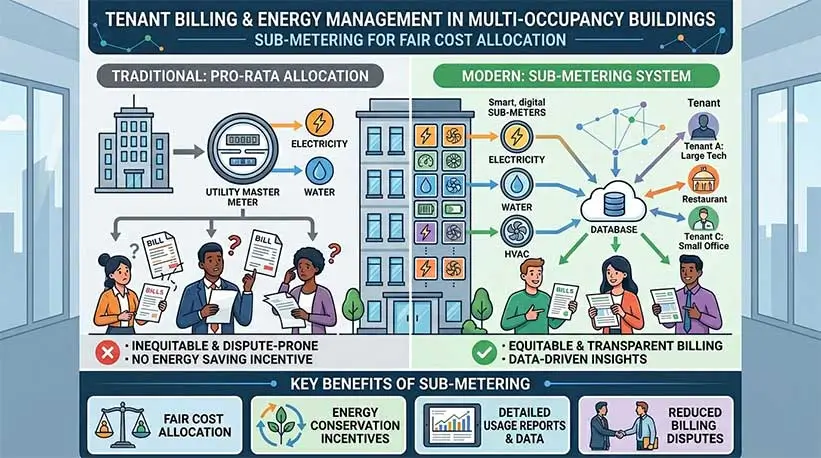
Unfairness: A low-energy creative office that only operates a few computers daily has to share high electricity bills with a neighboring tech company that has a small server room and high-energy-consuming servers, all within the same area.
Suppressing Energy Conservation Incentives: When tenants realize that "no matter how much electricity they save, the bill still depends on the building's total consumption," they lose the initiative to shut down appliances and practice environmental protection.
Operational Loopholes: This method masks energy waste inherent in the building itself (such as hidden increases in shared areas, leaks in the pipe network, etc.), hindering long-term asset appreciation.
Sub-metering refers to installing secondary metering instruments (smart energy meters, smart water meters, heating and cooling meters, etc.) in each tenant's area, on specific floors, and even on high-energy-consuming equipment (such as central air conditioning terminals, independent machine rooms) after the utility company's main meter.
Through this system, management can accurately capture each tenant's actual energy consumption within a specific time period.
1. Pay-for-Use Billing
Sub-metering shifts the billing basis from "how much space you rent" to "how much energy you actually use."
Electricity Bills: Accurate down to the kilowatt-hour (kWh), and can even be coordinated with peak-valley electricity pricing to encourage tenants to run energy-intensive tasks during off-peak hours.
Water Bills: Accurately record the actual water consumption cubic meters for each business (especially large water users such as restaurants and car washes).
HVAC (Heating, Ventilation, and Air Conditioning): Calculate accurately based on tenants' actual cooling/heating consumption or air conditioning usage time using BTU meters or fan coil unit billing systems.
2. Separate Public Area Energy Consumption
With individual metering, the building's total energy consumption can be clearly divided into two parts: individual tenant energy consumption + public area energy consumption.
"Public area energy consumption," such as lobby, elevators, corridors, and exterior lighting, can be reasonably shared according to area ratios after deducting tenants' actual usage. This "actual usage + transparent sharing" model ensures that every penny is traceable.
3. Provide Data Support to Reduce Rental Disputes
Smart individual metering systems typically feature a digital backend that generates detailed bills including daily and hourly energy consumption curves. When tenants question charges, management can present irrefutable data charts to address the issue, significantly reducing legal and commercial disputes arising from opaque billing.
Implementing individual metering not only addresses tenant complaints but also delivers significant business value to asset holders:
Enhanced Asset Attractiveness: Modern businesses (especially multinational corporations or ESG-focused companies) prefer low-carbon buildings that offer independent energy bills and support green supply chain audits.
More Efficient Property Management: Digital meters monitor abnormal flow in real time. For example, if a tenant experiences a surge in water consumption late at night during off-peak hours, the system automatically alerts, helping property management promptly identify leaks in concealed pipes or equipment malfunctions.
Reduce Property Operational Financing Risk: In traditional models, property management must pay large total bills upfront and then collect from tenants. Individual metering systems typically support prepayment or high-frequency settlements, significantly optimizing property cash flow.
Under the dual trends of refined operation and sustainable development in commercial real estate, individual metering has transformed from a "bonus feature" to a "must-have" for multi-tenant buildings. It uses digital technology to rebuild trust between owners and tenants, transforming passive "lump-sum energy consumption" management into a green and low-carbon new trend involving all stakeholders, truly achieving a win-win situation for both economic and social benefits.

Power Monitoring
KPM31 single-phase DIN Rail Prepaid Energy Meter integrates data acquisition and control functions
Learn More
Power Monitoring
The KPM33 Three-phase DIN-rail 4G Prepaid Energy Meter is designed for DIN-rail mounting.
Learn More
Power Monitoring
The KPM37 4G Three-phase OEM Energy Meter features a 35mm DIN rail mounting design and an LCD display.
Learn MoreCompere provides the integrated energy management solution including online monitoring, analyzing, reporting, controlling, maintenance, production management, prediction, and other functions. We offer u technical support and professional solution at 7*24h service.
Unit 1, Building 38, LIANDONG U Valley, No. 352 Lianhua Street, High-tech Zone, Zhengzhou, China
Our helpline is always open to receive any inquiry or feedback.Please feel free to drop us an email from the form below and we will get back to you as soon as we can.
Compere mainly provides kpm series smart energy meters. If you have any needs, please feel free to contact us.