Power Monitoring
KPM31 single-phase DIN Rail Prepaid Energy Meter integrates data acquisition and control functions
Learn More
Cement production is a typical high-energy-consuming process industry, with electricity costs typically accounting for around 30% of total production costs. With increasing global demands for green manufacturing and carbon neutrality, utilizing wireless smart energy meters to build a sophisticated energy monitoring system has become a core means for cement companies to reduce operating costs and enhance competitiveness.
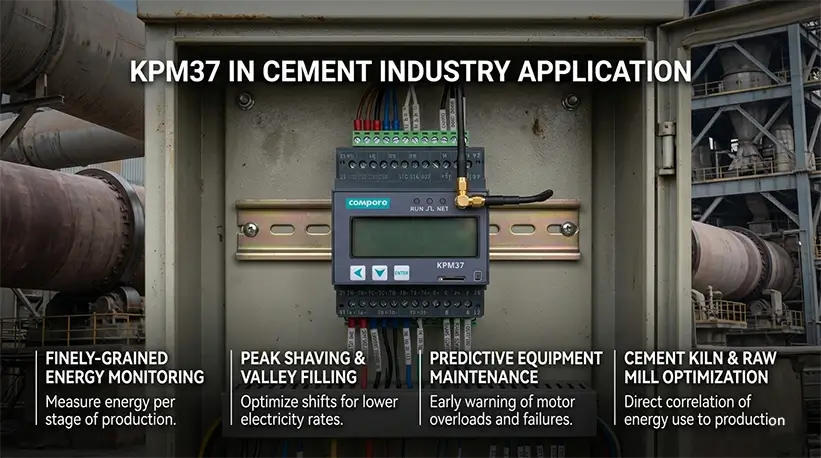
In the complex processes of cement production, smart meters are not simply metering tools, but rather "data tentacles" distributed across various stages:
Raw Material Mill and Cement Mill Systems: Mills are major electricity consumers in the plant. By installing high-precision smart meters on the main motors of ball mills or vertical mills, rotor current, active power, and power quality can be monitored in real time, analyzing the ratio of mill load to hourly output.
Rotary Kiln System: Monitoring the power consumption data of the frequency converters for high-temperature fans and kiln head and tail fans. Smart meters can capture the energy efficiency performance of fans at different operating degrees, providing data support for airflow optimization.
Waste Heat Power Generation System: Smart meters bidirectionally measure the power generation and grid-connected power of waste heat power generation, helping enterprises accurately calculate the economic benefits of "coal saving and emission reduction".
Substations and Distribution Cabinets: Deploying smart grid analyzers in the main distribution room monitors the power factor, harmonic distortion, and three-phase imbalance throughout the plant, preventing motor overheating or burnout due to power quality issues.
Refined Cost Accounting and Energy Efficiency Benchmarking:
Traditional mechanical meters only record total electricity consumption, while smart meters connect data to the EMS (Energy Management System) via RS485 or Ethernet communication. Managers can clearly see "electricity consumption per ton of cement" or "electricity consumption per ton of clinker" and conduct energy efficiency assessments between work teams, incentivizing employees to optimize operating parameters.
Electricity Load Forecasting and Peak Shaving:
Cement plants possess significant peak-shaving potential. Historical electricity trend charts provided by smart meters can help enterprises develop scientific production plans. **Scheduled Maintenance and Low-Load Operation During Peak Electricity Pricing Periods, and Full-Scale Production During Off-Peak Periods:** This staggered production directly reduces electricity costs.
Equipment Early Warning and Maintenance:
By monitoring voltage fluctuations and current anomalies, smart meters can detect potential problems such as motor bearing wear and winding overheating earlier than traditional thermal relays. This shift from "reactive maintenance" to "predictive maintenance" significantly reduces the huge losses caused by unplanned downtime.
Harmonic Mitigation and Power Quality Optimization:
Cement plants extensively use frequency converters and high-power rectifiers, which easily generate harmonic interference. High-end smart meters (such as models with 2nd-63rd harmonic analysis capabilities) can locate interference sources, guiding companies to install reactive power compensation or filtering devices, extending the lifespan of electrical equipment.
The true power of smart meters lies in their networking capabilities. By integrating smart meter data into a smart factory platform, cement companies can achieve the following functions:
Automated Report Generation: Eliminate manual meter reading; generate daily, weekly, and monthly energy consumption reports in real time, and support one-click export of data required for enterprise ESG reports.
Real-time Mobile Monitoring: Engineers can view the current and power curves of key equipment in real time via mobile devices, ensuring that the production line always operates within its optimal efficiency range.
Carbon Footprint Tracking: Automatically convert electricity consumption into carbon emission data, helping companies cope with increasingly stringent carbon emission quota management.
In the cement industry's journey towards "Industry 4.0," smart meters are no longer peripheral power distribution accessories, but rather the cornerstone of digitalization. Through precise collection and analysis of electricity data, cement companies can not only achieve "energy savings," but also realize comprehensive transparency and green transformation of production processes through in-depth data mining.

Power Monitoring
KPM31 single-phase DIN Rail Prepaid Energy Meter integrates data acquisition and control functions
Learn More
Power Monitoring
The KPM33 Three-phase DIN-rail 4G Prepaid Energy Meter is designed for DIN-rail mounting.
Learn More
Power Monitoring
The KPM37 4G Three-phase OEM Energy Meter features a 35mm DIN rail mounting design and an LCD display.
Learn MoreCompere provides the integrated energy management solution including online monitoring, analyzing, reporting, controlling, maintenance, production management, prediction, and other functions. We offer u technical support and professional solution at 7*24h service.
Unit 1, Building 38, LIANDONG U Valley, No. 352 Lianhua Street, High-tech Zone, Zhengzhou, China
Our helpline is always open to receive any inquiry or feedback.Please feel free to drop us an email from the form below and we will get back to you as soon as we can.
Compere mainly provides kpm series smart energy meters. If you have any needs, please feel free to contact us.