Power Monitoring
KPM31 single-phase DIN Rail Prepaid Energy Meter integrates data acquisition and control functions
Learn More
Urban renewal has become a top priority for cities worldwide striving to meet modern sustainability goals and improve living standards. Among the most critical components of urban development is the modernization of older housing stocks. Many legacy neighborhoods still rely on infrastructure designed decades ago, leading to high operational costs, energy waste, and severe management inefficiencies.
Implementing comprehensive old residential area renovation project solutions allows municipalities, property management companies, and EPC contractors to transform outdated residential blocks into modern, energy-efficient smart communities. By integrating advanced IoT communication, robust hardware, and data analytics, these solutions bridge the gap between legacy infrastructure and modern digital community management.
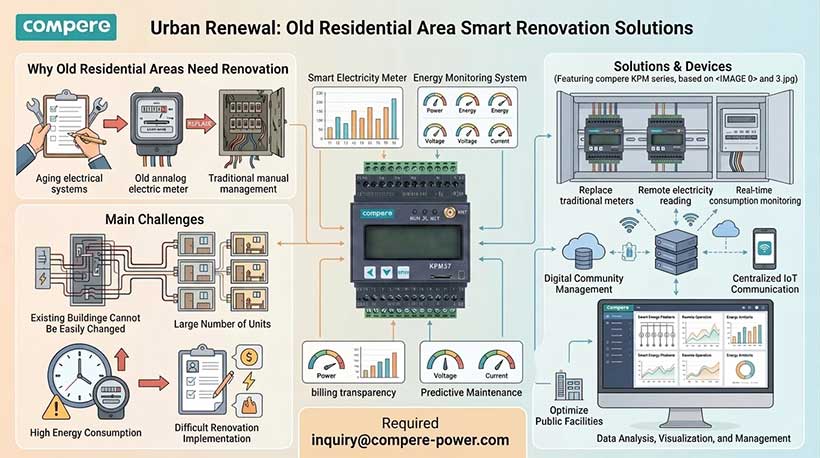
As urban populations grow, legacy residential zones face significant operational strain. Traditional management frameworks are increasingly incapable of meeting current energy efficiency standards and resident expectations.
Deploying a dedicated smart community renovation solution is no longer just an aesthetic upgrade; it is an essential structural necessity for long-term urban resilience.
Executing an old residential area renovation presents distinct structural, financial, and logistical hurdles that differ significantly from new construction projects.
Most legacy neighborhoods utilize outdated mechanical electricity meters that lack remote communication capabilities. These legacy systems offer zero visibility into real-time power consumption, making it nearly impossible to identify systemic faults, line losses, or unauthorized power draw until a major failure occurs. Upgrading to intelligent hardware is the foundational step toward resolving these vulnerabilities.
Without comprehensive data insights, property managers struggle to design effective energy saving solutions for residential buildings. Common areas like stairwells, parking garages, and community centers frequently waste electricity due to rigid, unoptimized operational schedules. This lack of transparency leads to escalating utility costs that strain both property budgets and municipal resources.
Unlike greenfield developments, retrofitting existing structures introduces severe physical constraints. Thick concrete walls, lack of dedicated wiring ducts, and fragmented layouts complicate network paths. Furthermore, contractors must deploy scalable solutions that minimize physical disruption to residents who continue to occupy the buildings during construction.
Manual workflows slow down operational response times. When billing discrepancies arise or power faults occur, resolving the issue requires physical deployment of personnel. Transitioning to a model of digital community management addresses these inefficiencies by consolidating disparate building systems into a centralized data pipeline.
A successful retrofitting project relies on a cohesive ecosystem combining robust hardware with intuitive software. The complete solution integrates four essential technology layers:
Replacing traditional mechanical meters with a smart energy meter for apartments and public spaces is crucial. These digital devices provide accurate, bi-directional utility measurements. They are installed across individual residential apartments, public facility rooms, and shared community buildings to support automated remote electricity reading, real-time consumption monitoring, time-of-use pricing configurations, and instant tamper detection.
An enterprise-grade residential power monitoring system acts as the analytical core of the estate. It continuously ingests data from localized endpoints to track overall power quality. The software aggregates load profiles, flags phase imbalances, isolates high-consumption anomalies, and provides actionable data to support long-term energy-saving initiatives.
To overcome the structural barriers of older buildings, specialized IoT communication hardware is deployed. Utilizing reliable long-range wireless protocols and advanced cellular gateways, this layer ensures seamless data transmission from individual meters to the central server without requiring extensive, disruptive new network cabling through concrete walls.
The software layer integrates hardware data into a unified dashboard, giving operators full control over their portfolio. It features interactive energy data visualization, remote power control for instant grid isolation, automated digital billing generation, and predictive maintenance alerts.
Implementing an integrated residential energy management system transforms daily operations across the community infrastructure, optimizing both workflow and financial outcomes.
Smart renovation solutions can be adapted to various operational scenarios within a renewal project:
| Smart Device / Solution | Renovation Benefits |
|---|---|
| Smart Electricity Meter | Replaces manual data collection with automated remote reading; ensures accurate billing transparency across individual apartments and shared public assets. |
| IoT Energy Management Solution | Aggregates localized consumption data to uncover operational waste; tracks baseline power trends to support corporate and municipal sustainability compliance. |
| IoT Communication Equipment | Bridges the gap in older architectural structures by enabling long-range wireless data transfer, reducing upfront cabling and retrofitting labor expenses. |
| Smart Management Platform | Consolidates asset status, billing records, and automated anomaly alerts into a centralized digital interface for multi-site property portfolios. |
Investing in a comprehensive infrastructure upgrade yields measurable advantages for all project stakeholders:
Selecting an experienced B2B technology partner is critical to navigating the complexities of retrofitting legacy environments.
As an established leader in industrial energy management and intelligent metering hardware, we offer field-proven old residential area renovation project solutions tailored for global markets.
Our capability spans the entire product lifecycle—from manufacturing high-precision smart meters to deploying secure wireless IoT gateways and building robust, cloud-based software systems. We focus on delivering integrated hardware and software ecosystems that install cleanly into older structures without requiring expensive structural re-engineering. By balancing robust industrial engineering with flexible custom features, we help municipal contractors, utilities, and property groups maximize energy efficiency while keeping project payback periods short.
A: The primary challenges include dealing with outdated electrical infrastructure, overcoming physical space and cabling constraints within older structures, controlling overall retrofitting costs, and deploying systems without disrupting daily life for current residents.
A: A complete upgrade requires intelligent hardware and software layers, including smart electricity meters for individual and shared loads, IoT communication equipment, localized energy monitoring devices, and a centralized digital management platform.
A: Smart meters eliminate the need for manual property walk-throughs by supporting remote data reading. They provide transparent utility data, enable immediate tampering alerts, and allow property managers to implement automated billing workflows.
A: Yes. By providing real-time visibility into energy use, these solutions expose hidden power leaks, optimize the runtime of communal infrastructure like elevators and lighting, and lower manual maintenance overhead through early fault alerts.
Retrofitting legacy infrastructure requires careful engineering alignment to match local grid standards and physical site realities. If you are developing an urban renewal project, managing an aging residential property portfolio, or preparing a municipal tender, our technical specialists are available to support your team.
Please reach out to us at [email protected] to discuss your project requirements. We offer complimentary professional consultations, detailed hardware specifications, and tailored on-site energy management solutions engineered to maximize operational efficiency and accelerate your return on investment.

Power Monitoring
KPM31 single-phase DIN Rail Prepaid Energy Meter integrates data acquisition and control functions
Learn More
Power Monitoring
The KPM33 Three-phase DIN-rail 4G Prepaid Energy Meter is designed for DIN-rail mounting.
Learn More
Power Monitoring
The KPM37 4G Three-phase OEM Energy Meter features a 35mm DIN rail mounting design and an LCD display.
Learn MoreCompere provides the integrated energy management solution including online monitoring, analyzing, reporting, controlling, maintenance, production management, prediction, and other functions. We offer u technical support and professional solution at 7*24h service.
Unit 1, Building 38, LIANDONG U Valley, No. 352 Lianhua Street, High-tech Zone, Zhengzhou, China
Our helpline is always open to receive any inquiry or feedback.Please feel free to drop us an email from the form below and we will get back to you as soon as we can.
Compere mainly provides kpm series smart energy meters. If you have any needs, please feel free to contact us.