Power Monitoring
KPM31 single-phase DIN Rail Prepaid Energy Meter integrates data acquisition and control functions
Learn More
In today’s industrial and commercial landscapes, energy efficiency is a core operational requirement. For engineering professionals, automation experts, and electrical contractors, delivering a robust energy management project involves aligning multiple complex variables. Managing varying client specifications, fragmented hardware procurement, and rigid software frameworks can quickly stall project delivery.
To scale operations and secure higher-margin projects, engineering teams need more than a hardware vendor. They require a dedicated energy management solution provider for system integrators—a technical partner capable of bridging the gap between field hardware, cloud connectivity, and actionable data insights.
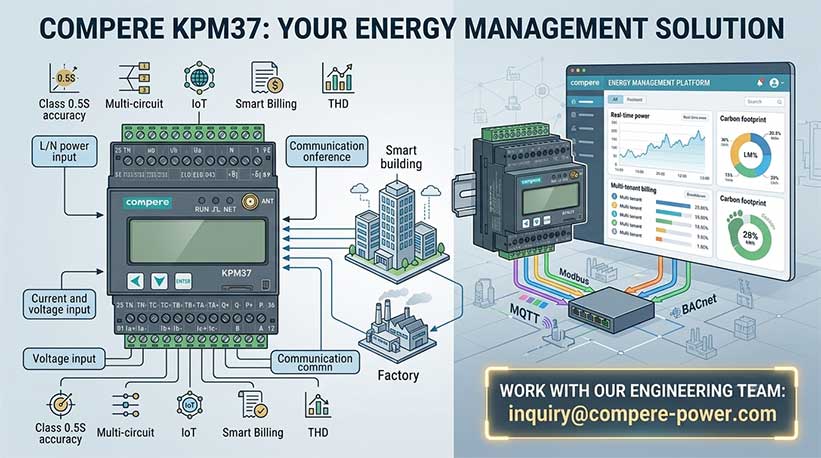
An energy management system integrator operates in a highly demanding ecosystem. End-users across commercial, industrial, and municipal sectors demand granular visibility into their energy consumption. To fulfill these demands, an integrator must connect complex architectures comprising smart meters, localized communication gateways, edge devices, and cloud software.
Attempting to source these components from fragmented, unverified vendors introduces significant deployment risks, potential data silos, and extended commissioning times.
A specialized smart energy solution provider eliminates these bottlenecks. By delivering fully validated, interoperable hardware and software ecosystems, they empower system integrators to focus on their core strength: delivering tailored client value. The right partner reduces engineering overhead, ensures zero data loss during transmission, and offers a unified roadmap from sub-metering hardware setup to final platform commissioning.
Successfully deploying an industrial energy monitoring solution or a building energy management solution requires balancing technical precision with tight project timelines. Integrators regularly navigate several systemic roadblocks that can jeopardize project profitability and client satisfaction.
Hardware incompatibility is a leading cause of project delays. System integrators frequently encounter field environments with legacy infrastructure that demands varied communication interfaces and protocols, such as Modbus-RTU, Modbus-TCP, or BACnet.
If a supplier’s power monitoring solution lacks flexibility, the integrator must invest extra engineering hours into protocol conversion, introducing hardware failure points and communication latency. Integrators require hardware that offers native interoperability and multiple communication options straight out of the box.
The true test of a supplier occurs during onsite deployment. When unexpected configuration anomalies, firmware conflicts, or packet drops occur during commissioning, standard customer service is insufficient.
Without deep, responsive technical assistance from the manufacturer, a system integrator can face extended downtime, cost overruns, and strained client relationships. B2B projects demand direct access to experienced field application engineers who understand network topologies and complex electrical installations.
No two energy management projects are identical. A commercial high-rise requires multi-tenant billing sub-metering; a heavy industrial plant requires high-frequency power quality analysis; and a microgrid integration demands bidirectional solar monitoring.
A rigid, one-size-fits-all hardware catalog forces integrators to compromise. To win competitive bids, integrators need a flexible smart meter OEM supplier capable of modifying form factors, firmware, and branding to fit exact project scopes.
B2B procurement operates on tight margins and strict penalty clauses for delivery delays. Integrators are vulnerable to global supply chain disruptions, fluctuating component pricing, and extended lead times. A reliable partner must provide stable pricing structures, consistent stock availability, and short, predictable lead times to protect the integrator's bottom line.
To mitigate technical and commercial risks, procurement and engineering teams should evaluate potential partners using four main performance benchmarks:
A reliable energy monitoring solution provider must offer a comprehensive product catalog that covers the entire data pipeline. This includes high-accuracy electrical smart meters, multi-circuit sub-meters, IoT gateways, and a centralized energy management platform provider framework. Sourcing the entire stack from a single vendor guarantees native compatibility and simplifies long-term maintenance.
Hardware must integrate seamlessly into wider automation, Building Management Systems (BMS), or third-party cloud environments. Look for suppliers prioritizing open data architectures, offering clean documentation, and supporting standard communication protocols like Modbus and MQTT. This ensures hassle-free data ingestion across all platforms.
True B2B capability is defined by flexible manufacturing. A strategic supplier offers robust OEM services, allowing system integrators to secure customized firmware configurations, custom enclosures, or fully white-labeled software interfaces that enhance their market presence.
Evaluate the vendor’s engineering infrastructure. Top-tier providers offer end-to-end technical support, from initial hardware selection based on single-line diagrams to remote troubleshooting assistance during system deployment.
An effective deployment combines high-accuracy instrumentation with resilient communication networks and intuitive software logic.
In office towers, shopping centers, and hotels, integrators implement solutions to manage HVAC, lighting, and common area loads. The system enables precise sub-metering, automates cost allocation across tenants, and integrates with Building Automation Systems to lower energy costs.
Manufacturing environments feature heavy, dynamic electrical loads. An industrial energy monitoring solution tracks machine-specific energy use, monitors power quality to protect sensitive equipment, and correlates energy consumption with production output to optimize operational efficiency.
For modern apartment complexes and smart communities, integrators deploy centralized metering arrays. These setups give property managers centralized access to consumption data, support prepaid billing models, and offer residents real-time visibility into their energy habits.
As microgrids and commercial solar installations expand, integrators need to monitor bidirectional energy flows. Energy solutions provide precise data on solar PV generation, battery storage status, and grid interaction, maximizing investment returns.
| Supplier Capability | Value for System Integrators |
|---|---|
| Product Customization | Tailors firmware configurations and physical designs to match specific client RFPs. |
| Technical Support | Minimizes engineering downtime with direct access to field application specialists. |
| Stable Supply Chain | Protects project schedules from inventory shortages and unexpected lead times. |
| Multiple Product Options | Simplifies procurement by offering an all-in-one source for diverse project needs. |
| Engineering Cooperation | Accelerates deployment timelines through pre-validated hardware and software matching. |
Partnering with an experienced, industrial-focused manufacturer delivers distinct strategic advantages to system integrators:
As an established manufacturer of high-precision smart energy meters and IoT hardware, we design solutions explicitly tailored for the integration market. We blend deep manufacturing expertise with flexible IoT innovations, ensuring our products integrate smoothly into any engineering environment.
We specialize in supporting system integrators through reliable smart meter OEM supplier models, technical agility, and uncompromised component quality. Whether you need specialized firmware configurations for an industrial monitoring project or a white-labeled dashboard for commercial buildings, our engineering team ensures your project is delivered on schedule, within scope, and fully optimized.
Integrators should look for protocol compatibility (such as Modbus, MQTT), hardware reliability certifications, single-source portfolio breadth (meters to software), and the vendor's willingness to provide direct technical support during commissioning.
Yes. A capable B2B supplier offers robust OEM capabilities, which include modifying hardware enclosures, adjusting firmware parameters for specific utility protocols, and providing white-labeled platform alternatives to meet unique project specifications.
Standard deployments utilize multi-circuit smart energy meters, power quality analyzers, smart IoT gateways for protocol conversion and data transmission, along with an intuitive energy management platform for reporting and data visualization.
Suppliers support integration teams by providing detailed technical drawings, offering remote engineering support during network commissioning, and delivering pre-configured hardware kits that simplify field installation.
Are you planning or bidding on an upcoming energy management installation? Navigating unique site requirements, communication barriers, or tight delivery schedules can be challenging without factory-direct backing. Partner with an expert engineering team to secure your project's success.
Contact us today to request detailed product documentation, explore our comprehensive OEM customization capabilities, or receive a tailored, site-specific hardware and software solution. Our application engineers provide dedicated, one-on-one consultation throughout your system integration layout. Reach out directly to [email protected] to get your free technical assessment and project quote started.

Power Monitoring
KPM31 single-phase DIN Rail Prepaid Energy Meter integrates data acquisition and control functions
Learn More
Power Monitoring
The KPM33 Three-phase DIN-rail 4G Prepaid Energy Meter is designed for DIN-rail mounting.
Learn More
Power Monitoring
The KPM37 4G Three-phase OEM Energy Meter features a 35mm DIN rail mounting design and an LCD display.
Learn MoreCompere provides the integrated energy management solution including online monitoring, analyzing, reporting, controlling, maintenance, production management, prediction, and other functions. We offer u technical support and professional solution at 7*24h service.
Unit 1, Building 38, LIANDONG U Valley, No. 352 Lianhua Street, High-tech Zone, Zhengzhou, China
Our helpline is always open to receive any inquiry or feedback.Please feel free to drop us an email from the form below and we will get back to you as soon as we can.
Compere mainly provides kpm series smart energy meters. If you have any needs, please feel free to contact us.