Power Monitoring
KPM31 single-phase DIN Rail Prepaid Energy Meter integrates data acquisition and control functions
Learn More
With the increasing popularity of smart homes and fluctuating electricity prices, more and more savvy families are using home WiFi energy meters to manage energy consumption and save on electricity bills. However, faced with a dazzling array of products on the market, many people are confused: Which home WiFi meter is best? Don't worry, this guide will act as your personal consultant, guiding you step-by-step from key points to brand analysis to help you choose the one that best suits your needs.
The first step in purchasing is to understand your primary purpose. There are two main categories:
【Socket-type WiFi Energy Meters】 - For a single appliance
Form: Like a smart socket with a screen, it plugs directly into a wall socket, and the appliance is then plugged into it.
Advantages: Extremely simple installation, plug and play; can accurately monitor the power consumption of a single appliance (such as an air conditioner, refrigerator, or water heater); usually supports remote on/off and timer functions.
Disadvantages: Can only monitor one appliance; whole-house monitoring requires purchasing multiple meters.
Suitable for: Users who want to identify specific high-energy-consuming appliances or remotely control their appliances.
【Rail-Mounted WiFi Energy Meter】 - For the Whole House Circuit
Form: Requires installation inside the home distribution box, fixed on a DIN rail, and connected after the main switch.
Advantages: Monitors total home power consumption, generating a complete home energy consumption report; extremely high power handling capacity.
Disadvantages: Installation requires some electrical knowledge; requires available space in the distribution box; cannot distinguish individual appliances (unless paired with multiple current transformers).
Suitable for: Users who want a comprehensive understanding of their home's total power consumption, have some DIY skills, or are willing to hire an electrician for installation.
Summary: If you want to troubleshoot a specific appliance, choose a socket-type meter; if you want to view the total home power consumption, choose a DIN rail-type meter.
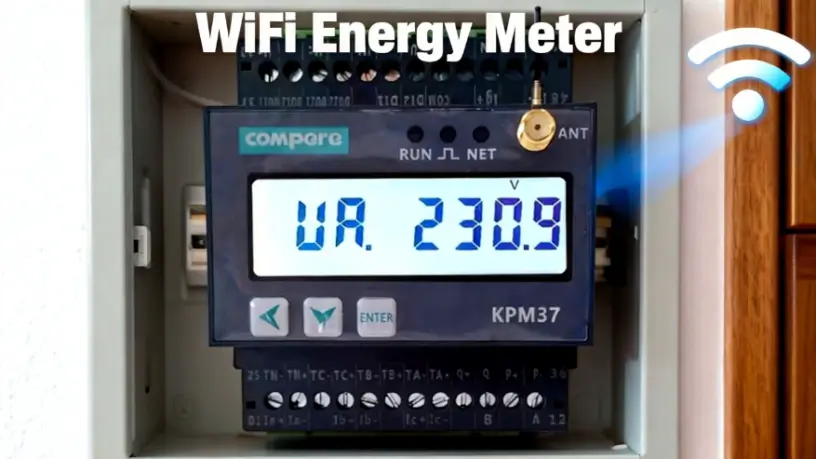
After determining the type, comparing the following 5 core elements will help you quickly select a high-quality product.
Accuracy: Check if the product description specifies the accuracy class (e.g., 1.0), as this relates to data reliability.
Monitoring Data: A good WiFi electricity meter should not only display real-time power consumption but also record cumulative power consumption, voltage, and current, and estimate carbon dioxide emissions and electricity costs (user-defined electricity prices are required).
WiFi Connection: Ensure support for 2.4GHz WiFi (currently used by the vast majority of smart devices).
Mobile App: Is the app's UI design intuitive? Are the data charts clear and easy to understand? Are the functions comprehensive (e.g., power consumption ranking, historical data comparison, electricity cost settings)? This is crucial for long-term use.
Socket Type: Pay attention to size to avoid blocking adjacent sockets.
DIN Rail Type: Confirm whether your distribution box has available space and whether the installation conditions are suitable.
Always check the product's rated maximum load power. For example, the maximum power of a typical socket-type WiFi power meter is usually between 3600W and 4000W, which is sufficient for high-power appliances such as air conditioners and water heaters. However, never overload it to avoid safety hazards.
Remote control/timed switch: Standard feature of socket-type meters, enabling automated scenarios such as power off when leaving home and timed water heating.
Energy consumption reminder: Set a power consumption threshold, and receive automatic reminders when exceeding the limit.
Data export: Suitable for users who like in-depth data analysis.
Back to the initial question: Which home WiFi power meter is best? The answer depends on your core needs.
“I want to see how much electricity my air conditioner uses overnight” → Choose a socket-type WiFi electricity meter with high accuracy and a user-friendly app.
“I want to fully understand my household electricity habits and see where my total electricity bill is going” → Consider a DIN rail-mounted WiFi energy meter.
"I not only want to monitor my electricity usage, but I also want to remotely control my appliances" → A plug-in WiFi energy meter with remote control capabilities is the perfect choice.
Hopefully, this comprehensive guide will help you navigate the complexities and make the wisest decision. Investing in a suitable WiFi energy meter is not just about buying hardware; it's the first step towards a smart, energy-efficient, and savvy lifestyle.

Power Monitoring
KPM31 single-phase DIN Rail Prepaid Energy Meter integrates data acquisition and control functions
Learn More
Power Monitoring
The KPM33 Three-phase DIN-rail 4G Prepaid Energy Meter is designed for DIN-rail mounting.
Learn More
Power Monitoring
The KPM37 4G Three-phase OEM Energy Meter features a 35mm DIN rail mounting design and an LCD display.
Learn MoreCompere provides the integrated energy management solution including online monitoring, analyzing, reporting, controlling, maintenance, production management, prediction, and other functions. We offer u technical support and professional solution at 7*24h service.
Unit 1, Building 38, LIANDONG U Valley, No. 352 Lianhua Street, High-tech Zone, Zhengzhou, China
Our helpline is always open to receive any inquiry or feedback.Please feel free to drop us an email from the form below and we will get back to you as soon as we can.
Compere mainly provides kpm series smart energy meters. If you have any needs, please feel free to contact us.