Power Monitoring
KPM31 single-phase DIN Rail Prepaid Energy Meter integrates data acquisition and control functions
Learn More
With the deepening of industrial digitalization, energy management is shifting from "passive statistics" to "real-time sensing + intelligent decision-making." Especially in the Industrial Internet of Things (IIoT) architecture, the way data is acquired directly determines the system's efficiency and scalability. Against this backdrop, wireless smart meters are rapidly replacing traditional wired solutions, becoming the core entry point for the next generation of energy management systems.
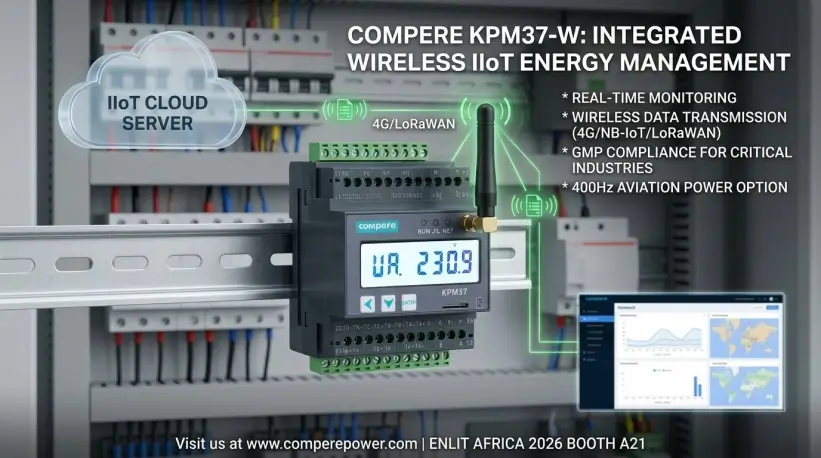
In the early stages of many projects, companies often focus on the unit price of equipment, neglecting the total cost of ownership (TCO). In reality, traditional RS485 cabling solutions hide a significant amount of "hidden expenses" in complex scenarios.
First, there are construction costs. Laying communication lines in existing factories or commercial buildings often involves cable tray installation, cabling construction, and manual debugging, with the overall cost potentially far exceeding the cost of the equipment itself.
Second, there is the risk of production downtime. The cabling process usually requires power outages or partial shutdowns. For continuously operating production systems, each downtime means direct economic losses.
More importantly, there is the difficulty of operation and maintenance. Wired communication is susceptible to electromagnetic interference. Once the lines age or have poor contact, troubleshooting becomes extremely time-consuming and costly, severely impacting system stability.
The maturity of wireless communication technology has freed energy data collection from dependence on physical wiring. Represented by Compere's wireless smart meters, truly flexible deployment is achieved through the combined application of various communication methods.
For geographically dispersed applications such as charging piles, communication base stations, and street lighting systems, wireless public network communication is the preferred solution.
These meters do not rely on a local network environment; the device connects to the cloud platform upon power-up, greatly simplifying the system architecture. Simultaneously, data can be directly uploaded, reducing intermediate steps and improving overall response speed and deployment efficiency.
In large factories or environments with dense metal structures, signal coverage is a key challenge. LoRaWAN, with its long-distance transmission and strong penetration capabilities, can achieve stable communication over a wide area.
A small number of gateways can cover the entire campus, making it ideal for large-scale meter deployments, especially for centralized management of DIN rail meters.
In distribution cabinets or densely populated equipment areas, a completely wireless approach may not be optimal. In such cases, a hybrid solution of "RS485 + gateway" can be adopted.
Locally, stable short-range communication is achieved via wired connections, and data is then uploaded centrally through the gateway. This model reduces communication costs while ensuring flexible system scalability.
Modern smart meters are no longer just electricity recording tools, but key data nodes in energy management systems.
Through high-frequency sampling and data analysis, they can achieve power quality monitoring, identify harmonic (THD) issues to prevent equipment damage, perform three-phase balance analysis to reduce line overload and safety risks, and detect abnormal power consumption and high-energy-consuming equipment.
This data is not only used for monitoring but also provides a basis for energy-saving optimization and production decisions, shifting energy management from "post-event analysis" to "real-time intervention."
The widespread adoption of wireless smart meters is not merely a technological replacement, but rather an upgrade to industrial energy management models. From "seeing electricity consumption" to "understanding energy consumption," enterprises are entering an era of more refined and intelligent energy management.

Power Monitoring
KPM31 single-phase DIN Rail Prepaid Energy Meter integrates data acquisition and control functions
Learn More
Power Monitoring
The KPM33 Three-phase DIN-rail 4G Prepaid Energy Meter is designed for DIN-rail mounting.
Learn More
Power Monitoring
The KPM37 4G Three-phase OEM Energy Meter features a 35mm DIN rail mounting design and an LCD display.
Learn MoreCompere provides the integrated energy management solution including online monitoring, analyzing, reporting, controlling, maintenance, production management, prediction, and other functions. We offer u technical support and professional solution at 7*24h service.
Unit 1, Building 38, LIANDONG U Valley, No. 352 Lianhua Street, High-tech Zone, Zhengzhou, China
Our helpline is always open to receive any inquiry or feedback.Please feel free to drop us an email from the form below and we will get back to you as soon as we can.
Compere mainly provides kpm series smart energy meters. If you have any needs, please feel free to contact us.