Power Monitoring
KPM31 single-phase DIN Rail Prepaid Energy Meter integrates data acquisition and control functions
Learn More
The widespread adoption of smart energy meters has brought accurate billing and electricity management, but users have raised privacy concerns regarding the frequency and content of data collection. This article will explain the purpose of smart meter data collection, what data is collected, and detail how power supply companies use technical and legal means to ensure user privacy and data security.
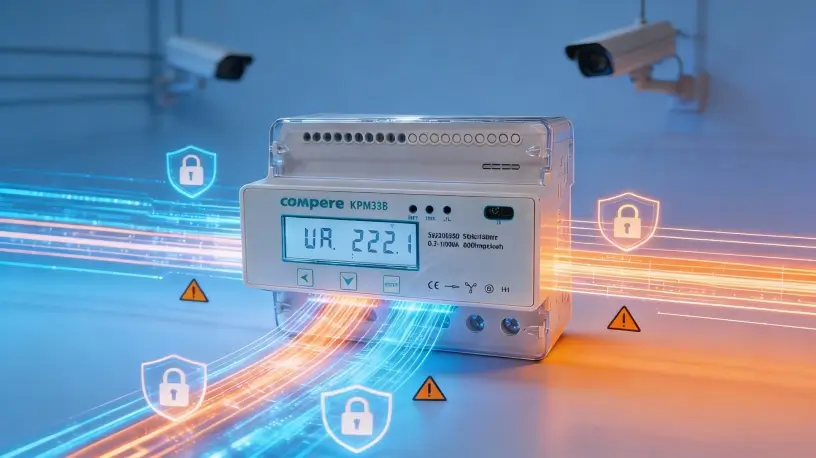
The core tasks of a smart meter are accurate metering and remote management. The data it collects is highly specialized and purposeful.
The data collected by smart meters mainly includes:
Metering Data: The most crucial data, including total active power, time-of-use power, and maximum demand. This is the direct basis for electricity bill calculation.
Time Data: Records the time points when electricity consumption occurs, used for implementing time-of-use pricing (peak-valley-flat).
Status Data: Records the meter's operating parameters such as voltage, current, and power factor, as well as the switching status of the meter's internal relays (used for remote control).
Event Data: Records abnormal events occurring on the electricity meter, such as voltage loss, current loss, meter opening, and remote tripping (for fault diagnosis and anti-theft purposes).
This data is not used for monitoring personal lives, but rather to serve the operation of the power grid and user services:
Billing and Settlement: Accurately calculates user electricity bills, especially time-of-use pricing and tiered pricing.
Power Grid Load Analysis: Helps the power grid company understand load distribution at different times, enabling scientific scheduling and forecasting, and ensuring the safe and stable operation of the power grid.
Fault Diagnosis: By monitoring meter status parameters, quickly locates fault points (such as abnormal voltage), improving repair efficiency.
Energy Optimization Suggestions: Provides users with accurate energy consumption reports, guiding them to adjust their electricity consumption habits to achieve energy conservation.
User concerns are reasonable. Although the collected data is professional data, high-frequency electricity consumption curves can theoretically be used to infer certain user habits:
Daily Routine: By analyzing peak and off-peak electricity consumption, it's possible to roughly infer a user's arrival time, sleep patterns, etc.
Appliance Usage Habits: Specific electricity consumption curves may indicate when a user turned on their air conditioner, water heater, or charged their electric vehicle.
However, it's important to clarify that smart meters collect electricity load data, not direct personal identification information or content information (such as voice or video). Data anonymization and encryption are crucial for protecting privacy.
Professional power supply service organizations and national agencies have implemented multiple measures to build a robust security system to prevent data leakage or misuse.
When conducting power grid analysis and big data applications, detailed user data is typically anonymized:
Anonymization: User electricity consumption data is stored separately from personal information such as name and address, or its association is weakened.
Aggregated Analysis: When used for macro-load analysis, data is aggregated by region or group, rather than analyzed on a per-user basis.
The data transmission process of smart meters follows the State Grid's security standards, ensuring data security during transmission and storage:
Transmission Encryption: Data is encrypted throughout its transmission from the meter to the acquisition terminal and then to the main station system, preventing eavesdropping or tampering during transmission.
Physical and Network Isolation: Power supply companies typically employ strict physical and network security isolation measures. Core metering and user data systems are not directly connected to the public internet to protect against external network attacks.
Compliance Requirements: Power supply companies must strictly comply with laws and regulations. Without authorization, they may not disclose, leak, or provide user electricity consumption data to others.
Internal Management: Access to user data by internal personnel is strictly limited. All operations are traceable and auditable, ensuring that only authorized personnel can view necessary data for work purposes.
View Privacy Scientifically, Use Electricity with Peace of Mind
The initial purpose of smart meter data collection is to optimize power grid operation and improve service quality, not to monitor personal lives.
Through technical encryption, anonymization, and strict legal and regulatory constraints, the security of user electricity data is fully guaranteed. Power supply companies have legal responsibility and industry standard constraints regarding the protection of user privacy.

Power Monitoring
KPM31 single-phase DIN Rail Prepaid Energy Meter integrates data acquisition and control functions
Learn More
Power Monitoring
The KPM33 Three-phase DIN-rail 4G Prepaid Energy Meter is designed for DIN-rail mounting.
Learn More
Power Monitoring
The KPM37 4G Three-phase OEM Energy Meter features a 35mm DIN rail mounting design and an LCD display.
Learn MoreCompere provides the integrated energy management solution including online monitoring, analyzing, reporting, controlling, maintenance, production management, prediction, and other functions. We offer u technical support and professional solution at 7*24h service.
Unit 1, Building 38, LIANDONG U Valley, No. 352 Lianhua Street, High-tech Zone, Zhengzhou, China
Our helpline is always open to receive any inquiry or feedback.Please feel free to drop us an email from the form below and we will get back to you as soon as we can.
Compere mainly provides kpm series smart energy meters. If you have any needs, please feel free to contact us.