Power Monitoring
KPM31 single-phase DIN Rail Prepaid Energy Meter integrates data acquisition and control functions
Learn More
In today's industrial manufacturing sector, cost reduction and efficiency improvement, along with green and low-carbon practices, are no longer optional but essential for business survival. However, for managers of large industrial parks, breaking down information silos and achieving efficient centralized energy management solutions among more than 50 factories with diverse production operations has become a significant challenge.
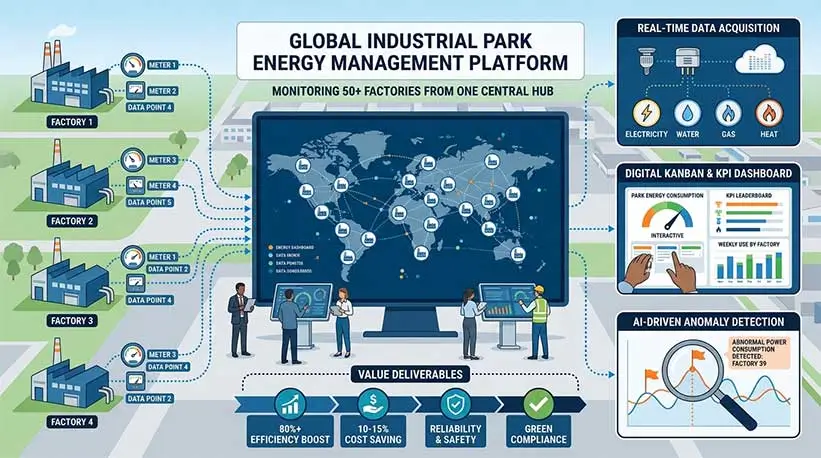
Managing an industrial park with more than 50 factories typically faces three major pain points:
Severe Data Silos: Factories have different construction dates, equipment models, and use different communication protocols (such as Modbus and MQTT), making cross-factory data exchange difficult.
High Operation and Maintenance Costs: Traditional methods like manual meter reading and individual factory reporting are not only inefficient but also prone to errors and lack real-time responsiveness.
Lack of a Holistic Perspective: Park managers cannot assess the overall energy consumption distribution across the park from a macro perspective, making it difficult to identify potential energy-saving opportunities and providing data support for the park's carbon peaking and carbon neutrality goals.
To overcome the above challenges, the core lies in building a centralized industrial park energy management platform (EMS). Through the Internet of Things (IoT) and big data technologies, energy consumption data from over 50 factories are "pulled" onto a single large screen.
1. Comprehensive Data Acquisition and Compatibility
The first step of the unified platform is "inclusive data collection." By deploying smart meters (electricity, water, gas, and heat meters) at key nodes in each factory, and utilizing edge computing gateways to standardize and convert heterogeneous data, real-time data acquisition across all energy media (electricity, water, gas, heat, etc.) is achieved within seconds.
2. Centralized Digital Dashboard (Dashboard Management)
The platform provides customized digital dashboards for the park management committee and factory managers:
Macro-level view of the park: Real-time display of total energy consumption, total carbon emissions, energy efficiency KPIs, and energy consumption rankings of each factory.
Micro-level view of the factories: Vertical drilling down to individual factories, or even specific production lines and key equipment (such as air compressors, boilers, and chillers), to view their detailed energy consumption curves.
3. AI-Driven Anomaly Warning and Energy Efficiency Optimization
Data collection is merely a means; energy consumption optimization is the ultimate goal. The platform's built-in AI algorithms can:
Automatically identify abnormal energy consumption: For example, if a factory experiences a sudden surge in power consumption during non-production hours, the system will immediately trigger an alarm.
Load forecasting and capacity demand management: Predicting the park's electricity load for the next phase helps businesses rationally declare their maximum demand, reducing basic electricity costs.
Multi-energy complementarity and collaboration: If the park is equipped with rooftop photovoltaics, energy storage systems, or microgrids, the platform can optimize the "source-grid-load-storage" scheduling strategy based on real-time electricity prices.
Managing over 50 factories through a single platform can bring tangible benefits to the park and businesses:
| Benefit Dimension | Key Performance & Value Deliverables |
|---|---|
| Operational Efficiency | Eliminate traditional manual data logging. Generate comprehensive, park-wide energy reports with a single click, boosting management efficiency by over 80%. |
| Direct Cost Reduction | Identify leakages, optimize peak/off-peak power consumption, and fine-tune equipment operations to slash overall park energy costs by 10% - 15%. |
| Power Reliability & Safety | Continuously monitor power distribution metrics (voltage, current, power factor) and trigger early warnings before equipment failures to avoid costly, unscheduled production downtime. |
| Green Compliance | Automatically track and calculate carbon footprint metrics, providing authoritative, audit-ready data evidence to fulfill green supply chain requirements and strict national decarbonization policies. |
Managing over 50 factories may seem like a complex system engineering project, but by using the right "unified platform," it can be simplified. Digitalization is the cornerstone of low-carbonization, and low-carbonization is the future of digitalization. By building a unified energy management platform for industrial parks, park managers can not only keep a firm grasp on the destination of every kilowatt-hour of electricity and every ton of water, but also lead enterprises in the park to the forefront of the green transformation and achieve sustainable high-quality development.

Power Monitoring
KPM31 single-phase DIN Rail Prepaid Energy Meter integrates data acquisition and control functions
Learn More
Power Monitoring
The KPM33 Three-phase DIN-rail 4G Prepaid Energy Meter is designed for DIN-rail mounting.
Learn More
Power Monitoring
The KPM37 4G Three-phase OEM Energy Meter features a 35mm DIN rail mounting design and an LCD display.
Learn MoreCompere provides the integrated energy management solution including online monitoring, analyzing, reporting, controlling, maintenance, production management, prediction, and other functions. We offer u technical support and professional solution at 7*24h service.
Unit 1, Building 38, LIANDONG U Valley, No. 352 Lianhua Street, High-tech Zone, Zhengzhou, China
Our helpline is always open to receive any inquiry or feedback.Please feel free to drop us an email from the form below and we will get back to you as soon as we can.
Compere mainly provides kpm series smart energy meters. If you have any needs, please feel free to contact us.