Power Monitoring
KPM31 single-phase DIN Rail Prepaid Energy Meter integrates data acquisition and control functions
Learn More
In the industrial electricity sector, accurate electricity metering is fundamental for cost reduction, efficiency improvement, and safe operation. Faced with single-phase and three-phase industrial energy meters, how can enterprises make the most reasonable choice based on their actual needs?
This article will provide you with an easy-to-understand selection guide from core dimensions such as power supply system, load power, and application scenarios.
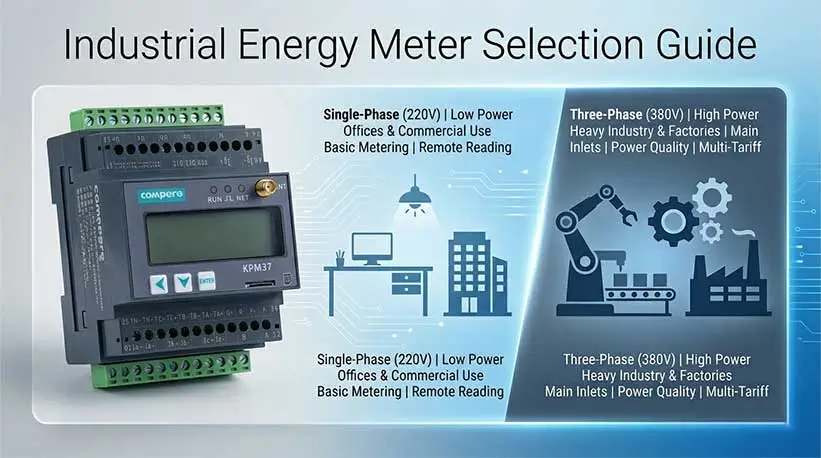
Before diving into the selection process, let's clarify the fundamental differences between the two in terms of power transmission:
Single-Phase Electricity: Consists of one live wire and one neutral wire, with a voltage typically of 220V. It's like a single-lane road, suitable for transmitting small to medium power.
Three-Phase Electricity: Consists of three live wires and one neutral wire (or without a neutral wire), with a line voltage typically of 380V. It's like a three-lane road, transmitting higher power and providing a more stable power supply.
The choice between single-phase and three-phase industrial electricity meters depends primarily on the following three decisive factors:
1. Consider the factory's incoming power supply type (the most direct basis)
The meter selection must match the on-site power distribution system:
If the distribution box provides a 220V single-phase line, a single-phase meter must be selected.
If the incoming line is a 380V three-phase line (whether it's a three-phase three-wire or three-phase four-wire system), a three-phase meter must be selected.
2. Consider the power and type of the electrical equipment
Single-phase meters: Suitable for single-phase loads, typically with power ratings within a few kilowatts (kW). Examples include: office lighting in industrial parks, dormitory electricity, small single-phase water pumps, or miniature machine tools.
Three-phase meters: Suitable for high-power equipment, especially those requiring the driving of three-phase AC motors. Because three-phase electricity provides a stable rotating magnetic field, industrial main switches, large production lines, central air conditioning systems, and high-power welding machines must use three-phase meters.
3. Assess the Depth of Management and Monitoring Needs
Industrial electricity consumption is often more than just "billing"; it's about "energy management":
Single-phase industrial meters: Relatively simple function, mainly measuring active energy; some smart models support remote meter reading.
Three-phase industrial meters: Extremely powerful function. Besides measuring active/reactive energy, they can monitor grid quality parameters such as voltage imbalance, harmonics, and power factor, which is crucial for protecting large, precision industrial equipment.
To facilitate quick decision-making, we have summarized the core differences between the two as follows:
Scenario A: Employee dormitories or independent offices in an industrial park
Characteristics: Electrical equipment mainly consists of air conditioners, computers, and lighting, all using 220V single-phase power.
Selection Recommendation: Choose a single-phase smart meter with DIN rail mounting and communication capabilities (such as RS485 or wireless DIN rail meters). This system meets metering requirements while facilitating centralized remote meter reading and management by property management or factory back-end systems.
Scenario B: Small to medium-sized processing plant workshops
Features: Multiple 380V CNC machine tools, stamping machines, and air compressors.
Selection Recommendation: Choose a three-phase four-wire smart meter. If the total current in the workshop exceeds 100A, a current transformer (CT) is required for measurement.
Scenario C: Large manufacturing enterprises requiring "dual energy consumption control" or refined management
Features: Not only is electricity consumption monitored, but the energy efficiency ratio of each production line must also be assessed to prevent penalties from the power grid due to low power factor.
Selection Recommendation: Choose a high-precision (e.g., 0.5S level) multi-functional three-phase power meter. These meters support multiple tariff periods (peak-valley-flat pricing calculations) and can monitor harmonics and reactive power compensation, making them core hardware for enterprise digital energy management systems (EMS).
In industrial meter selection, remember "larger is better than smaller, and long-term functionality is key":
Current margin: For direct-connection meters, the total current of the equipment should be kept below 80% of the meter's maximum rated current to avoid prolonged full-load heating.
Never substitute single for three: Never use three single-phase meters to simply replace one three-phase meter for measuring three-phase power. This not only violates electrical regulations but also leads to inaccurate metering because it cannot calculate three-phase imbalance and reactive power.
By clearly defining your incoming line voltage, total equipment power, and whether you need to connect to a system (such as software meter reading), you can easily select the most suitable industrial meter for your factory.

Power Monitoring
KPM31 single-phase DIN Rail Prepaid Energy Meter integrates data acquisition and control functions
Learn More
Power Monitoring
The KPM33 Three-phase DIN-rail 4G Prepaid Energy Meter is designed for DIN-rail mounting.
Learn More
Power Monitoring
The KPM37 4G Three-phase OEM Energy Meter features a 35mm DIN rail mounting design and an LCD display.
Learn MoreCompere provides the integrated energy management solution including online monitoring, analyzing, reporting, controlling, maintenance, production management, prediction, and other functions. We offer u technical support and professional solution at 7*24h service.
Unit 1, Building 38, LIANDONG U Valley, No. 352 Lianhua Street, High-tech Zone, Zhengzhou, China
Our helpline is always open to receive any inquiry or feedback.Please feel free to drop us an email from the form below and we will get back to you as soon as we can.
Compere mainly provides kpm series smart energy meters. If you have any needs, please feel free to contact us.