Power Monitoring
KPM31 single-phase DIN Rail Prepaid Energy Meter integrates data acquisition and control functions
Learn More
In modern manufacturing environments, optimizing utility consumption is no longer just an environmental initiative—it is a critical imperative for financial survival. Fluctuating power tariffs, strict corporate carbon mandates, and thin operational margins require plant managers, system integrators, and project procurement teams to maintain absolute visibility over every watt of power consumed. Relying on monthly utility bills or legacy manual data logs creates severe blind spots, leaving organizations exposed to unpredicted peak-demand penalties and structural energy waste.
To establish control over factory operational overhead, implementing a structured industrial energy monitoring solution is an essential engineering step. This comprehensive guide reviews the structural challenges faced by heavy industrial operations, breaks down the foundational architecture of automated power diagnostics, and provides a clear strategic checklist for evaluating enterprise-grade deployment vendors.
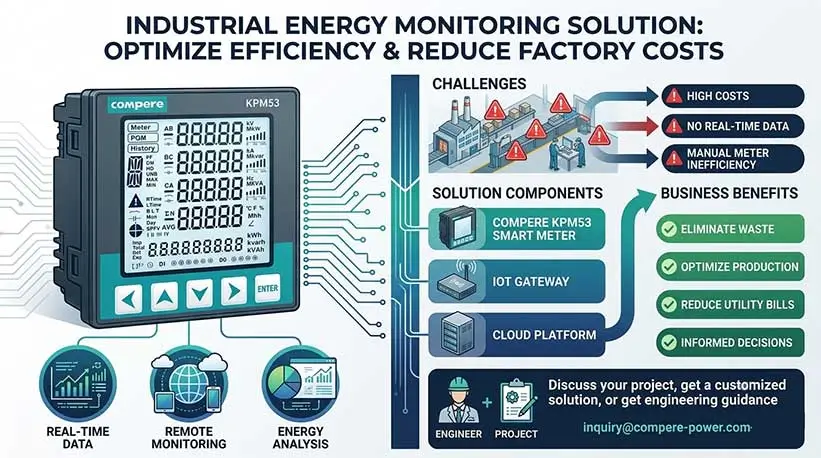
Industrial plants operate complex multi-tiered electrical distributions that support thousands of interconnected components. Without modern diagnostics, engineering and procurement teams routinely encounter several systemic bottlenecks that directly impact the corporate bottom line:
Industrial facilities encounter escalating utility pricing alongside intensive production power demands, making systematic cost control highly difficult to achieve. Peak demand surcharges and low power factor fees can significantly inflate a monthly invoice, yet without granular circuit-level tracking, facilities lack the capability to target these systemic overcharges.
Many plants run operations with limited visibility, unable to determine precisely which heavy machinery consumes more energy, where structural energy waste happens, or how load distribution shifts across different production schedules. This lack of historical baselines means that cost-saving initiatives are driven by arbitrary estimates rather than accurate field statistics.
Large-scale operations typically span multiple workshops, independent manufacturing cells, and isolated auxiliary units. When energy consumption data is aggregated into a single corporate facility invoice, it is impossible to calculate precise per-unit production costs or accurately attribute operational expenses to specific product lines.
Relying on plant technicians to physically log meter registers introduces operational risks. Manual inspections require continuous labor, yield slow data accumulation, and are highly prone to human input errors. Furthermore, static spreadsheets cannot provide the actionable insights required to identify temporary phase imbalances or momentary voltage drops before they lead to hardware downtime.
Summary: Standard reactive workflows leave facilities vulnerable to hidden operational inefficiencies. Resolving these challenges requires transitioning to an automated, centralized, and data-driven infrastructure.
A resilient industrial energy management system resolves visibility gaps by seamlessly integrating reliable field hardware with real-time analytics. The system operates through three primary structural layers:
The foundation of the architecture depends on sub-metering hardware. Integrating an industrial-grade smart electricity meter for industry at key sub-distribution panels enables detailed electrical tracking and real-time data collection. These meters continuously measure essential physical parameters without interrupting active production runs.
Utilizing industrial Internet-of-Things (IoT) transmission units, the system securely collects data remotely to monitor multiple locations from a central control room. This removes isolated operational siloes, enabling facility managers to monitor separate manufacturing plants or distributed regional warehouses within a singular, coherent infrastructure.
Raw electrical data is automatically pushed into centralized management software. The platform processes these datasets to help managers analyze consumption trends, compile accurate regulatory compliance documentation, and pinpoint specific load anomalies, revealing clear, data-backed energy-saving opportunities.
Deploying an integrated smart energy monitoring solution delivers immediate operational visibility and financial tracking across a variety of demanding industrial sectors:
Manufacturing enterprises utilize centralized monitoring to accurately evaluate plant-wide power patterns, schedule energy-intensive processes during lower off-peak tariff hours, and significantly reduce unnecessary standby energy usage during weekend closures.
Engineering teams cross-reference machine-specific power consumption with live operational output. This data-driven approach isolates sub-optimal machine configurations, identifies mechanical friction or wear before equipment failure occurs, and determines precise per-unit manufacturing costs.
Large-scale distribution facilities, commercial industrial parks, and plant offices use the network to optimize HVAC scheduling, balance multi-phase power distribution, and automate localized tenant utility sub-billing with complete financial clarity.
System integrators and energy service companies (ESCOs) use these comprehensive hardware-software packages as the core framework for large-scale energy-saving projects, verifying performance baselines and proving return on investment (ROI) for digital factory upgrades.
An enterprise-grade industrial power monitoring solution is engineered to balance strict metrological accuracy with flexible industrial integration requirements.
The field meters feature dedicated microprocessing units that calculate true RMS measurements for a wide range of essential parameters, including:
The solution supports persistent online monitoring and centralized asset management. Authorized project engineers can log into secure web-based dashboards to evaluate operational parameters, track facility status, and generate custom historical trends from any device.
To ensure seamless installation alongside existing factory infrastructure, field devices are equipped with adaptable communication interfaces:
The system actively protects plant operations through instant abnormal consumption detection. When parameters exceed pre-configured operating limits—such as an over-current spike or a critical voltage drop—the system fires automated notifications. Simultaneously, the core software builds historical analysis profiles and detailed energy reports for administrative analysis.
Transitioning to an automated remote energy monitoring system shifts a factory from a reactive position to a strategic, data-supported operational workflow. The table below outlines the core commercial and physical benefits delivered by this system:
| Solution Value | Business Impact |
|---|---|
| Real-Time Energy Data | Empowers management to make data-backed operational decisions, adjust load profiles, and eliminate peak demand penalties. |
| Remote Monitoring | Eliminates manual meter-reading labor requirements, reducing overhead and completely removing human input errors. |
| Energy Analysis | Pinpoints specific machinery anomalies, optimizes equipment maintenance, and justifies the capital investment of infrastructure upgrades. |
| Smart Meter Integration | Provides precise high-accuracy metrology, facilitating fair and transparent cost allocation across separate production divisions. |
Selecting a hardware and software partner is a long-term operational decision. To protect your investment and ensure system reliability, procurement teams should evaluate an energy management solution provider using four core technical criteria:
The vendor must possess an established track record in heavy industrial deployments. Field devices must be built to withstand severe electromagnetic interference (EMI), voltage transients, and challenging temperature conditions typical of factory floor environments.
Evaluate the depth of the vendor's product lines. High-quality manufacturers offer versatile installation options, such as compact DIN-rail form factors for space-constrained electrical cabinets, along with internal non-volatile memory to safeguard data during network interruptions.
Every industrial site presents unique structural and network demands. Your selected vendor must have the engineering capability to adapt firmware parameters, adjust communication configurations, or refine software data structures to align with your facility's specific layout.
Post-installation support is crucial for long-term project success. Ensure the manufacturer offers clear engineering documentation, straightforward wiring topologies, and direct remote engineering support to keep your project deployment strictly on schedule.
As a specialized manufacturer focused on industrial sub-metering and power engineering, we provide a unified hardware-to-software portfolio designed for demanding industrial environments. Rather than supplying disconnected components, we deliver fully integrated architectures tailored to the realities of factory floor operations. Our solutions combine long-term hardware reliability with adaptable communication protocols, ensuring your facility gains the precise insights needed to eliminate waste, maintain regulatory compliance, and control energy costs through every production cycle.
An industrial energy monitoring solution is an integrated network of smart electricity meters, communication gateways, and data management software. It works collectively to measure, transmit, and analyze comprehensive power consumption metrics across an enterprise's operational assets.
The system provides granular, real-time tracking that helps facility managers identify passive energy waste, shift heavy loads away from peak pricing windows, improve poor power factors, and detect inefficient, failing machinery prior to major breakdowns.
A standard deployment comprises high-precision smart energy meters installed at sub-distribution boards, current transformers (CTs) for non-disruptive current tracking, communication gateways (such as Modbus-RTU, 4G, or LoRaWAN), and a central software interface to log and interpret the incoming data streams.
Yes. Networked cloud-based energy management systems are designed to compile data from geographically distributed production sites, regional workshops, or independent buildings into a single dashboard, allowing management to easily benchmark energy performance across the entire organization.
Eliminate hidden energy waste and secure absolute transparency over your plant's power costs. Whether you are designing a new manufacturing facility, retrofitting an active production line, or developing a system integration project, our dedicated application engineers are here to support your team. We provide tailored hardware configurations, comprehensive firmware mapping, and direct engineering guidance to ensure your deployment succeeds.
Contact our engineering team today to receive a customized technical proposal and solution consultation:
Email: [email protected]

Power Monitoring
KPM31 single-phase DIN Rail Prepaid Energy Meter integrates data acquisition and control functions
Learn More
Power Monitoring
The KPM33 Three-phase DIN-rail 4G Prepaid Energy Meter is designed for DIN-rail mounting.
Learn More
Power Monitoring
The KPM37 4G Three-phase OEM Energy Meter features a 35mm DIN rail mounting design and an LCD display.
Learn MoreCompere provides the integrated energy management solution including online monitoring, analyzing, reporting, controlling, maintenance, production management, prediction, and other functions. We offer u technical support and professional solution at 7*24h service.
Unit 1, Building 38, LIANDONG U Valley, No. 352 Lianhua Street, High-tech Zone, Zhengzhou, China
Our helpline is always open to receive any inquiry or feedback.Please feel free to drop us an email from the form below and we will get back to you as soon as we can.
Compere mainly provides kpm series smart energy meters. If you have any needs, please feel free to contact us.