Power Monitoring
KPM31 single-phase DIN Rail Prepaid Energy Meter integrates data acquisition and control functions
Learn More
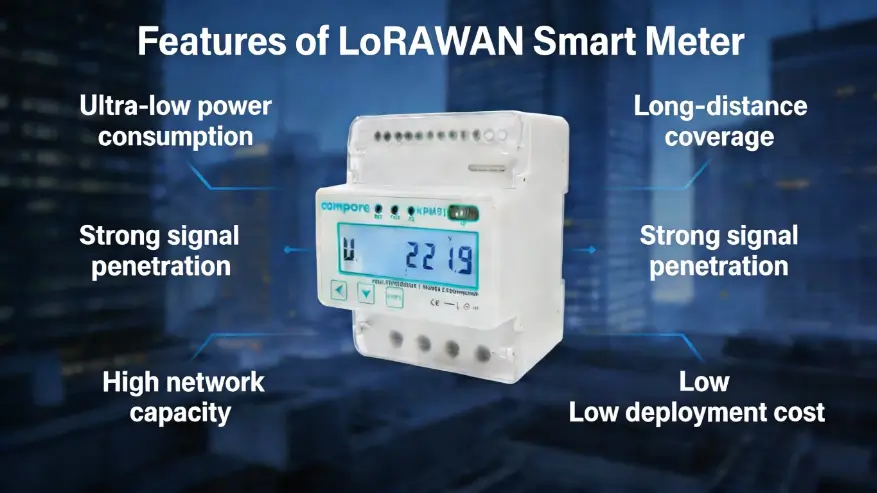
With the rapid development of IoT technology, LoRaWAN technology is increasingly being used in the field of smart meters. LoRaWAN, with its low power consumption, long distance transmission, strong penetration, and large capacity connectivity, provides an ideal communication solution for smart meters. The following details the main application scenarios and advantages of LoRaWAN smart energy meters.
Automated Data Acquisition: LoRaWAN smart energy meters can automatically and periodically upload electricity consumption data, completely replacing manual meter reading and reducing labor costs and errors.
Real-time Load Monitoring: Grid operators can monitor regional electricity load in real time and adjust power supply strategies promptly to avoid overload or power waste.
Line Loss Analysis: Through high-frequency data collection, abnormal loss points in the power grid can be accurately located, improving transmission efficiency.
Rapid Fault Response: Abnormal meter data (such as voltage drops or power outages) can trigger real-time alarms, shortening fault repair time.
Multi-loop Monitoring: Independent metering of different power consumption units such as production lines, air conditioning, and lighting in factories, shopping malls, etc., to identify high-energy-consuming links.
Peak-valley Electricity Pricing Strategy: Automatically adjusting production plans or equipment operating times based on real-time electricity price data to reduce electricity costs.
Monitoring parameters such as voltage fluctuations and harmonics to help maintain the stable operation of sensitive equipment (such as precision instruments and servers).
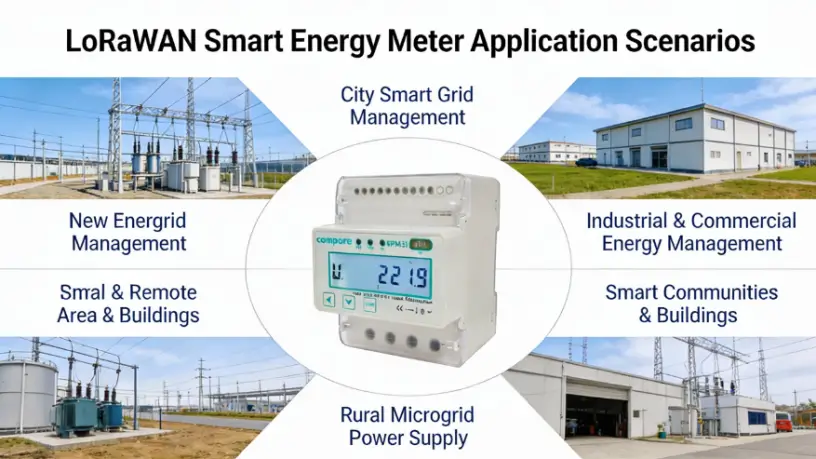
Prepaid Model: Supports remote recharge and electricity usage reminders to reduce disputes over unpaid bills.
Abnormal Electricity Consumption Alarm: Real-time detection of abnormal electricity consumption patterns (such as leakage and electricity theft) to enhance community security.
Monitoring of public electrical equipment such as corridor lighting, elevators, and water pumps to achieve on-demand power supply and reduce property energy consumption.
LoRaWAN base stations can cover areas ranging from several kilometers to tens of kilometers, suitable for sparsely populated areas, reducing investment in communication infrastructure.
Solar Power Compatibility: Low-power meters can be paired with solar cells to solve the problem of electricity monitoring in areas without stable power sources.
Enables remote collection of electricity consumption data in remote areas, assisting in power grid planning and power resource allocation.
Real-time monitoring of the output of distributed generation units such as photovoltaic and wind power, optimizing power dispatch within the microgrid.
Energy Storage System Collaboration: Controlling the charging and discharging of energy storage devices based on electricity consumption curves to improve the utilization rate of renewable energy.
Monitoring charging pile electricity consumption data and coordinating charging times to avoid peak grid pressure.
Future Development Trends
With the advancement of digital twin cities and dual-carbon goals, LoRaWAN smart energy meters will be further integrated with technologies such as AI analytics and blockchain (for energy trading) to achieve:
Predictive Maintenance: Predicting equipment failures through big data.
Demand-side response: Users participate in grid peak shaving to reap energy savings.
Cross-domain data fusion: Combining water and gas meter data to build a comprehensive energy management platform.
The application of LoRaWAN smart energy meters in urban, industrial, rural, and new energy scenarios not only improves electricity efficiency and security but also lays a solid foundation for building a sustainable smart grid. For power companies, enterprises, and users, deploying LoRaWAN smart energy meters is a crucial step towards refined energy management and a low-carbon future.

Power Monitoring
KPM31 single-phase DIN Rail Prepaid Energy Meter integrates data acquisition and control functions
Learn More
Power Monitoring
The KPM33 Three-phase DIN-rail 4G Prepaid Energy Meter is designed for DIN-rail mounting.
Learn More
Power Monitoring
The KPM37 4G Three-phase OEM Energy Meter features a 35mm DIN rail mounting design and an LCD display.
Learn MoreCompere provides the integrated energy management solution including online monitoring, analyzing, reporting, controlling, maintenance, production management, prediction, and other functions. We offer u technical support and professional solution at 7*24h service.
Unit 1, Building 38, LIANDONG U Valley, No. 352 Lianhua Street, High-tech Zone, Zhengzhou, China
Our helpline is always open to receive any inquiry or feedback.Please feel free to drop us an email from the form below and we will get back to you as soon as we can.
Compere mainly provides kpm series smart energy meters. If you have any needs, please feel free to contact us.