Power Monitoring
KPM31 single-phase DIN Rail Prepaid Energy Meter integrates data acquisition and control functions
Learn More
In modern smart grids, distribution transformers are core assets for delivering electricity to end users. However, with the rapid growth of electric vehicle (EV) charging, heat pumps, and distributed energy sources such as rooftop solar power, transformers are facing unprecedented load pressure.
Prolonged overload can cause a sharp rise in the internal temperature of the transformer, accelerating the aging of insulation materials and even triggering catastrophic failures. Fortunately, modern smart energy meters are no longer just billing tools; they are becoming the first line of defense against thermal damage to transformers.
The lifespan of a transformer largely depends on the lifespan of its internal insulation paper. The rate of insulation material degradation is closely related to temperature, which can be described by the Arrhenius Equation.
According to the industry-recognized "6-Degree Rule," for every 6°C increase in the temperature of the transformer winding's hotspot, the aging rate of the insulation material doubles.
Without real-time monitoring, power companies often only discover problems after a transformer has already started smoking or lost power. By then, the cost of replacing the asset is irreversible.
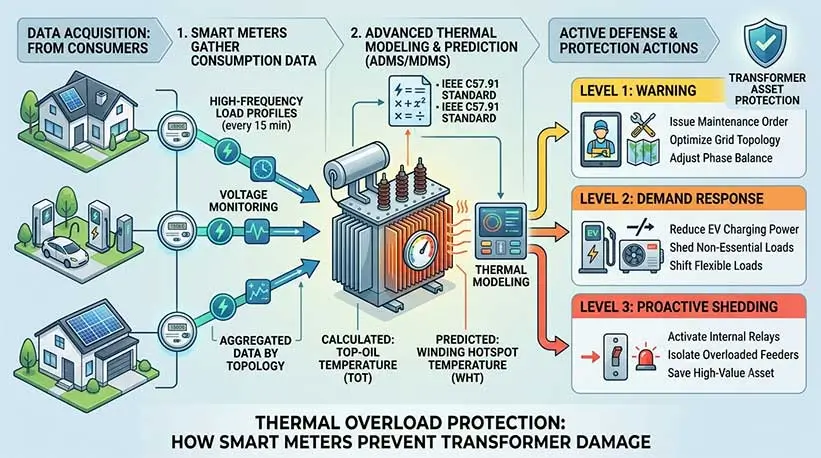
Smart meters themselves do not directly measure transformer oil temperature, but they are deployed at each user's point of sale. By collecting current, voltage, and power factor data at high frequencies, smart meters provide core data support for high-precision thermal mathematical models of upstream transformers.
Core Data Support:
High-Frequency Load Profiles: Smart meters can report power data every 5 to 15 minutes. By topologically aggregating the data from all meters connected to the same transformer, the total load curve of the transformer can be reconstructed in real time.
Voltage Fluctuation Monitoring: Severe overloads are often accompanied by sudden voltage drops. By analyzing the magnitude of the voltage drop at the end of the line, the system can infer the severity of the transformer overload.
After acquiring meter data, the power company's management system (such as MDMS or ADMS) combines ambient temperature with transformer thermodynamic equations defined by standards such as IEEE C57.91 for calculation.
The system estimates the following two key indicators in real time:
Top-Oil Temperature
Winding Hotspot Temperature
Through these virtual indicators, smart meters essentially transform the entire distribution network into a vast, predictable thermal monitoring network.
Once aggregated data from smart meters indicates that a transformer is heading towards "thermal runaway," the system automatically triggers the following tiered protection mechanisms:
| Protection Level | Trigger Conditions | Smart Meter & System Actions |
|---|---|---|
| 1. Warning Stage | Load approaches critical threshold; winding hotspot temperature is predicted to exceed limits within hours. | System issues a maintenance order to operations teams to optimize grid topology or adjust phase balance. |
| 2. Demand Response | Transformer is actively overloaded; temperatures continue to surge rapidly. | System sends signals via smart meters to specific users (e.g., EVs charging, ESS) to automatically reduce charging power or defer flexible loads. |
| 3. Proactive Shedding | Temperature reaches extreme limits; catastrophic damage will occur within minutes if unaddressed. | Smart meters utilize their internal relays to disconnect non-essential loads, immediately protecting the high-value transformer asset. |
Utilizing smart meters for thermal overload protection brings significant economic and operational benefits to power companies and society as a whole:
Extending Asset Life: Preventing transformers from "prematurely dying" due to periodic severe overloads, maximizing asset lifespan. Reduce Operational Expenditure (OPEX): Minimize emergency nighttime repairs and power outage claims due to transformer burnout.
Support Energy Transition: Allow the grid to connect more electric vehicles and photovoltaic devices without blindly expanding transformer capacity, enabling smarter load management.
In the era of emerging renewable energy sources, transformers are facing unprecedented thermal stress. Smart meters, acting as distributed intelligent sensors, transform massive amounts of electricity data into precise insights into the health status of transformers. Thermal overload protection is no longer a simple fuse blowing, but an elegant, seamless asset protection battle based on data flow.

Power Monitoring
KPM31 single-phase DIN Rail Prepaid Energy Meter integrates data acquisition and control functions
Learn More
Power Monitoring
The KPM33 Three-phase DIN-rail 4G Prepaid Energy Meter is designed for DIN-rail mounting.
Learn More
Power Monitoring
The KPM37 4G Three-phase OEM Energy Meter features a 35mm DIN rail mounting design and an LCD display.
Learn MoreCompere provides the integrated energy management solution including online monitoring, analyzing, reporting, controlling, maintenance, production management, prediction, and other functions. We offer u technical support and professional solution at 7*24h service.
Unit 1, Building 38, LIANDONG U Valley, No. 352 Lianhua Street, High-tech Zone, Zhengzhou, China
Our helpline is always open to receive any inquiry or feedback.Please feel free to drop us an email from the form below and we will get back to you as soon as we can.
Compere mainly provides kpm series smart energy meters. If you have any needs, please feel free to contact us.