Power Monitoring
KPM31 single-phase DIN Rail Prepaid Energy Meter integrates data acquisition and control functions
Learn More
As a typical energy-intensive industry, the steel industry often sees energy costs accounting for 20% to 30% of total production costs. Driven by digital transformation and carbon neutrality goals, wireless smart energy meters have evolved into core sensing terminals for steel companies to achieve refined energy efficiency management.
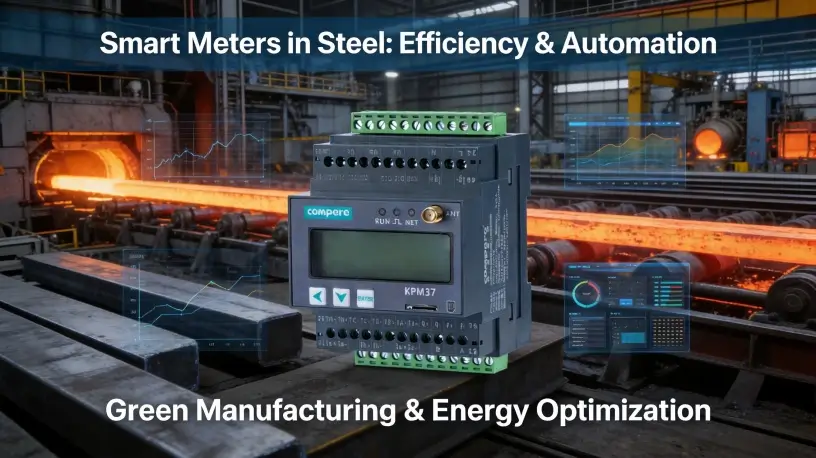
The steel production process is extremely complex, encompassing multiple energy-intensive stages such as coking, sintering, ironmaking, steelmaking, and rolling. Smart meters, through deep deployment across these processes, achieve transparency in energy flow:
Total Plant-wide Monitoring: High-precision instruments are deployed at the incoming line cabinets and main transformer terminals to monitor total load and power factor in real time, providing a basis for electricity settlement.
Process Energy Consumption Breakdown: Metering units are deployed down to core equipment such as electric furnaces and rolling mills. Specialized meters with harmonic analysis capabilities can accurately capture power quality fluctuations during the operation of large nonlinear loads.
Cost Center Benchmarking: Automatically collects power consumption data from each shift and production line, calculating key indicators such as "power consumption per ton of steel," directly serving the optimization and evaluation of production plans.
During the smelting process, EAFs generate a large number of harmonics and voltage flicker due to the instability of the electric arc.
In this scenario, smart meters not only measure the harmonics but, more importantly, monitor the 2nd to 63rd harmonics in real time. This helps engineers accurately identify harmonic pollution sources, guide the efficient operation of filtering and compensation devices, and reduce equipment damage caused by power quality issues.
Steel rolling production lines rely on a large number of high-power motors operating for extended periods.
Through continuous monitoring of current imbalance rate, power factor, and starting current waveform by smart meters, companies can provide early warnings of motor overload or winding aging risks. This "predictive maintenance" mode effectively avoids millions of dollars in production losses due to unexpected downtime.
As major electricity consumers, steel mills utilize peak-valley electricity price differences as the most direct means of cost reduction.
Management personnel can adjust the power of discontinuous auxiliary systems (such as pumping stations and circulating water) during peak hours by using energy efficiency dashboards with real-time feedback from smart meters, maximizing the use of off-peak electricity and achieving significant cost optimization.
The true power of smart meters lies in their robust data integration capabilities.
At the communication level, meters generally support the Modbus-RTU protocol, enabling seamless data integration into the plant's existing EMS energy management system. Furthermore, this real-time data can be uploaded to a cloud platform. Management personnel can view the intranet energy efficiency dashboard built on a responsive layout via mobile phone or computer, monitoring the plant's operational dynamics anytime, anywhere.
Smart meters not only provide steel companies with accurate energy bills, but more importantly, they build a data foundation. Through modeling and analyzing long-term production data, companies can uncover previously undetected energy vulnerabilities.
Key Benefits Recap:
Energy Transparency: Identifying high-energy-efficiency bottlenecks and optimizing process parameters.
Quality Assurance: Real-time monitoring of power quality to protect expensive electrical control systems.
Green Transformation: Providing accurate and reliable underlying data support for carbon footprint tracking and carbon trading.
In the smart factories of the future, smart meters will be deeply integrated with AI algorithms, helping the steel industry achieve a green and low-carbon digital transformation while ensuring high output.

Power Monitoring
KPM31 single-phase DIN Rail Prepaid Energy Meter integrates data acquisition and control functions
Learn More
Power Monitoring
The KPM33 Three-phase DIN-rail 4G Prepaid Energy Meter is designed for DIN-rail mounting.
Learn More
Power Monitoring
The KPM37 4G Three-phase OEM Energy Meter features a 35mm DIN rail mounting design and an LCD display.
Learn MoreCompere provides the integrated energy management solution including online monitoring, analyzing, reporting, controlling, maintenance, production management, prediction, and other functions. We offer u technical support and professional solution at 7*24h service.
Unit 1, Building 38, LIANDONG U Valley, No. 352 Lianhua Street, High-tech Zone, Zhengzhou, China
Our helpline is always open to receive any inquiry or feedback.Please feel free to drop us an email from the form below and we will get back to you as soon as we can.
Compere mainly provides kpm series smart energy meters. If you have any needs, please feel free to contact us.