Power Monitoring
KPM31 single-phase DIN Rail Prepaid Energy Meter integrates data acquisition and control functions
Learn More
In today's pursuit of automation and green production, electricity meters are no longer the "little boxes" silently billing in the corner of distribution boxes. For industrial enterprises, they are the nerve endings of the energy management system and a core tool for cost reduction and efficiency improvement. Faced with a dazzling array of models on the market, how can industrial users sift through the fog and choose the one that best suits their needs?
This guide will set aside complex circuit diagrams and guide you from a practical perspective to grasp the core logic of selection.
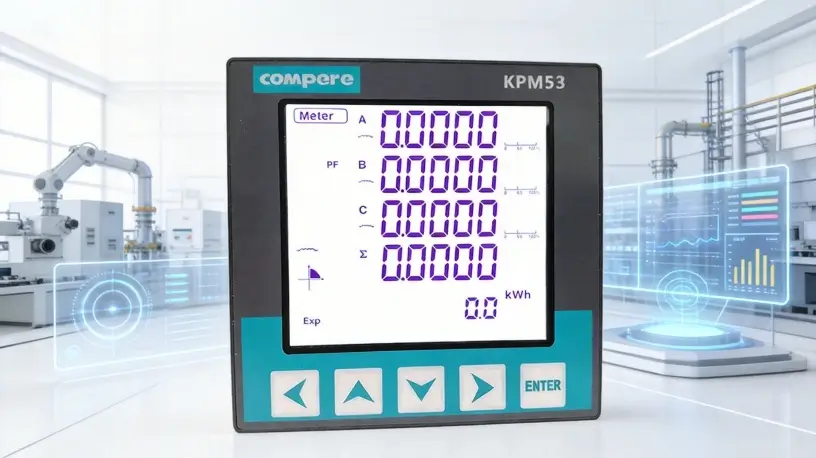
The first step in selection is not looking at parameters, but at location. Electricity consumption in industrial plants is typically divided into three levels, with correspondingly different meter requirements:
Incoming Line (General Contractor): Here, an "all-rounder" is needed. It not only needs to be accurate but also able to monitor voltage fluctuations, frequency, and other power quality aspects in real time, helping you detect grid pollution and prevent damage to large equipment.
Workshop/Production Line Level: The goal here is "cost accounting." You need to calculate the energy consumption percentage of each workshop and production line using electricity meters to optimize production scheduling.
Critical Equipment Level: This applies to energy-intensive equipment such as air compressors and electric furnaces. Here, the electricity meter acts more like a "health monitor," alerting to equipment malfunctions through abnormal current fluctuations.
In the Industry 4.0 era, manual meter reading is a thing of the past. When selecting a meter, communication capabilities are crucial in determining its lifespan.
Wired Connection: If your factory has convenient wiring, RS485 communication (using the Modbus protocol) is currently the most reliable and cost-effective option. It allows your meter data to be directly transmitted to the control room screen.
Wireless Connection: For renovations of older factories, wiring costs are extremely high. In this case, wireless communication solutions such as LoRaWAN or NB-IoT should be prioritized. These are like equipping the meter with a mobile phone; data is directly uploaded to the cloud, eliminating the hassle of drilling through walls.
Industrial distribution cabinets often have very limited space, making the size of the meter crucial:
DIN Rail Mounting: This is currently the mainstream method in industrial applications. It clips directly onto the rail like a circuit breaker, is small in size, quick to install, and ideal for "squeezing in" existing distribution boxes.
Front Panel Mounting: If you need on-site personnel to see real-time power or current at a glance during on-site inspections, a front panel meter mounted on the cabinet door is more intuitive.
Higher Accuracy Isn't Always Better: For meters used in internal testing, Class 1 accuracy is sufficient. Blindly pursuing 0.2S-level high accuracy only results in unnecessary procurement premiums.
Environmental Tolerance: Industrial environments often involve high temperatures, humidity, and even electromagnetic interference. When selecting a meter, ensure it has good shielding performance and a wide operating temperature range.
Matching Current Transformers: High industrial currents typically require the use of current transformers (CTs). Please remember that the accuracy of an electricity meter is "tied" to the current transformer. If you choose a poor-quality current transformer, even the most expensive meter will be inaccurate.
Choosing the right electricity meter is essentially choosing an energy management methodology. It transforms the invisible current into visible bills and equipment diagnostic reports.

Power Monitoring
KPM31 single-phase DIN Rail Prepaid Energy Meter integrates data acquisition and control functions
Learn More
Power Monitoring
The KPM33 Three-phase DIN-rail 4G Prepaid Energy Meter is designed for DIN-rail mounting.
Learn More
Power Monitoring
The KPM37 4G Three-phase OEM Energy Meter features a 35mm DIN rail mounting design and an LCD display.
Learn MoreCompere provides the integrated energy management solution including online monitoring, analyzing, reporting, controlling, maintenance, production management, prediction, and other functions. We offer u technical support and professional solution at 7*24h service.
Unit 1, Building 38, LIANDONG U Valley, No. 352 Lianhua Street, High-tech Zone, Zhengzhou, China
Our helpline is always open to receive any inquiry or feedback.Please feel free to drop us an email from the form below and we will get back to you as soon as we can.
Compere mainly provides kpm series smart energy meters. If you have any needs, please feel free to contact us.