Power Monitoring
KPM31 single-phase DIN Rail Prepaid Energy Meter integrates data acquisition and control functions
Learn More
In today's healthcare industry, medical equipment manufacturers not only need to focus on the functionality and safety of their equipment, but energy management is also becoming a core competitive advantage. Modern hospitals have extremely high requirements for the stable operation and cost control of high-energy-consuming equipment (such as MRI, CT, PET-CT, etc.).
To this end, we have tailored a "device-native" energy monitoring solution for medical equipment manufacturers, aiming to embed it into the equipment ecosystem and provide deep value to end-user medical institutions.
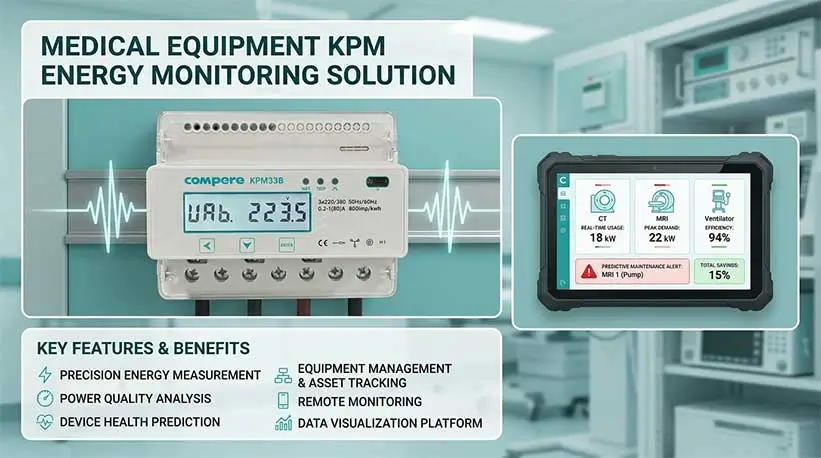
This solution adopts a three-layer "edge-cloud" architecture to achieve refined energy management from a single medical device to the entire hospital's equipment assets.
Medical Equipment Hardware Layer: Built-in or external high-precision metering modules (such as current, voltage, and power factor sensors) are responsible for the native acquisition of underlying data.
Edge Computing Layer: Relying on edge gateways or the device's built-in MCU, it performs second-level data acquisition, waveform analysis, and captures abnormal transients.
Cloud-based central control platform: Connects to standard IoT platforms in manufacturing or local hospital EMS systems, providing energy consumption dashboards and health predictions.
Scenario 1: Refined Energy Consumption Management Throughout the Lifecycle (For Hospital Logistics)
Large imaging equipment consumes significant amounts of power even in standby mode (e.g., the superconducting sustainment system of MRI).
State-based Energy Consumption Decoupling: Automatically identifies and breaks down the energy consumption curves of equipment in different states such as "standby," "ready," "scanning/working," and "power off."
Energy Efficiency and Carbon Efficiency Dashboard: Automatically generates energy consumption reports by department and equipment, calculates carbon emissions, and assists hospitals in meeting green hospital accreditation and carbon neutrality assessment indicators.
Scenario 2: Equipment Health Prediction Based on Energy Consumption Characteristics (For Manufacturers and Maintenance)
Before a hardware failure occurs, medical equipment often exhibits subtle anomalies in its electrical parameters (such as starting current, power factor, and harmonic distortion rate).
Abnormal Energy Consumption Warning: When core components such as CT tubes and MRI compressors experience abnormal power consumption spikes or fluctuations, the system automatically triggers a warning.
Predictive Maintenance: Combining AI algorithms, energy consumption characteristics are matched with equipment lifespan models, prompting maintenance before actual equipment failure, transforming "retrofitting" into "preventing" rather than "repairing."
Scenario 3: Medical Power Quality Assurance (For Medical Safety)
High-precision medical equipment is extremely sensitive to power quality (such as voltage sags and harmonic interference).
Power Quality Monitoring: Real-time monitoring of voltage and current harmonics at equipment interfaces, recording voltage sags/boosts.
Responsibility Boundary Delineation: When equipment malfunctions due to power supply issues, monitoring data serves as clear digital evidence, distinguishing between "hospital power grid problems" and "equipment malfunctions."
High Precision and High-Frequency Acquisition: Employing industrial-grade metering chips, supporting high-frequency sampling, enabling the capture of pulse currents during medical equipment operation.
Seamless Integration: Offers a modular hardware design, allowing for deep integration as a native component at the factory, and also supports non-invasive (external CT rail) rapid installation on older devices.
Standard Protocol Compatibility: Supports multiple protocols such as Modbus and MQTT, easily connecting to existing hospital HIS, HRP, or EMS systems.
Value for Medical Equipment Manufacturers:
Enhancing Product Competitiveness: Adapting to the green healthcare trend, imbuing equipment with "energy-saving and intelligent" features, enhancing differentiated competitive advantages.
Feedback to R&D Design: Obtaining real-world equipment energy consumption data helps R&D teams optimize the circuitry and power consumption design of next-generation products.
Upgrading Business Model: Extending from simple hardware sales to service-oriented offerings, developing SaaS value-added services such as "energy efficiency management + predictive maintenance."
Value for End-User Hospitals:
Reducing Operating Costs: Clearly understanding the billing of energy-intensive equipment, optimizing scheduling to reduce peak-hour electricity costs, and minimizing unnecessary standby waste.
Improve Return on Assets: Reduce equipment failure rates and downtime, significantly increasing the return on investment (ROI) of heavy-duty medical equipment.
Ensure Medical Safety: Real-time monitoring of the power environment of sensitive equipment effectively prevents medical accidents caused by power fluctuations, improving service continuity.
Medical equipment energy consumption monitoring is not only a tool for saving electricity, but also an essential infrastructure for the digital, intelligent, and green transformation of medical equipment. Through this solution, manufacturers can collaborate with hospitals to create an efficient, safe, and low-carbon modern medical environment.

Power Monitoring
KPM31 single-phase DIN Rail Prepaid Energy Meter integrates data acquisition and control functions
Learn More
Power Monitoring
The KPM33 Three-phase DIN-rail 4G Prepaid Energy Meter is designed for DIN-rail mounting.
Learn More
Power Monitoring
The KPM37 4G Three-phase OEM Energy Meter features a 35mm DIN rail mounting design and an LCD display.
Learn MoreCompere provides the integrated energy management solution including online monitoring, analyzing, reporting, controlling, maintenance, production management, prediction, and other functions. We offer u technical support and professional solution at 7*24h service.
Unit 1, Building 38, LIANDONG U Valley, No. 352 Lianhua Street, High-tech Zone, Zhengzhou, China
Our helpline is always open to receive any inquiry or feedback.Please feel free to drop us an email from the form below and we will get back to you as soon as we can.
Compere mainly provides kpm series smart energy meters. If you have any needs, please feel free to contact us.