Power Monitoring
KPM31 single-phase DIN Rail Prepaid Energy Meter integrates data acquisition and control functions
Learn More
As more industrial facilities, commercial buildings, and renewable energy projects adopt smart energy management systems, collecting accurate and real-time energy data has become a critical requirement. However, many companies face challenges when connecting multiple energy devices from different locations, especially when various communication protocols and network environments are involved.
For example, a factory may install hundreds of smart electricity meters across different production areas. Without an effective communication solution, collecting energy consumption data manually can be time-consuming, and equipment abnormalities may not be detected quickly. Similar challenges also exist in smart buildings, distributed energy projects, and microgrid systems.
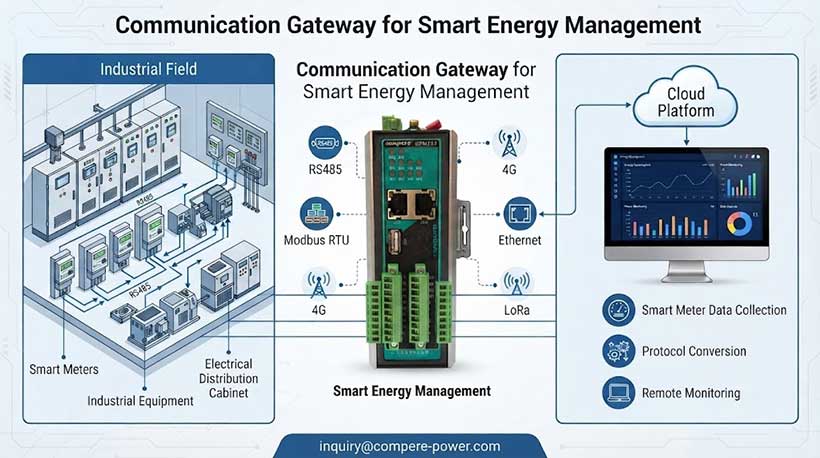
A communication gateway provides an efficient solution by connecting field devices such as smart meters, power monitoring equipment, and sensors with energy management platforms. It works as a bridge between different devices and networks, enabling reliable data acquisition, protocol conversion, and remote monitoring.
Understanding the application scenarios and correct installation methods of communication gateways helps businesses build a more reliable and scalable smart energy management system.
A communication gateway is a device that enables data exchange between different communication networks or devices. In smart energy systems, it is mainly used to collect data from field devices and transmit the information to local servers or cloud-based energy management platforms.
Unlike traditional monitoring methods that require manual data collection, communication gateways allow automatic data transmission from multiple energy devices. They support various communication protocols and network methods, making them suitable for complex industrial environments.
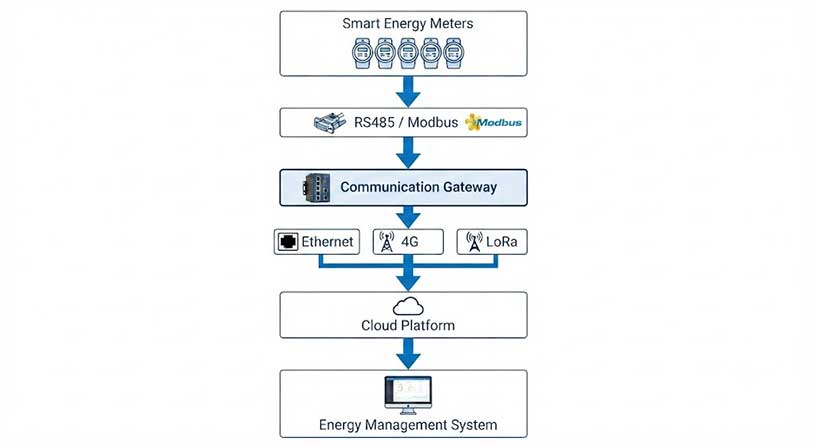
In a typical smart energy monitoring system, the communication process works as follows:
For industrial energy management applications, communication gateways are especially important because they improve system compatibility and allow different devices to work together within one unified monitoring platform.
Industrial facilities usually contain a large number of electrical devices, production machines, and distribution panels. Monitoring energy consumption at each point helps companies identify energy waste and improve operational efficiency.
A communication gateway for smart meters allows multiple meters installed in factories or industrial parks to transmit data to a centralized energy management system. Engineers can monitor:
In practical industrial projects, RS485 Modbus communication gateways are commonly used because many industrial meters already support Modbus RTU communication. This makes integration easier without replacing existing electrical equipment.
Commercial buildings such as office buildings, shopping malls, hotels, and residential complexes require efficient energy monitoring to reduce operating costs.
Communication gateways can connect electricity meters, lighting control systems, HVAC equipment, and other building automation devices. Through centralized data management, facility managers can understand energy usage patterns and optimize equipment operation.
For example, a smart building energy management system can use gateway-collected data to compare energy consumption between different floors or departments, identify abnormal usage, and support energy-saving decisions.
Renewable energy projects often include multiple devices such as solar inverters, battery storage systems, power meters, and environmental sensors. These devices may use different communication methods, creating challenges for system integration.
Communication gateways help connect these distributed devices and provide a unified data transmission channel. In microgrid applications, gateways support:
By integrating renewable energy equipment with an energy management platform, operators can improve visibility and make better decisions based on real-time data.
Traditional manual meter reading requires technicians to visit different locations regularly, which increases labor costs and makes real-time monitoring impossible.
Communication gateways enable remote meter reading systems by automatically collecting meter data and uploading it to a central platform. This approach is widely used in:
With remote data access, operators can monitor consumption trends, generate reports, and receive alerts without visiting the installation site.
Proper installation is essential to ensure stable communication and reliable data transmission. During practical energy monitoring projects, engineers usually evaluate the application environment, communication requirements, and device compatibility before installation.
Before installing a communication gateway, technicians should confirm the system requirements, including connected devices, communication distance, and network conditions.
Important factors include:
In many industrial energy monitoring projects, smart meters communicate with gateways through RS485 connections.
During installation, technicians need to pay attention to:
Incorrect wiring or inconsistent communication parameters are common causes of unstable communication. Therefore, testing the connection between meters and gateways before full deployment is an important step.
After connecting field devices, the communication gateway needs to be configured according to the network environment.
Ethernet gateways are suitable for factories, data centers, and buildings with stable wired networks. They provide reliable communication and are commonly used in fixed energy monitoring systems.
4G gateways are suitable for remote locations where wired internet access is unavailable. They are widely used in distributed energy projects, outdoor equipment monitoring, and temporary installations.
LoRa communication gateways are commonly applied in large buildings and retrofit projects. They provide long-distance wireless communication with low power consumption, reducing the need for complex wiring.
The final installation step is integrating the gateway with the energy management platform.
A typical data transmission process is:
Smart Meter Data → Communication Gateway → Cloud Server → Energy Management Platform
After successful integration, users can achieve:
The communication distance between field devices and gateways directly affects system stability. For large projects, engineers should evaluate wiring distance and select suitable communication methods to avoid signal loss.
A stable network connection is essential for continuous data transmission. Industrial environments may require Ethernet, 4G, or wireless communication solutions depending on actual conditions.
A suitable communication gateway should support multiple protocols to simplify system integration and provide future expansion possibilities.
Industrial environments may include dust, vibration, temperature changes, and electrical interference. Selecting an appropriate installation location, such as an electrical cabinet, helps improve long-term reliability.
Communication gateways play an important role in improving the efficiency of modern energy management systems. By automatically collecting and transmitting energy data, they reduce dependence on manual inspection and provide better visibility into energy usage.
Businesses can benefit from communication gateway solutions by:
For industrial companies, better energy data means better decision-making. By understanding where and how energy is consumed, companies can optimize operations and improve overall energy performance.
Selecting the right communication gateway depends on the actual application requirements rather than only the device specifications.
Before choosing a solution, companies should consider:
A well-designed communication gateway solution should not only solve current communication challenges but also support future energy monitoring expansion.
For companies planning to build smart energy monitoring systems, combining smart meters, communication gateways, and energy management software provides a complete solution for data collection, analysis, and remote management.
For industrial energy monitoring projects, selecting a communication gateway that works seamlessly with smart meters is essential.
KPM Energy Meter provides integrated energy monitoring solutions, including smart meters, Modbus communication gateways, and IoT-based energy management systems. Products such as KPM37 smart energy meters support RS485, WiFi, 4G, and LoRa communication options, making them suitable for industrial monitoring and retrofit projects.
For multi-circuit monitoring applications, KPM312 multi-channel energy meters can simplify system deployment by combining multiple measurement channels into one compact DIN rail device.
Communication gateways are a key component connecting field devices and energy management platforms. They enable reliable data acquisition, protocol conversion, and remote monitoring for industrial facilities, commercial buildings, and renewable energy projects.
By selecting the right communication method and following proper installation procedures, businesses can build a stable and scalable smart energy management system that improves energy visibility and operational efficiency.
If you are planning an industrial energy monitoring project, contact our energy management experts to develop a suitable communication gateway solution based on your application requirements.

Power Monitoring
KPM31 single-phase DIN Rail Prepaid Energy Meter integrates data acquisition and control functions
Learn More
Power Monitoring
The KPM33 Three-phase DIN-rail 4G Prepaid Energy Meter is designed for DIN-rail mounting.
Learn More
Power Monitoring
The KPM37 4G Three-phase OEM Energy Meter features a 35mm DIN rail mounting design and an LCD display.
Learn MoreCompere provides the integrated energy management solution including online monitoring, analyzing, reporting, controlling, maintenance, production management, prediction, and other functions. We offer u technical support and professional solution at 7*24h service.
Unit 1, Building 38, LIANDONG U Valley, No. 352 Lianhua Street, High-tech Zone, Zhengzhou, China
Our helpline is always open to receive any inquiry or feedback.Please feel free to drop us an email from the form below and we will get back to you as soon as we can.
Compere mainly provides kpm series smart energy meters. If you have any needs, please feel free to contact us.