Power Monitoring
KPM31 single-phase DIN Rail Prepaid Energy Meter integrates data acquisition and control functions
Learn More
Choosing the right energy meter accuracy class is a critical decision for industrial facilities that rely on accurate energy data for cost control, efficiency improvement, and power management. However, many industrial users struggle to determine whether they need a high accuracy energy meter or a standard measurement device for their specific application.
The right selection depends on several factors, including measurement purpose, application requirements, energy management goals, and project budget. This guide explains how industrial users can select the most suitable industrial energy meter accuracy class for different scenarios and build a reliable industrial power monitoring solution.
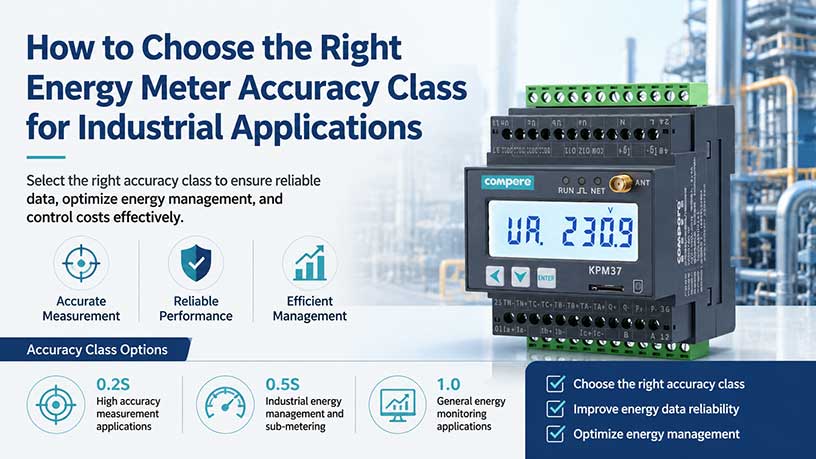
Industrial companies are increasingly relying on energy data to optimize operations, reduce energy waste, and improve equipment efficiency. However, selecting the right industrial energy meter accuracy level is often challenging because different applications have different measurement requirements.
Energy measurement accuracy directly influences the quality of energy management decisions. When an energy meter does not provide reliable data, industrial users may face difficulties analyzing consumption patterns, identifying energy waste, and evaluating improvement results.
For example, inaccurate measurement data can lead to:
For factories and industrial facilities with large electricity consumption, choosing an appropriate accuracy class is essential to ensure trustworthy energy information.
One common challenge during energy meter selection is choosing either excessive accuracy or insufficient accuracy.
Selecting a higher accuracy meter than necessary may increase project costs without providing additional practical benefits. On the other hand, selecting a low accuracy meter for critical measurement applications may result in unreliable data and affect energy management performance.
The goal is not simply to choose the highest accuracy class, but to select the most suitable accuracy level according to the actual application requirements.
Industrial facilities usually contain various electrical systems, and each system may require different measurement accuracy.
For example:
Understanding the purpose of measurement is the first step in energy meter accuracy class selection.
Many purchasing teams and engineering companies understand the importance of energy monitoring but may not have enough experience selecting the correct accuracy class.
A professional supplier should provide application-based recommendations instead of simply offering different meter models. Proper guidance helps customers choose suitable products based on electrical system requirements, monitoring objectives, and future expansion plans.
Energy meter accuracy class refers to the maximum allowable measurement error of an energy meter under specified operating conditions. A higher accuracy class means the meter can measure electrical energy with smaller measurement deviation.
For industrial applications, measurement accuracy is important because energy data is used for operational analysis, cost management, equipment optimization, and energy-saving decisions.
For example, a meter used for general energy monitoring may not require the same accuracy level as a meter used for detailed energy analysis or high-value electrical systems.
When selecting an industrial energy meter, users should consider:
A suitable accuracy class ensures reliable data without unnecessary equipment costs.
The best energy meter accuracy class depends on the specific industrial application. Instead of selecting a meter based only on accuracy specifications, users should evaluate what role the measurement data will play in daily operations and energy management.
For general industrial energy monitoring, the main goal is to understand overall electricity consumption trends and identify potential energy-saving opportunities.
These applications usually require:
For many industrial facilities, a standard industrial energy meter accuracy level can provide sufficient performance for energy visibility and management analysis.
Manufacturing companies often need to monitor individual machines or production lines to understand energy consumption and improve operational efficiency.
In these applications, measurement reliability becomes more important because small differences in energy data can affect equipment performance evaluation and production optimization.
A suitable smart energy meter for industrial applications should provide accurate data collection while supporting long-term equipment monitoring.
Industrial parks, factories, and commercial facilities often use sub-metering systems to measure energy consumption in different departments, production areas, or equipment groups.
These applications require higher measurement accuracy because energy data may be used for:
Selecting an appropriate accuracy class helps ensure fair and transparent energy measurement.
For electrical systems where measurement reliability is extremely important, industrial users typically require higher accuracy energy meters.
These systems may include important production equipment, high-value electrical loads, or applications requiring detailed power analysis.
Higher accuracy measurement helps users obtain more precise energy information and improve operational control.
When selecting an industrial energy meter, the difference between 0.2S and 0.5S accuracy classes is one of the most common questions from engineers and purchasing teams. Both accuracy levels can provide reliable energy measurement, but they are designed for different application requirements.
The correct choice depends on whether the measurement data is used for general monitoring, energy management, cost allocation, or more precise electrical analysis.
| Accuracy Class | Typical Application | Suitable Users |
|---|---|---|
| 0.2S | High accuracy measurement applications requiring very precise energy data | Advanced monitoring projects, critical energy measurement systems |
| 0.5S | Industrial energy management, sub-metering, and production monitoring | Factories, industrial facilities, system integrators |
| 1.0 | Basic energy consumption monitoring applications | General monitoring projects with standard accuracy requirements |
For most industrial energy management projects, 0.5S accuracy meters provide a practical balance between measurement performance and project cost. For applications requiring highly precise measurement data, 0.2S meters may be a better choice.
Therefore, higher accuracy does not always mean better value. The ideal solution is selecting the accuracy class that matches the actual measurement purpose.
Different industrial environments have different energy measurement requirements. Understanding application scenarios helps users select the most suitable energy meter accuracy class.
Manufacturing plants usually contain multiple production lines, machines, and electrical systems with different energy consumption patterns.
Energy meters are commonly used for:
For factory energy management, industrial energy meters with suitable accuracy provide reliable consumption data for improving production efficiency and reducing unnecessary energy usage.
Industrial buildings require continuous monitoring of electricity usage across different areas, including production spaces, warehouses, offices, and auxiliary systems.
A properly selected energy meter helps facility managers:
Many companies upgrade existing electrical systems to improve energy visibility and reduce operating costs.
In retrofit projects, accurate measurement is important because users need reliable before-and-after data to evaluate improvement results.
A suitable industrial energy meter accuracy level allows companies to identify energy waste, monitor improvement performance, and make better investment decisions.
Individual equipment monitoring is becoming increasingly important for manufacturers that want to improve operational efficiency.
By measuring the energy consumption of specific machines, companies can:
Selecting the right accuracy class ensures that equipment energy data is reliable enough for operational analysis.
Accurate energy measurement is the foundation of an effective industrial power monitoring solution. However, a complete energy management system requires more than just installing meters.
A professional industrial energy monitoring solution typically includes:
Smart energy meters provide accurate measurement of electrical parameters and collect reliable energy consumption data from industrial systems.
A suitable communication solution enables collected energy data to be transferred efficiently for centralized monitoring and analysis.
An energy management platform helps users analyze consumption trends, identify energy-saving opportunities, and optimize operational decisions.
The complete process can be summarized as:
Accurate Measurement → Data Collection → Energy Analysis → Optimization Management
By combining accurate measurement hardware with intelligent energy management tools, industrial users can achieve better energy visibility and long-term efficiency improvement.
Choosing the right supplier is as important as selecting the right accuracy class. A reliable supplier should understand industrial applications and provide technical support throughout the project lifecycle.
Professional suppliers should provide:
Good technical support helps customers avoid incorrect product selection and ensures the meter meets actual project needs.
Industrial projects often have different measurement requirements depending on electrical system design and monitoring objectives.
A capable supplier should provide flexible solutions based on:
Suppliers with practical industrial experience can better understand real-world challenges and recommend suitable energy measurement solutions.
When evaluating suppliers, industrial users should consider product reliability, technical knowledge, and experience supporting different energy monitoring applications.
The suitable accuracy class depends on your application. For general industrial energy management, 0.5S is commonly used. Applications requiring more precise measurement may require higher accuracy levels such as 0.2S.
The main difference is measurement accuracy. A 0.2S energy meter provides more precise measurement than a 0.5S meter, making it suitable for applications requiring higher data accuracy.
Not necessarily. Higher accuracy may increase costs. The best choice is the accuracy level that matches your monitoring objectives and application requirements.
Consider your measurement purpose, required accuracy, monitoring goals, electrical system requirements, and future expansion plans. Professional supplier support can also help identify the most suitable solution.
Selecting the correct energy meter accuracy class helps industrial users achieve reliable energy data, better cost control, and more effective energy management.
If you need assistance choosing the right industrial energy meter for your application, our technical team can help you evaluate measurement requirements and recommend a suitable accuracy class solution.

Power Monitoring
KPM31 single-phase DIN Rail Prepaid Energy Meter integrates data acquisition and control functions
Learn More
Power Monitoring
The KPM33 Three-phase DIN-rail 4G Prepaid Energy Meter is designed for DIN-rail mounting.
Learn More
Power Monitoring
The KPM37 4G Three-phase OEM Energy Meter features a 35mm DIN rail mounting design and an LCD display.
Learn MoreCompere provides the integrated energy management solution including online monitoring, analyzing, reporting, controlling, maintenance, production management, prediction, and other functions. We offer u technical support and professional solution at 7*24h service.
Unit 1, Building 38, LIANDONG U Valley, No. 352 Lianhua Street, High-tech Zone, Zhengzhou, China
Our helpline is always open to receive any inquiry or feedback.Please feel free to drop us an email from the form below and we will get back to you as soon as we can.
Compere mainly provides kpm series smart energy meters. If you have any needs, please feel free to contact us.