Power Monitoring
KPM31 single-phase DIN Rail Prepaid Energy Meter integrates data acquisition and control functions
Learn More
Industrial companies are facing increasing pressure to reduce energy costs, improve operational efficiency, and achieve better control over electricity consumption. Modern factories usually contain multiple production lines, motors, compressors, HVAC systems, lighting networks, and auxiliary equipment, all of which contribute to overall energy usage.
However, many industrial facilities still lack detailed visibility into how electricity is consumed across different areas. Without accurate and real-time energy data, it becomes difficult to identify inefficient equipment, locate energy waste, and make effective optimization decisions.
A multi channel energy meter for industrial applications provides a practical solution by enabling multiple circuits to be monitored through one centralized device. By combining multi-circuit measurement, real-time data collection, and system integration capabilities, it helps factories build a more efficient and intelligent energy monitoring system.
Before implementing an effective energy management system, industrial companies need to understand the challenges that limit traditional monitoring methods. As factory electrical systems become more complex, conventional energy measurement approaches are often unable to provide the detailed information required for modern energy management.
One of the biggest industry challenges is the difficulty of monitoring multiple electrical loads across a factory. A typical manufacturing facility may include dozens or even hundreds of energy-consuming devices, including production machines, motors, pumps, compressors, and other supporting equipment.
Traditional single-circuit energy meters usually monitor only one electrical point. To monitor multiple loads, companies need to install many individual meters, which increases equipment quantity, installation work, and maintenance requirements.
As a result, facility managers often cannot clearly understand which machines consume the most energy or which production processes have higher electricity usage.
Another important industry challenge is the lack of real-time monitoring information. Many factories still rely on manual meter reading or isolated measurement devices, which cannot provide continuous energy data.
When abnormal energy consumption occurs, such as equipment running inefficiently or unexpected power increases, managers may not discover the problem until receiving monthly electricity bills.
Without real-time data analysis, companies lose opportunities to reduce energy waste and improve equipment efficiency.
Traditional energy monitoring systems often require multiple meters installed in different locations. This creates several challenges:
For large industrial projects, expanding a traditional metering system can become costly and difficult to manage. Companies need a more flexible solution that can support multiple monitoring points while simplifying installation.
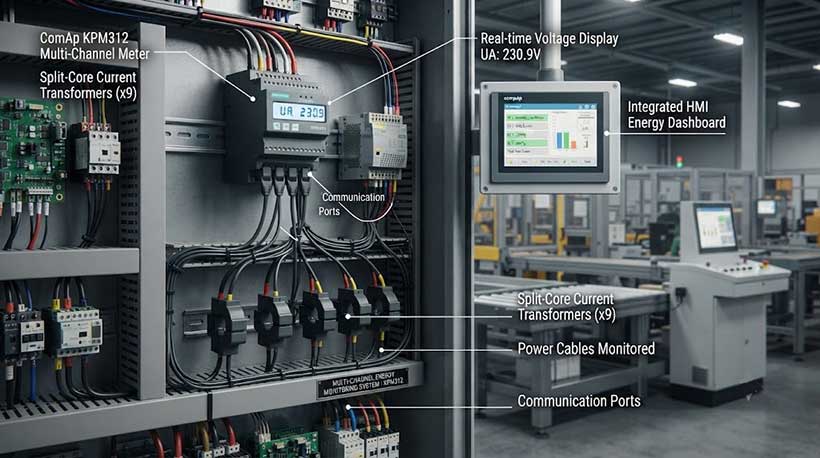
A multi channel energy meter for industrial applications addresses these challenges by combining multiple measurement channels into one compact monitoring device. Instead of installing separate meters for every circuit, factories can monitor multiple electrical loads through a centralized solution.
This approach improves energy visibility and creates a foundation for advanced industrial energy management. The meter collects electrical data from different circuits and sends the information to local or cloud-based platforms for analysis.
The main advantage of a multi channel energy meter is the ability to monitor multiple circuits simultaneously. It can measure energy consumption from different feeders, branch circuits, or equipment groups within a factory.
For example, a manufacturing plant can monitor several production machines, lighting systems, and auxiliary equipment using one multi-channel monitoring device. This reduces the number of meters required and simplifies the overall system architecture.
Sub-metering is an important part of industrial energy management. By monitoring different areas separately, companies can understand detailed electricity consumption patterns.
A multi channel energy meter allows businesses to analyze energy usage by:
This detailed information helps energy managers identify high-consumption equipment and develop targeted energy-saving strategies.
Modern factories require connected energy solutions rather than standalone measurement devices. Multi channel energy meters can integrate with industrial energy management systems, IoT platforms, SCADA systems, and building management systems.
Depending on project requirements, communication options may include RS485 Modbus RTU, Ethernet, WiFi, 4G, or LoRaWAN.
With system integration, companies can achieve:
| Traditional Energy Meter | Multi Channel Energy Meter Solution |
|---|---|
| One meter monitors one circuit | One device monitors multiple circuits |
| Requires more installation space | Reduces cabinet space requirements |
| More wiring and maintenance work | Simplified installation and management |
| Limited energy visibility | Detailed real-time energy data |
| Difficult to expand monitoring systems | Flexible for future expansion |
Manufacturing facilities are one of the most common applications for multi channel energy monitoring. Production equipment often represents a significant portion of total electricity consumption.
By monitoring machines and production lines separately, manufacturers can evaluate equipment efficiency, identify unnecessary energy consumption, and optimize production processes.
Data centers require accurate power monitoring because servers, cooling systems, and network equipment operate continuously.
Multi channel energy meters help operators monitor different power distribution branches, improve energy efficiency, and maintain reliable operation.
Large buildings often contain multiple energy systems, including HVAC equipment, elevators, lighting systems, and tenant areas.
Multi-circuit energy monitoring provides detailed consumption data for different areas, helping facility managers improve energy management and reduce operating costs.
Industrial environments require stable and accurate measurement performance. Reliable measurement of voltage, current, power, and energy consumption is essential for making correct energy management decisions.
A suitable multi channel energy meter should support flexible communication methods to connect with existing industrial systems. Common communication options include Modbus RTU, Ethernet, WiFi, 4G, and LoRaWAN.
Different projects require different monitoring capacities. Depending on application needs, companies may select solutions with different channel numbers, such as 4-channel, 8-channel, 12-channel, or customized configurations.
A successful industrial energy management project requires more than installing measurement equipment. It requires a complete solution that connects energy measurement, communication, analysis, and optimization.
A typical industrial energy monitoring architecture includes:
By implementing a multi channel energy monitoring solution, industrial companies can achieve better control over electricity usage, reduce unnecessary energy costs, and build a smarter factory energy management system.
A multi channel energy meter is used to monitor multiple electrical circuits or loads through one device. It is commonly used in factories, industrial buildings, and energy management projects.
It provides detailed energy consumption data from different monitoring points, helping factories identify energy waste, analyze equipment performance, and optimize electricity usage.
Yes. Many multi channel energy meters support communication protocols such as Modbus, Ethernet, WiFi, 4G, and LoRaWAN for integration with IoT and industrial energy platforms.
A multi channel solution reduces installation complexity, saves cabinet space, simplifies maintenance, and provides centralized monitoring of multiple circuits.

Power Monitoring
KPM31 single-phase DIN Rail Prepaid Energy Meter integrates data acquisition and control functions
Learn More
Power Monitoring
The KPM33 Three-phase DIN-rail 4G Prepaid Energy Meter is designed for DIN-rail mounting.
Learn More
Power Monitoring
The KPM37 4G Three-phase OEM Energy Meter features a 35mm DIN rail mounting design and an LCD display.
Learn MoreCompere provides the integrated energy management solution including online monitoring, analyzing, reporting, controlling, maintenance, production management, prediction, and other functions. We offer u technical support and professional solution at 7*24h service.
Unit 1, Building 38, LIANDONG U Valley, No. 352 Lianhua Street, High-tech Zone, Zhengzhou, China
Our helpline is always open to receive any inquiry or feedback.Please feel free to drop us an email from the form below and we will get back to you as soon as we can.
Compere mainly provides kpm series smart energy meters. If you have any needs, please feel free to contact us.