Power Monitoring
KPM31 single-phase DIN Rail Prepaid Energy Meter integrates data acquisition and control functions
Learn More
Apartment buildings are facing increasing demand for accurate energy measurement, remote monitoring, and efficient electricity management. However, installing traditional wired metering systems in multi-floor residential buildings can be complicated, especially for existing apartments where additional communication cables are difficult and expensive to install.
A wireless smart meter installation for apartments provides a flexible alternative by reducing wiring requirements and simplifying the deployment of modern energy management systems. With wireless communication technologies such as LoRa, 4G, and WiFi, property managers can achieve remote meter reading, real-time energy monitoring, and centralized electricity management without major building modifications.
For both new apartment projects and retrofit applications, wireless smart meters help improve installation efficiency while providing reliable energy data for better operational decisions.
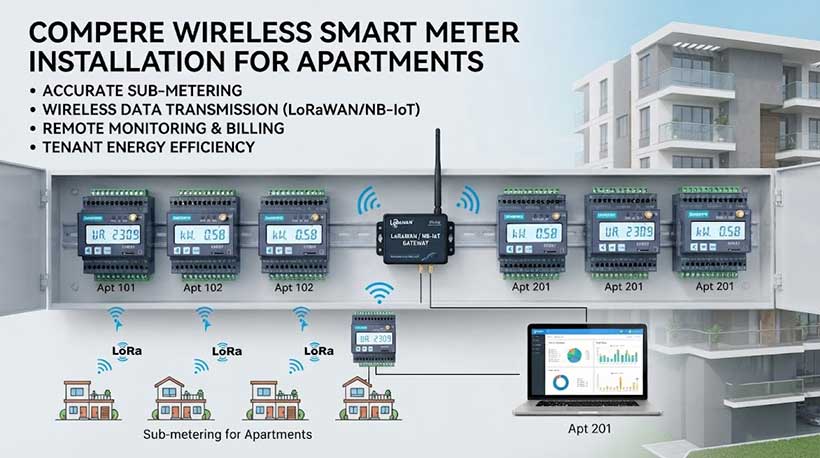
Many apartment buildings require individual electricity measurement for each unit. Traditional solutions often rely on wired communication networks, which means additional cables must be installed between meters, gateways, and monitoring platforms.
For new construction projects, cable installation can be planned during the building phase. However, for existing apartments, adding communication wiring may require wall modification, additional labor, and longer installation periods.
These challenges increase project costs and create inconvenience for residents. Wireless smart meter solutions eliminate many of these problems by transmitting meter data through wireless communication networks.
Many residential buildings still use traditional electricity meters that require manual meter reading. Property managers often face problems such as:
A wireless smart meter for apartments allows existing buildings to upgrade their metering infrastructure without large-scale renovation. The meters can be installed in electrical cabinets or distribution panels while maintaining the existing power system layout.
Modern apartment management requires more than simple electricity measurement. Operators need accurate data to support:
By connecting wireless meters with an IoT energy management system, building operators can monitor electricity consumption from a centralized platform and improve operational efficiency.
A successful wireless smart meter installation for apartments usually includes several important steps, from site evaluation to system integration.
Before installation, engineers evaluate the building structure and electrical system to determine the most suitable solution.
The assessment usually includes:
This step ensures that the selected wireless technology can provide stable communication throughout the building.
After completing the site assessment, smart meters are installed in the designated electrical panels or meter cabinets.
Depending on the application, different meter types can be selected:
Compared with traditional wired solutions, wireless meters reduce communication cable installation and provide greater flexibility during deployment.
The communication gateway plays an important role in collecting meter data and transferring information to the management platform.
Common communication options include:
After communication setup, collected electricity data can be uploaded to an energy management platform.
The system enables:
LoRa technology is widely used in apartment energy monitoring projects because of its long communication distance and low power consumption.
For multi-floor residential buildings, LoRa smart meters can provide stable communication even in environments with multiple walls and obstacles. A single gateway can cover many meters, reducing system complexity.
LoRa wireless smart meter solutions are commonly used in:
4G smart meters connect directly to cloud platforms through cellular networks. They are suitable for distributed apartment projects where installing local communication infrastructure is difficult.
Advantages include:
WiFi smart meters are suitable for smaller apartment projects where wireless internet coverage already exists. They provide a simple way to achieve remote monitoring without additional communication equipment.
The biggest advantage of wireless metering is the reduction of communication wiring work. Property developers and system integrators can save costs related to:
Wireless solutions simplify installation and reduce project timelines. This is especially valuable for apartment renovation projects where minimizing disruption to residents is important.
Wireless smart meters are suitable for various residential applications, including:
With accurate electricity data, property managers can better understand consumption patterns and improve energy efficiency. The collected data supports smarter decisions for building operation and maintenance.
Selecting the right solution depends on project requirements, building structure, and future expansion plans.
Consider whether the project requires:
The communication method should match the building environment. Large apartment buildings often benefit from LoRa due to its coverage capability, while distributed projects may prefer 4G communication.
For commercial property management, the smart meter system should support integration with:
Different apartment projects may require customized solutions, including communication methods, meter functions, software interfaces, and installation designs. Working with an experienced smart meter manufacturer helps ensure successful project implementation.
Wireless smart meters allow property operators to measure electricity consumption for each apartment and simplify tenant billing management.
Landlords can use remote meter reading systems to monitor electricity usage and improve management efficiency.
Individual room measurement helps universities manage electricity consumption and encourage energy-saving behavior.
Integrated apartment energy monitoring systems provide centralized visibility for large residential properties.
Yes. Wireless smart meters are designed for both new buildings and retrofit projects. They reduce the need for additional communication wiring, making them suitable for upgrading existing apartment buildings.
Installation time depends on the number of meters, building structure, and communication method. Wireless solutions usually require less installation work compared with traditional wired systems.
No. Wireless smart meters transmit data through technologies such as LoRa, 4G, or WiFi, reducing the need for additional communication cables.
The best option depends on project requirements. LoRa is commonly used for large apartment buildings because of its long range and strong penetration, while 4G is suitable for remote or distributed projects.
Wireless smart meter installation for apartments provides a practical solution for modern residential energy management. By reducing wiring requirements, simplifying deployment, and enabling remote monitoring, wireless metering systems help property developers and operators improve efficiency while lowering installation costs.
For apartment projects that require reliable electricity measurement and intelligent energy management, choosing the right wireless smart meter solution is the foundation for building a smarter and more efficient energy system.

Power Monitoring
KPM31 single-phase DIN Rail Prepaid Energy Meter integrates data acquisition and control functions
Learn More
Power Monitoring
The KPM33 Three-phase DIN-rail 4G Prepaid Energy Meter is designed for DIN-rail mounting.
Learn More
Power Monitoring
The KPM37 4G Three-phase OEM Energy Meter features a 35mm DIN rail mounting design and an LCD display.
Learn MoreCompere provides the integrated energy management solution including online monitoring, analyzing, reporting, controlling, maintenance, production management, prediction, and other functions. We offer u technical support and professional solution at 7*24h service.
Unit 1, Building 38, LIANDONG U Valley, No. 352 Lianhua Street, High-tech Zone, Zhengzhou, China
Our helpline is always open to receive any inquiry or feedback.Please feel free to drop us an email from the form below and we will get back to you as soon as we can.
Compere mainly provides kpm series smart energy meters. If you have any needs, please feel free to contact us.