Power Monitoring
KPM31 single-phase DIN Rail Prepaid Energy Meter integrates data acquisition and control functions
Learn More
In the context of "Industry 4.0" and carbon neutrality goals, traditional factories face pain points such as outdated equipment, unclear energy consumption data, and low efficiency of manual meter reading. Multi-circuit energy meters, with their high integration and powerful data acquisition capabilities, are becoming the preferred solution for upgrading factory distribution cabinets.
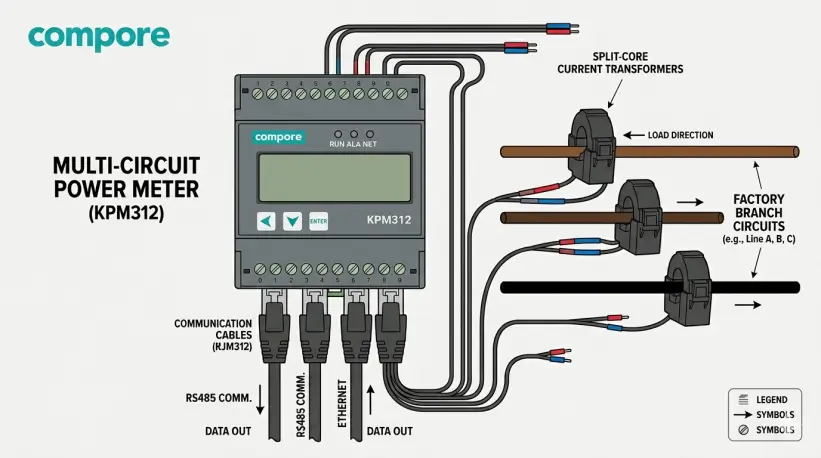
Traditional factory distribution rooms or workshop distribution boxes have limited space. Installing a traditional meter for each injection molding machine, air compressor, or production line not only makes it difficult to fit within the cabinet space but also exponentially increases wiring complexity. Furthermore, scattered data is difficult to synchronize in real time, making it impossible for management to accurately calculate the unit cost of energy consumption for individual products and to detect power waste caused by equipment idling.
Multi-circuit meters employ a modular design, offering advantages such as:
Maximum Space Utilization: Utilizing standard DIN rail mounting, a single unit can monitor multiple three-phase circuits or dozens of single-phase circuits, with a volume only one-quarter that of an equivalent number of traditional meters.
Non-Outage Installation (Open-Type CT): For retrofit projects, open-type current transformers can be matched. During construction, there's no need to cut the factory's main busbar cables; signal acquisition is completed simply by attaching the transformer to the conductor, significantly reducing production losses due to downtime.
Comprehensive Electrical Parameter Monitoring: In addition to basic energy metering, it can monitor current, voltage, power factor, and harmonics in real time. This is crucial for detecting abnormal inductive loads in the factory power grid and preventing transformer overheating.
Workshop Cost Center Accounting: By installing multi-circuit meters in the workshop's secondary distribution box, electricity consumption can be calculated by shift and production line. Management can intuitively compare energy efficiency across different time periods, providing real data support for performance evaluation.
Power Equipment Status Early Warning: Before malfunctions occur, motor-type equipment such as circulating pumps and fans are often accompanied by abnormal current or power factor fluctuations. Multi-circuit meters upload data to the monitoring system in real time via RS485 or Ethernet interfaces, enabling fault early warning and preventing unplanned downtime.
Power Quality Management: Inverters and high-power rectifiers generate a large amount of harmonics. The built-in harmonic analysis function of multi-circuit meters helps engineers accurately locate interference sources, providing a basis for installing capacitor banks or active power filters.
Identify the key loads that need to be monitored (e.g., central air conditioning unit, main production line, air compressor station). It is recommended to centrally deploy multi-circuit meters at the secondary distribution cabinet to obtain the highest cost-effectiveness.
Select an appropriate CT ratio based on the circuit current magnitude. Considering the high electromagnetic interference in the factory environment, it is recommended that the communication link use shielded twisted-pair cable with the Modbus-RTU protocol, or be converted to the MQTT protocol via a gateway for direct cloud access.
Integrate the meter data into the factory's existing EMS (Energy Management System). Through data visualization dashboards, achieve energy consumption trend analysis, peak/valley electricity cost statistics, and anomaly alarm push notifications.
Through the application of multi-circuit meters, the factory can typically detect 5% to 15% of abnormal energy efficiency losses within the first year. For example, it may discover excessively high "standby power consumption" during non-production periods, or reduce demand charges by optimizing the startup sequence of high-power equipment.

Power Monitoring
KPM31 single-phase DIN Rail Prepaid Energy Meter integrates data acquisition and control functions
Learn More
Power Monitoring
The KPM33 Three-phase DIN-rail 4G Prepaid Energy Meter is designed for DIN-rail mounting.
Learn More
Power Monitoring
The KPM37 4G Three-phase OEM Energy Meter features a 35mm DIN rail mounting design and an LCD display.
Learn MoreCompere provides the integrated energy management solution including online monitoring, analyzing, reporting, controlling, maintenance, production management, prediction, and other functions. We offer u technical support and professional solution at 7*24h service.
Unit 1, Building 38, LIANDONG U Valley, No. 352 Lianhua Street, High-tech Zone, Zhengzhou, China
Our helpline is always open to receive any inquiry or feedback.Please feel free to drop us an email from the form below and we will get back to you as soon as we can.
Compere mainly provides kpm series smart energy meters. If you have any needs, please feel free to contact us.