Power Monitoring
KPM31 single-phase DIN Rail Prepaid Energy Meter integrates data acquisition and control functions
Learn More
Accurate electricity measurement is the foundation of modern energy management. Whether used in industrial facilities, commercial buildings, or smart energy monitoring systems, energy meters must provide reliable data to support energy analysis, operational optimization, and cost management.
One of the most important specifications used to describe an energy meter’s performance is meter accuracy class.
But what does meter accuracy class actually mean?
Meter accuracy class defines the maximum permissible measurement error of an energy meter under specified testing conditions. It indicates how close the measured energy value is to the actual energy consumption value.
For example, a Class 0.5S energy meter has a maximum permissible error of ±0.5% under specified conditions. This means the measured energy value should remain within 0.5% of the reference value during accuracy testing.
Understanding meter accuracy class helps engineers, system integrators, and energy managers evaluate measurement reliability and build more accurate energy monitoring systems.
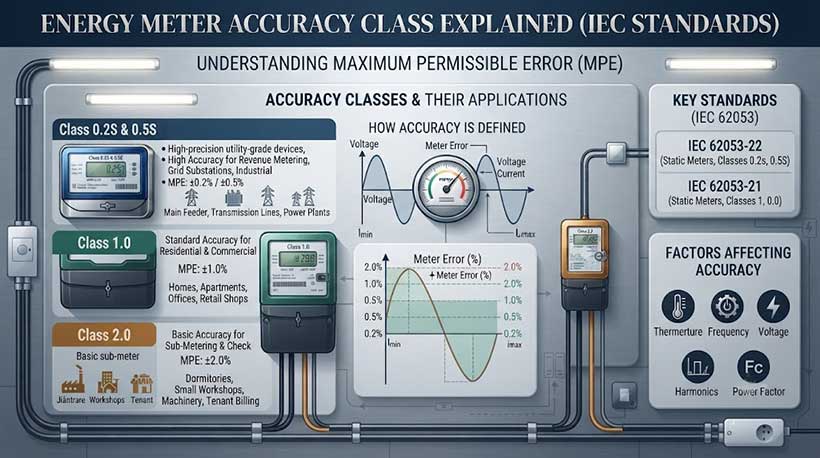
Meter accuracy class is a standardized indication of the measurement performance of an electric energy meter.
It represents the maximum allowable difference between the energy measured by the meter and the actual energy value determined by a reference measurement system.
In simple terms:
Assume the actual energy consumption of a load is:
10,000 kWh
The possible measurement deviation would be approximately:
| Accuracy Class | Maximum Permitted Error | Possible Measurement Deviation |
|---|---|---|
| Class 0.2S | ±0.2% | ±20 kWh |
| Class 0.5S | ±0.5% | ±50 kWh |
| Class 1.0 | ±1% | ±100 kWh |
| Class 2.0 | ±2% | ±200 kWh |
This example shows why accuracy class is important when energy measurement data is used for analysis, monitoring, or financial calculation.
Understanding the meaning of accuracy class is the first step before comparing different meter accuracy levels. For a detailed comparison between Class 0.2S and Class 0.5S meters, read our guide: 0.2S vs 0.5S Energy Meter: Which Accuracy Class Should You Choose?
Energy meter accuracy is determined by comparing the measurement result of the meter under test with a highly accurate reference standard.
During accuracy testing, the energy meter measures electrical parameters such as voltage, current, power factor, and energy consumption. The measured result is then compared with the reference value to calculate the measurement error.
The measurement error can be calculated using the following formula:
Measurement Error (%) = (Measured Value - Reference Value) / Reference Value × 100%
For example:
If the error remains within the specified accuracy limit, the meter meets the requirements of that accuracy class.
Energy measurement accuracy is affected by several electrical and environmental factors. A high-quality energy meter is designed to maintain stable measurement performance under different operating conditions.
Current measurement is one of the key factors affecting energy meter accuracy.
Changes in load current can influence measurement performance, especially when the current level becomes very low compared with the rated current of the meter.
Stable voltage conditions help maintain reliable energy measurement results.
Voltage fluctuations, harmonics, and abnormal power conditions may affect measurement accuracy depending on the meter design and measurement capability.
Power factor affects the relationship between active power and apparent power measurement.
Accurate energy meters are designed to maintain measurement performance across different power factor conditions.
Temperature changes can affect electronic components inside energy meters.
Professional energy meters are tested to ensure measurement stability within specified temperature ranges.
Meter accuracy class is not only a technical specification. It directly affects the quality of energy data collected by an energy monitoring system.
Reliable measurement data supports:
For modern industrial energy management systems, accurate measurement data is the foundation for effective monitoring and optimization.
After understanding accuracy class principles, the next step is selecting the appropriate accuracy level for your application. Learn more in our guide: How to Choose the Right Energy Meter Accuracy Class for Industrial Applications.
Energy meter accuracy is verified through controlled testing procedures where the meter under test is compared with a high-precision reference standard.
The purpose of accuracy testing is to determine whether the meter operates within the specified error limits of its accuracy class.
The typical accuracy testing process includes the following steps:
Meters are tested at different operating points because accuracy performance may vary depending on load conditions.
| Testing Factor | Description |
|---|---|
| Current Level | Evaluates measurement performance under different load currents. |
| Voltage Condition | Checks measurement stability under rated voltage conditions. |
| Power Factor | Verifies accuracy under different electrical load characteristics. |
| Frequency | Ensures stable measurement performance at the rated frequency. |
| Temperature | Evaluates measurement stability under environmental changes. |
When selecting high-accuracy energy meters, users often see specifications such as 0.2S and 0.5S.
The letter "S" represents a special accuracy class defined for transformer-operated energy meters. These meters are designed to maintain higher measurement accuracy, especially under lower current operating conditions.
Compared with standard accuracy classes, S-class meters provide improved measurement performance across a wider current range.
In many industrial and commercial applications, energy meters are connected through current transformers (CTs). The actual operating current may change significantly depending on equipment operation.
S-class meters are designed to provide reliable accuracy even when operating conditions are not at the maximum rated load.
This makes them suitable for applications where consistent measurement performance is required throughout the operating range.
When selecting an energy meter, accuracy class is sometimes confused with other technical parameters. However, these specifications describe different aspects of meter performance.
| Specification | Meaning | Impact on Energy Measurement |
|---|---|---|
| Accuracy Class | Maximum permitted measurement error | Determines measurement reliability |
| Resolution | Smallest value displayed or recorded by the meter | Affects data display detail, not necessarily accuracy |
| Sampling Rate | Frequency of data measurement and recording | Affects monitoring response and data analysis capability |
| Communication Protocol | Method used for data transmission | Determines system integration capability |
A meter with a high display resolution does not always provide higher measurement accuracy.
For example, a meter displaying energy values with three decimal places may still have a larger measurement error if its accuracy class is lower.
Accuracy class describes measurement correctness, while resolution describes measurement display detail.
Communication functions such as Modbus, RS485, Ethernet, WiFi, or LoRaWAN determine how energy data is transmitted.
However, communication capability does not improve measurement accuracy.
A smart energy meter needs both:
Together, these functions create a complete energy monitoring solution.
Energy meter accuracy performance is defined by international standards that specify measurement requirements and testing methods.
The IEC 62052 series defines general requirements, testing conditions, and equipment requirements for electricity metering equipment.
It provides the foundation for evaluating meter performance, safety, and reliability.
The IEC 62053 series focuses on specific requirements for electricity meter accuracy and performance.
It defines accuracy classes and testing requirements for different types of electrical energy meters.
| Standard Series | Main Purpose |
|---|---|
| IEC 62052 | General requirements and testing conditions for electricity meters |
| IEC 62053 | Specific accuracy and performance requirements |
| IEC 62053-22 | Static meters for active energy measurement accuracy requirements |
With the increasing adoption of smart energy management systems, measurement accuracy has become more important than ever.
Industrial companies use energy data to:
Accurate energy measurement provides the trusted data foundation required for digital energy management platforms and IoT-based monitoring solutions.
Meter accuracy class indicates the maximum permissible measurement error of an energy meter under defined testing conditions. It shows how accurately the meter can measure electrical energy compared with a reference standard.
Energy meter accuracy is calculated by comparing the measured energy value from the meter with a reference measurement value. The difference between these two values determines the measurement error percentage.
0.5S refers to an S-class energy meter with a maximum permissible measurement error of ±0.5%. The S-class design provides improved accuracy performance, especially for transformer-connected applications and systems with changing load conditions.
Yes. A lower accuracy class number represents a smaller maximum measurement error. For example, a Class 0.5S meter provides higher measurement accuracy than a Class 1.0 meter because the allowed error range is smaller.
Yes. Accuracy class directly affects the reliability of energy data collected by smart monitoring systems. Higher measurement accuracy helps improve energy analysis, consumption tracking, and operational decision-making.
Accuracy class describes how close the measured value is to the actual value, while resolution describes the smallest value that the meter can display or record. A meter can have high display resolution but still have lower measurement accuracy.
Accuracy class is important because industrial energy management systems depend on reliable measurement data. Accurate energy information helps companies analyze consumption patterns, identify energy waste, and improve energy efficiency.
Choosing the right energy meter requires a clear understanding of measurement accuracy, application requirements, and system objectives. Our technical team can help you select a suitable energy measurement solution for your project.

Power Monitoring
KPM31 single-phase DIN Rail Prepaid Energy Meter integrates data acquisition and control functions
Learn More
Power Monitoring
The KPM33 Three-phase DIN-rail 4G Prepaid Energy Meter is designed for DIN-rail mounting.
Learn More
Power Monitoring
The KPM37 4G Three-phase OEM Energy Meter features a 35mm DIN rail mounting design and an LCD display.
Learn MoreCompere provides the integrated energy management solution including online monitoring, analyzing, reporting, controlling, maintenance, production management, prediction, and other functions. We offer u technical support and professional solution at 7*24h service.
Unit 1, Building 38, LIANDONG U Valley, No. 352 Lianhua Street, High-tech Zone, Zhengzhou, China
Our helpline is always open to receive any inquiry or feedback.Please feel free to drop us an email from the form below and we will get back to you as soon as we can.
Compere mainly provides kpm series smart energy meters. If you have any needs, please feel free to contact us.