Power Monitoring
KPM31 single-phase DIN Rail Prepaid Energy Meter integrates data acquisition and control functions
Learn More
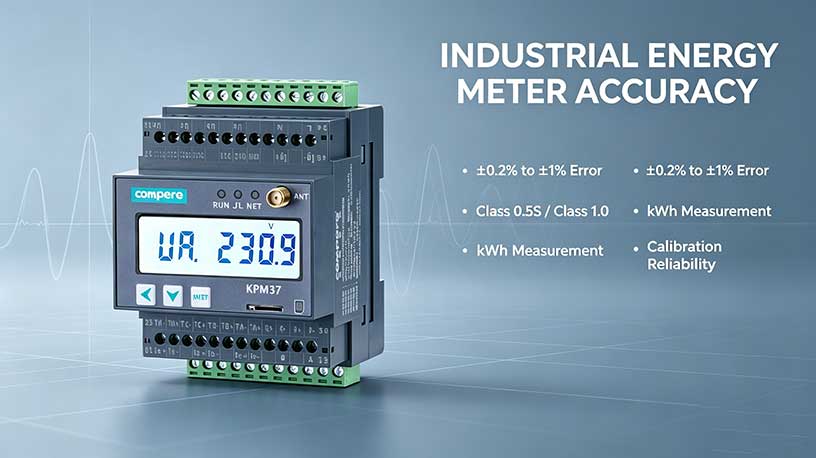
The required accuracy of an industrial energy meter depends on the purpose of the monitoring project. For most factory energy monitoring applications, Class 0.5S meters provide a practical balance between measurement reliability and investment cost. Higher accuracy levels may be required for critical measurement, energy allocation, or advanced analysis applications. Engineers should select accuracy based on the value of the data, not simply choose the highest available specification. Compere provides industrial energy meter solutions designed for reliable power monitoring and energy management.
Industrial energy monitoring projects are becoming increasingly important as manufacturers look for better visibility into electricity consumption and equipment performance. However, one common question engineers face is: how accurate does an energy meter really need to be?
Choosing excessive accuracy can increase project costs without creating additional value, while insufficient accuracy may result in unreliable energy analysis. The right approach is to match measurement accuracy with the actual application requirements.
In many industrial projects, engineers evaluate not only the meter specification but also how the collected data will be used. Energy cost management, equipment monitoring, production optimization, and efficiency improvement may require different measurement accuracy levels.
Energy data is the foundation of industrial energy management. If measurement data is inaccurate, engineers may have difficulty identifying energy waste, comparing equipment performance, or evaluating improvement results.
For example, when monitoring a large production line, small measurement errors may have limited impact. However, when comparing several production processes or allocating energy costs between different departments, measurement accuracy becomes more important.
From an engineering perspective, accuracy should be considered as part of the entire monitoring system. Meter performance, installation conditions, electrical environment, and data analysis methods all influence the final quality of energy information.
There is no single accuracy level suitable for every industrial application. The required accuracy depends on the monitoring objective.
Class 1.0 energy meters are commonly used for general energy consumption monitoring where basic electricity usage information is required.
Typical applications include:
Class 0.5S energy meters are widely used in industrial power monitoring because they provide improved measurement performance while maintaining reasonable project costs.
They are suitable for applications such as:
For many industrial facilities, Class 0.5S provides the right balance between data reliability and investment.
Class 0.2S meters are designed for applications where measurement accuracy has a higher business value.
They may be considered for:
| Application | Typical Accuracy Requirement | Reason |
|---|---|---|
| Factory production monitoring | Class 0.5S | Provides reliable data for energy analysis and optimization |
| Basic facility monitoring | Class 1.0 | Suitable for general consumption tracking |
| Energy cost allocation | Class 0.5S or higher | Requires more reliable measurement data |
| Critical measurement applications | Class 0.2S | Higher accuracy for important energy data |
Incorrect installation conditions can affect measurement results. Engineers should consider current transformer performance, wiring conditions, and electrical system stability.
Temperature changes, electrical noise, and industrial operating conditions may influence measurement performance. Selecting meters designed for industrial environments helps improve long-term reliability.
Accuracy is valuable only when the collected data supports practical decisions. A complete energy monitoring solution should combine reliable measurement with effective data management.
| Comparison | Traditional Monitoring | Smart Energy Monitoring |
|---|---|---|
| Energy Data Quality | Limited measurement information | More reliable and detailed energy data |
| Energy Analysis | Difficult to identify consumption patterns | Supports data-based improvement decisions |
| Equipment Monitoring | Requires manual checking | Provides continuous monitoring capability |
| Management Efficiency | Limited visibility | Improves operational understanding |
Manufacturers use energy meters to monitor production equipment and analyze electricity consumption across different processes. Suitable accuracy helps engineers identify inefficient operations and evaluate improvement results.
Large facilities often contain multiple electrical loads. Accurate energy monitoring helps operators understand consumption distribution and improve energy management strategies.
Commercial buildings use energy monitoring solutions to track major systems and optimize operational efficiency.
Compere provides smart energy meters and industrial energy monitoring solutions designed for factories, industrial facilities, and commercial applications.
Based on practical project experience, engineers usually focus on finding the right balance between measurement accuracy, installation requirements, and long-term system value.
Compere helps customers select suitable energy measurement solutions according to different monitoring objectives, from basic consumption tracking to advanced industrial energy management applications.
Not necessarily. Higher accuracy is valuable when the application requires more reliable data, but engineers should evaluate whether the additional accuracy provides meaningful benefits for the project.
Class 0.5S is commonly selected for industrial energy monitoring because it provides reliable measurement performance for many factory applications while maintaining practical project costs.
Compere provides technical support and industrial energy monitoring solutions to help engineers select suitable meters based on application requirements, measurement needs, and system objectives.
Compere provides smart energy meters and industrial power monitoring solutions to help companies achieve better energy visibility and management efficiency.
Request Industrial Energy SolutionContact Compere Engineering Team for professional energy monitoring support.

Power Monitoring
KPM31 single-phase DIN Rail Prepaid Energy Meter integrates data acquisition and control functions
Learn More
Power Monitoring
The KPM33 Three-phase DIN-rail 4G Prepaid Energy Meter is designed for DIN-rail mounting.
Learn More
Power Monitoring
The KPM37 4G Three-phase OEM Energy Meter features a 35mm DIN rail mounting design and an LCD display.
Learn MoreCompere provides the integrated energy management solution including online monitoring, analyzing, reporting, controlling, maintenance, production management, prediction, and other functions. We offer u technical support and professional solution at 7*24h service.
Unit 1, Building 38, LIANDONG U Valley, No. 352 Lianhua Street, High-tech Zone, Zhengzhou, China
Our helpline is always open to receive any inquiry or feedback.Please feel free to drop us an email from the form below and we will get back to you as soon as we can.
Compere mainly provides kpm series smart energy meters. If you have any needs, please feel free to contact us.