Power Monitoring
KPM31 single-phase DIN Rail Prepaid Energy Meter integrates data acquisition and control functions
Learn More
In traditional energy management, electricity meters play a silent role as "recorders"—a glance at the electricity bill at the end of the month reveals the amount of electricity used. This reactive approach makes managing electricity consumption akin to "the blind men and the elephant," hindering cost control.
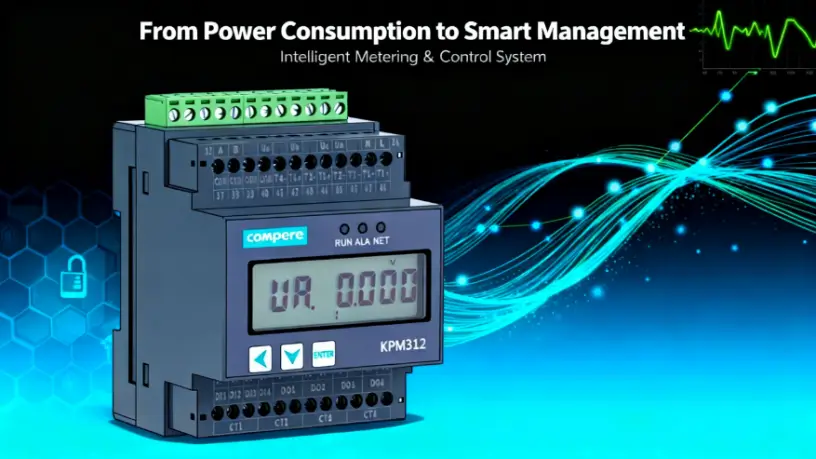
The widespread adoption of smart electricity meters is fundamentally changing this. They are no longer just billing receipts, but a crucial entry point for enterprises to achieve a strategic transformation from extensive "electricity consumption" to refined "electricity management."
Compared to traditional mechanical meters or ordinary electronic meters, the essence of smart meters lies in their leap forward in data acquisition, communication, and insight capabilities.
High-Precision, Multi-Dimensional Data Acquisition
They not only record total electricity consumption but also collect multi-dimensional data such as voltage, current, power factor, and harmonics in real time at minute or even second-level frequencies. This provides rich data resources for in-depth energy analysis.
Two-way Real-time Communication Capability
Through IoT technologies such as NB-IoT, 4G/5G, and LoRa, smart meters can transmit data to a cloud management platform in real time. Managers can check energy dynamics anytime, anywhere via computer or mobile phone, achieving a leap from "monthly bills" to "real-time monitoring."
Edge Computing and Intelligent Early Warning
Advanced smart meters possess preliminary data analysis capabilities. They can set thresholds and immediately issue warnings to managers when abnormal electricity consumption, excessive load, or demand exceeding limits are detected, transforming problem-solving from "post-event remediation" to "in-process intervention."
When enterprises possess real-time, multi-dimensional data provided by smart meters, they can unlock a series of refined management scenarios.
Problem: Knowing only that the total electricity bill is high, but not knowing where the money is specifically spent.
Solution: By installing smart meters in key circuits such as production lines, office areas, and air conditioning systems, itemized metering is achieved. Businesses can clearly see the energy consumption percentage at each stage, enabling them to assign cost control to specific departments and precisely "slim down."
Problem: Production scheduling and equipment start-up/shutdown largely rely on historical experience, lacking energy efficiency data support.
Solution: Analyzing load curves provided by smart meters allows for precise identification of peak electricity consumption periods. By adjusting production plans and implementing peak-valley pricing strategies, non-urgent tasks can be scheduled during off-peak hours, effectively reducing average electricity costs.
Problem: Hidden dangers such as aging lines and three-phase imbalances are difficult to detect, often only addressed after a malfunction or fire occurs.
Solution: Smart meters, monitoring power factor, harmonic content, and other data in real time, act as a "stethoscope" for power quality. They can provide early warnings of electrical fire risks, diagnose equipment health status, enable predictive maintenance, and ensure production safety.
Problem: While there is a willingness to conserve energy and reduce carbon emissions, there is a lack of quantifiable data support and implementation pathways.
Solution: Smart meters are the foundation for calculating a company's carbon footprint. The accurate energy consumption data they provide is the authoritative basis for setting emission reduction targets, evaluating the effectiveness of energy-saving renovations, and generating ESG reports, helping companies respond to “dual carbon” goals.
The value of a single smart meter is limited. Only when it is integrated into a complete energy management system as a sensing terminal is its full potential released.
Data Aggregation: The system aggregates data from smart meters throughout the plant onto a unified platform.
Visual Display: A large dashboard displays the company's energy efficiency overview in chart form.
Intelligent Analysis and Optimization: The system utilizes AI algorithms to deeply mine historical and real-time data, automatically generating energy-saving diagnostic reports and optimization strategy suggestions.
Thus, the enterprise has completed a full upgrade from "seeing" to "understanding" and then to "optimizing," truly achieving smart energy management.
Conclusion: Investing in smart meters is essentially investing in a future-oriented, sophisticated management and decision-making system. It makes invisible and intangible energy consumption visible, manageable, and controllable. For any enterprise hoping to reduce operating costs, improve operational efficiency, and achieve green development, deploying smart meters is an indispensable first step from passively "using electricity" to proactively "managing electricity."

Power Monitoring
KPM31 single-phase DIN Rail Prepaid Energy Meter integrates data acquisition and control functions
Learn More
Power Monitoring
The KPM33 Three-phase DIN-rail 4G Prepaid Energy Meter is designed for DIN-rail mounting.
Learn More
Power Monitoring
The KPM37 4G Three-phase OEM Energy Meter features a 35mm DIN rail mounting design and an LCD display.
Learn MoreCompere provides the integrated energy management solution including online monitoring, analyzing, reporting, controlling, maintenance, production management, prediction, and other functions. We offer u technical support and professional solution at 7*24h service.
Unit 1, Building 38, LIANDONG U Valley, No. 352 Lianhua Street, High-tech Zone, Zhengzhou, China
Our helpline is always open to receive any inquiry or feedback.Please feel free to drop us an email from the form below and we will get back to you as soon as we can.
Compere mainly provides kpm series smart energy meters. If you have any needs, please feel free to contact us.