Power Monitoring
KPM31 single-phase DIN Rail Prepaid Energy Meter integrates data acquisition and control functions
Learn More
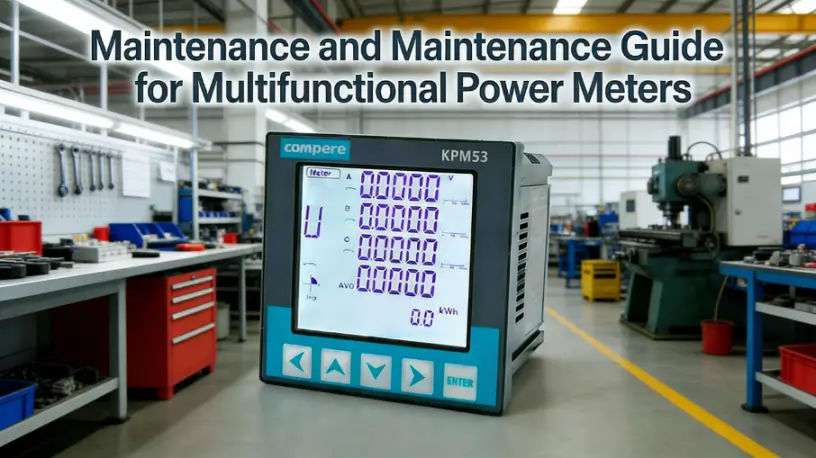
Multifunctional power meters, as key monitoring devices in modern power systems, can measure various parameters such as voltage, current, power, and power quality in real time, and are widely used in industrial, commercial, and public utilities. Regular maintenance and care are crucial to ensure their long-term stable operation and data accuracy. This article will detail the systematic maintenance methods for multifunctional power meters.
Daily/Weekly Inspection: Check the instrument casing for damage, cracks, or deformation.
Cleaning: Gently wipe the display screen and casing with a dry, soft cloth. Avoid using chemical solvents.
Environmental Assessment: Ensure the environment around the instrument is dry, well-ventilated, and away from corrosive gases and sources of strong vibration.
Confirm the display screen is clear and without abnormalities, and all indicator lights are working normally.
Check for any alarm messages or abnormal codes displayed.
Verify that the data display is stable, without flickering or garbled characters.
Power Off Operation: Always disconnect the power supply and ensure safety before performing any internal inspections.
Tighten Terminals: Check and tighten all power and signal cable terminals to prevent poor contact or overheating due to looseness.
Cable Condition: Check connecting cables for signs of aging, damage, or overheating.
It is recommended to perform accuracy calibration every 6-12 months.
Use a standard source to compare instrument readings. Calibrate promptly if the error exceeds the allowable range.
Record calibration data and establish an instrument performance history archive.
Performed by professionals under power-off conditions.
Use compressed air or specialized tools to remove internal dust.
Inspect the circuit boards for abnormalities and components for obvious damage.
Perform complete electrical performance tests, including basic error, repeatability, and stability.
Test communication functions (such as Modbus, Profibus, etc.) for proper functioning.
Check the status of the backup battery (if available) to ensure data is not lost during power outages.
Check if the manufacturer has updated firmware versions.
Upgrade under the guidance of professionals to improve instrument performance and security.
Back up existing settings to prevent data loss during the update process.
Verify that the instrument's protection rating (IP rating) still meets requirements.
Check the integrity of components such as seals and protective covers.
Ensure that lightning protection and overvoltage protection devices are functioning properly.
Increase inspection frequency and observe for condensation.
Consider installing a protective enclosure or dehumidifier.
Shorten cleaning cycles to prevent dust accumulation from affecting heat dissipation.
Check that ventilation holes are unobstructed.
Regularly check the effectiveness of shielding measures.
Verify that instrument readings are not affected by interference.
Check that sensors and wiring are normal.
Verify that parameter settings are correct.
Eliminate external interference factors.
Check communication lines and interfaces.
Verify communication protocols and address settings.
Test communication equipment compatibility.
Check power supply stability
Troubleshooting display screen malfunctions
Establish comprehensive maintenance records, including:
System maintenance not only extends the service life of multi-function power meters but also ensures the accuracy and reliability of their measurement data, providing a reliable basis for energy management, fault diagnosis, and equipment protection. It is recommended to develop personalized maintenance plans based on the instrument's operating environment and workload, and to operate in conjunction with the manufacturer's specific recommendations. When encountering problems that cannot be resolved, contact professional technicians or equipment suppliers promptly to avoid equipment damage or safety accidents caused by improper operation.
Through scientific maintenance management, multi-function power meters will continuously provide accurate and stable monitoring services for your power system, helping to achieve efficient and safe energy management goals.

Power Monitoring
KPM31 single-phase DIN Rail Prepaid Energy Meter integrates data acquisition and control functions
Learn More
Power Monitoring
The KPM33 Three-phase DIN-rail 4G Prepaid Energy Meter is designed for DIN-rail mounting.
Learn More
Power Monitoring
The KPM37 4G Three-phase OEM Energy Meter features a 35mm DIN rail mounting design and an LCD display.
Learn MoreCompere provides the integrated energy management solution including online monitoring, analyzing, reporting, controlling, maintenance, production management, prediction, and other functions. We offer u technical support and professional solution at 7*24h service.
Unit 1, Building 38, LIANDONG U Valley, No. 352 Lianhua Street, High-tech Zone, Zhengzhou, China
Our helpline is always open to receive any inquiry or feedback.Please feel free to drop us an email from the form below and we will get back to you as soon as we can.
Compere mainly provides kpm series smart energy meters. If you have any needs, please feel free to contact us.