Guide to Choose Energy Meters Wired vs Wireless Communication

News

Guide to Choose Energy Meters Wired vs Wireless Communication

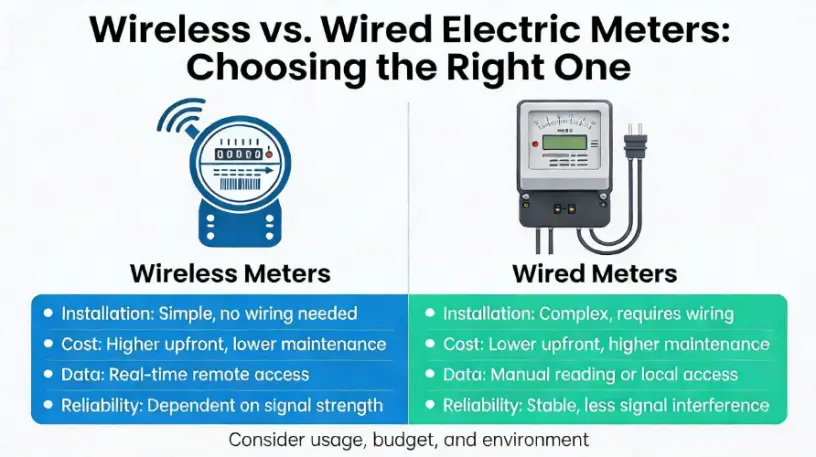
In today's rapidly developing smart grid and intelligent energy management landscape,smart energy meters are no longer just simple metering tools, but intelligent terminals integrating data acquisition, remote transmission, and real-time monitoring.Faced with the choice between wired and wireless communication methods,many users, businesses, and project decision-makers encounter difficulties.This article analyzes the technical characteristics, applicable scenarios,and cost-effectiveness of both solutions to help you make an informed choice.

I. Core Differences: Understanding the Technical Essence

1. Wired Communication Solutions

Wired communication typically employs power line carrier (PLC), RS-485 bus,fiber optic, or Ethernet methods.

Advantages

  • Stable and reliable signal, largely unaffected by external electromagnetic interference
  • High data transmission bandwidth and speed
  • High security due to physical isolation, making interception difficult

Disadvantages

  • Large initial installation workload with complex wiring
  • Higher upfront installation and labor costs
  • Poor flexibility once meter locations are fixed
  • More challenging maintenance for additional wiring or expansion
Guide to Choose Energy Meters Wired vs Wireless Communication

2. Wireless Communication Solutions

Wireless communication primarily utilizes public networks(2G/3G/4G/5G, NB-IoT) or private networks(LoRaWAN, WiFi).

Advantages

  • Highly flexible installation without complex wiring
  • Short deployment cycle and lower construction costs
  • Easy expansion when adding new meters
  • Simple maintenance, ideal for hard-to-wire environments

Disadvantages

  • Signal may be affected by buildings, distance, or electromagnetic interference
  • Potential data latency depending on network conditions
  • Dependence on network coverage and operator services
  • Stability may be slightly lower than wired solutions in extreme environments

II. Four-Step Decision-Making Method

Step 1: Clarify Core Needs and Usage Scenarios

  • New buildings, factories, industrial parks: Wired solutions are ideal if cabling is planned early; wireless offers faster deployment and flexibility.
  • Renovation projects: Wireless solutions are preferred due to minimal construction disruption.
  • Distributed scenarios: NB-IoT or 4G wireless solutions are the most economical choice.
  • High-density centralized scenarios: Wired solutions such as industrial Ethernet provide superior reliability.
  • Temporary or mobile scenarios: Wireless plug-and-play solutions are irreplaceable.

Step 2: Evaluate Key Performance Indicators

  • Real-time performance: Wired or 4G/5G networks for second-level data; NB-IoT or LoRaWAN for daily readings.
  • Reliability: Wired solutions are preferred in mission-critical environments.
  • Data security: Wired networks offer inherent security; wireless requires encryption and VPN technologies.

Step 3: Analyze the Economics

  • Initial investment: Wireless solutions typically cost less to deploy.
  • Operating costs: Wired focuses on maintenance; wireless includes communication module and service fees.
  • Lifecycle costs: Wireless solutions are easier and cheaper to upgrade over 5–15 years.

Step 4: Future Scalability and Maintenance

  • Wireless systems allow easy expansion without rewiring
  • Remote diagnostics and firmware upgrades simplify maintenance
  • Wireless technologies evolve rapidly and integrate well with IoT platforms

III. Recommended Solutions for Typical Scenarios

  • Urban residential meter reading: NB-IoT or LoRaWAN
  • Commercial complexes and office buildings: Hybrid networking
  • Industrial parks and factories: Wireless for offices, wired for critical production areas
  • Public infrastructure: NB-IoT or 4G wireless solutions

IV. Hybrid Networking: The Best of Both Worlds

A hybrid architecture combining a wired backbone with wireless access is becoming the mainstream choice for medium and large-scale energy management systems.

  • Fiber optics ensure high-speed, stable backbone communication
  • Wireless networks provide flexible terminal access

Conclusion and Final Recommendations

Choosing between wired and wireless communication solutions is ultimately a balance between stability, flexibility, cost, and future planning.

Choose wired solutions when:

  • Stability, real-time performance, and security are critical
  • Cabling is feasible during early construction
  • Meter locations are fixed long-term
  • Electromagnetic interference is severe

Choose wireless solutions when:

  • Rapid deployment and cost control are required
  • Cabling is difficult or too expensive
  • Equipment is distributed or mobile
  • Future scalability and easy maintenance are priorities

Final advice: Always conduct small-scale field tests before deployment.Select meter products with open protocols and multi-communication support to ensure long-term flexibility and future upgrades.

In the era of energy digitalization, there is no single perfect solution—only the one that best fits your current needs while preparing for the future.

Hot Products

Energy & Power Meters

KPM31 Single-phase DIN Rail OME Prepaid 4G Energy Meter

Power Monitoring

KPM31 single-phase DIN Rail Prepaid Energy Meter integrates data acquisition and control functions

Learn More

KPM33 Three-phase DIN Rail 4G OEM Prepaid Energy Meter

Power Monitoring

The KPM33 Three-phase DIN-rail 4G Prepaid Energy Meter is designed for DIN-rail mounting.

Learn More
KPM37 4G Three-phase OEM Din Rail WiFi Energy Meter

Power Monitoring

The KPM37 4G Three-phase OEM Energy Meter features a 35mm DIN rail mounting design and an LCD display.

Learn More

Contact Us

Illuminate Your Message Get in Contact

Compere provides the integrated energy management solution including online monitoring, analyzing, reporting, controlling, maintenance, production management, prediction, and other functions. We offer u technical support and professional solution at 7*24h service.

Address

Unit 1, Building 38, LIANDONG U Valley, No. 352 Lianhua Street, High-tech Zone, Zhengzhou, China

Telephone

+86-15938727545

Our helpline is always open to receive any inquiry or feedback.Please feel free to drop us an email from the form below and we will get back to you as soon as we can.